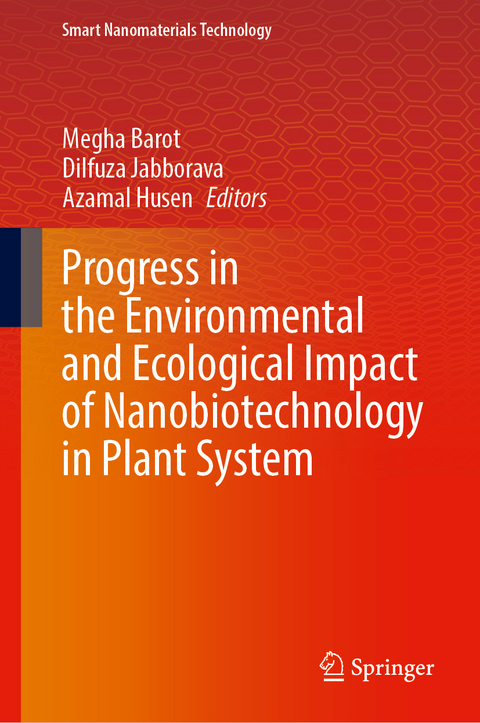
Progress in the Environmental and Ecological Impact of Nanobiotechnology in Plant System
Springer Verlag, Singapore
978-981-95-5910-7 (ISBN)
- Titel nicht im Sortiment
- Artikel merken
Dr. Megha Barot is an assistant professor (Research Cadre) in the Department of Environmental Science, Parul Institute of Applied Sciences, Parul University, India. She has over a decade of experience in environmental science, life science research, and clinical diagnostics. She has served as the National Coordinator of the Biotech Innovation Ignition School (BIIS) at SRISTI, in collaboration with DBT–BIRAC, Government of India, and as a Junior Scientist and NABL Internal Auditor at the Neuberg Centre for Genomic Medicine, Ahmedabad. A recipient of the Research Contribution Award from GCPC, she also attended a fully funded training program on Marine Environmental Health and Safety at Xiamen University, China. Dr. Barot has finalized seven academic books with CRC Press, Springer, and CABI, and has numerous research publications to her credit. Professor Dilfuza Jabborova is a distinguished scientist at the Institute of Genetics and Plant Experimental Biology, Academy of Sciences of the Republic of Uzbekistan. She earned her Ph.D. and D.Sc. degrees in Biological Sciences from the same institute. Her primary research areas include plant–microbe interactions, soil biochemistry, physiology of medicinal plants, and biological control of plant diseases. Currently, her work focuses on using microbial inoculants to promote plant growth, manage plant diseases biologically, and enhance sustainable agriculture. Dr. Jabborova has received several international fellowships, including the China Great Wall Fellowship (2010), the DAAD Research Scholarship (2014–2015) at the Leibniz Centre for Agricultural Landscape Research in Germany, and the DBT–TWAS Postdoctoral Fellowship (2020–2021) at ICAR–IARI, New Delhi, India. She has participated in more than 50 international conferences, received nine academic awards, and published 57 peer-reviewed research papers in reputed international journals. Professor Azamal Husen is a distinguished scholar with over two decades of expertise in nanobiotechnology, plant physiology, environmental botany, medicinal plants, and clonal propagation. He has held senior academic roles, including a full professor and a head of the department of Biology at the University of Gondar, Ethiopia, and currently, serves as a Foreign Delegate at Wolaita Sodo University, Ethiopia, and Adjunct Professor at Graphic Era University, India. He has also served as a Professor at Sankalchand Patel University and Visiting Faculty at leading Indian institutions. Prof. Husen has led multiple nationally and internationally funded research projects, contributed extensively to curriculum development, trained academic professionals worldwide, delivered various lecture and has been also honored by the University of Gondar for outstanding service. Named among the World’s Top 2% Scientists (from 2021 onwards) by Stanford University, he is a prolific author, editor, and contributor to several international journals and book series.
Introduction to plant nanotechnology.- Recent advances in plant nanotechnology.- Impact of plant nanotechnology on Soil Health and Microbial Communities.- Ecotoxicological Studies of nanoparticles on Non-Target Organisms.- Phytotoxicity and Plant Health.- Development of sustainable nanomaterials with reduced ecological impact .- Remediation approaches for contaminated soils and water bodies.- Transport of Nanoparticles in the Environment and surroundings.- Translocation studies of different nanoparticles in plants.- Role of plant nanotechnology in plant growth and disease control.- Role of plant nanotechnology in water pollution.- Impact of plant nanotechnology on food chain.- Strategies for sustainable usage of plant nanotechnology.- Comparative studies of different nanoparticles being used in agriculture.- Nanotechnology and plant science – current opportunities and challenges.- Plant nanotechnology: A case studies on human health, risk assessment management strategies and future prospects.- Impact of nanoparticles in sustainable agriculture.- Role of nanotechnology on environmental sustainability.
| Erscheint lt. Verlag | 13.5.2026 |
|---|---|
| Reihe/Serie | Smart Nanomaterials Technology |
| Zusatzinfo | 43 Illustrations, color |
| Verlagsort | Singapore |
| Sprache | englisch |
| Maße | 155 x 235 mm |
| Themenwelt | Naturwissenschaften |
| Technik ► Maschinenbau | |
| Technik ► Umwelttechnik / Biotechnologie | |
| Schlagworte | Ecotoxicological Studies of Nanoparticles • Phytotoxicity and Plant Health • Plant Growth and Disease Control • Plant nanotechnology • Plants Microbial • Pollution Remediation • Soil health • sustainable agriculture • Transport of Nanoparticles • Water pollution |
| ISBN-10 | 981-95-5910-3 / 9819559103 |
| ISBN-13 | 978-981-95-5910-7 / 9789819559107 |
| Zustand | Neuware |
| Informationen gemäß Produktsicherheitsverordnung (GPSR) | |
| Haben Sie eine Frage zum Produkt? |
aus dem Bereich