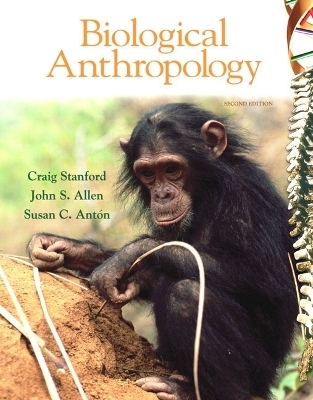
Biological Anthropology
Pearson (Verlag)
978-0-13-601160-6 (ISBN)
- Titel erscheint in neuer Auflage
- Artikel merken
Biological Anthropology, 2/e continues to build upon the strength and success of the first edition by integrating the foundations and the most current innovations in the field from the ground up.
Over the past twenty years, this field has rapidly evolved from the study of physical anthropology into biological anthropology, incorporating the evolutionary biology of humankind based on information from the fossil record and the human skeleton, genetics of individuals and of populations, our primate relatives, human adaptation, and human behavior. The second edition of Biological Anthropology combines the most up-to-date, comprehensive coverage of the foundations of the field with modern innovations and discoveries.
Craig Stanford is a professor of anthropology and biological sciences at the University of Southern California, where he also directs the Jane Goodall Research Center. He has conducted field research on primate behavior in south Asia, Latin America, and East Africa. He is well known for his long-term studies of meat-eating among wild chimpanzees in Gombe, Tanzania, and of the relationship between mountain gorillas and chimpanzees in the Impenetrable Forest of Uganda. He has authored or coauthored more than 120 scientific publications. Craig has received USC’s highest teaching awards for his introductory Biological Anthropology course. In addition, he has published eleven books on primate behavior and human origins, including Significant Others (2001) and Upright (2003). He and his wife, Erin Moore, a cultural anthropologist at USC, live in South Pasadena, California, and have three children. John Allen is a research scientist in the Dornsife Cognitive Neuroscience Imaging Center and the Brain and Creativity Institute at the University of Southern California, where he is also an adjunct research associate professor in the Department of Anthropology. Previously, he was a neuroscience researcher at the University of Iowa College of Medicine and a faculty member in the Department of Anthropology at the University of Auckland, New Zealand, for several years. His primary research interests are the evolution of the human brain and behavior, and behavioral disease. He also has research experience in molecular genetics, nutritional anthropology, and the history of anthropology. He has conducted fieldwork in Japan, New Zealand, Papua New Guinea, and Palau. He has received university awards for teaching introductory courses in biological anthropology both as a graduate student instructor at the University of California and as a faculty member at the University of Auckland. John and his wife, Stephanie Sheffield, have two sons, Reid and Perry. Susan Antón is an associate professor in the Center for the Study of Human Origins, Department of Anthropology at New York University, where she also directs the M.A. program in Human Skeletal Biology. She is joint editor of the Journal of Human Evolution. Her field research concerns the evolution of genus Homo in Indonesia and human impact on island ecosystems in the South Pacific. She is best known for her work on H. erectus in Kenya and Indonesia. She received awards for teaching as a graduate student instructor of introductory physical anthropology and anatomy at the University of California and was Teacher of the Year while at the University of Florida. She has been twice elected to Who’s Who Among America’s Teachers. Susan and her husband, Carl Swisher, a geochronologist, raise Anatolian shepherd dogs.
Introduction: What Is Biological Anthropology?
The Scope Of Biological Anthropology
The Roots Of Modern Biological Anthropology
Anthropology And Its Other Subfields
Summary • Critical Thinking Questions • Key Terms • Suggested Readings
Part I: Mechanisms of Evolution
Chapter 1: Origins of Evolutionary Thought
What Is Science?
The Early Thinkers
The Road To The Darwinian Revolution
The Darwinian Revolution
The Response To Darwin
Science And Creationism
Summary • Critical Thinking Questions • Key Terms • Suggested Readings
Chapter 2: Genetics: Cells and Molecules
Genetics
The Cell
DNA Structure And Function
Molecular Tools For Bioanthropological Research
Summary • Critical Thinking Questions • Key Terms • Suggested Readings
Chapter 3: Genetics: From Genotype to Phenotype
From Genotype To Phenotype
Mendelian Genetics
Mutation
Genetics Beyond Mendel
Phenylketonuria: Illustrating Mendelian And Post-Mendelian Concepts
Genes And Environments
Summary • Critical Thinking Questions • Key Terms • Suggested Readings
Chapter 4 : The Forces of Evolution and the Formation of Species
How Evolution Works
Classification And Evolution
Levels Of Selection
Summary • Critical Thinking Questions • Key Terms • Suggested Readings
Chapter 5: Human Variation: Evolution, Adaptation, and Adaptability
Human Variation At The Individual And Group Level
Historical Perspectives On Human Variation
Population Genetics
Polymorphisms And Natural Selection In Human Populations
Adaptation And Adaptability
Summary • Critical Thinking Questions • Key Terms • Suggested Readings
Part II: PRIMATES
Chapter 6: The Primates
The Primate Radiation
A Guide To The Nonhuman Primates
Primate Ecology
Primate Communities
Summary • Critical Thinking Questions • Key Terms • Suggested Readings
Chapter 7: Primate Behavior
Studying Primates
The Evolution Of Primate Social Behavior
Why Are Nonhuman Primates Social?
Reconstructing The Evolution Of Primate Societies
Summary • Critical Thinking Questions • Key Terms • Suggested Readings
Part III: PALEONTOLOGY AND PRIMATE EVOLUTION
Chapter 8: Fossils in Geological Context
How To Become A Fossil
The Importance Of Context
How Old Is It?
The Earth In The Cenozoic
Summary • Critical Thinking Questions • Key Terms • Suggested Readings
Chapter 9: Origin of Primates
The Mesozoic And Beyond
Changes In The Paleocene: Origin Of The Primates?
Early Primates Of The Eocene
Evolution Of Higher Primates
Molecular Evolution In Primates
Summary • Critical Thinking Questions • Key Terms • Suggested Readings
Chapter 10: Becoming Human: The Ape–Hominid Transition
Becoming a Biped
The Transition to Human Behavior
Summary • Critical Thinking Questions • Key Terms • Suggested Readings
Part IV: The Human Fossil Record
Chapter 11: Early Hominids
Will You Know A Hominid When You See One?
The First Hominids?
Australopithecus And Kin
Understanding The Australopithecine Radiation
Questions For Future Paleoanthropologists
Summary • Critical Thinking Questions • Key Terms • Suggested Readings
Chapter 12: Rise of the Genus Homo
Defining The Genus Homo
Earliest Genus Homo
Early Tool Use
Hunting And Scavenging
Who Was Homo Erectus?
Homo Erectus Around The World
The Lifeways Of Homo Erectus
Summary • Critical Thinking Questions • Key Terms • Suggested Readings
Chapter 13: Archaic Homo sapiensand Neandertals
Hominid Evolution In The Middle To Late Pleistocene
Archaic Homo Sapiens
Behavior Of Archaic Homo Sapiens
The Neandertals
Neandertal Behavior
Phylogenetic And Taxonomic Issues: An Overview
Summary • Critical Thinking Questions • Key Terms • Suggested Readings
Chapter 14:The Emergence and Dispersal of Homo sapiens
The Emergence Of Modern Humans
Models Of Modern Human Origins
Anatomy And Distribution Of Early Humans
Archaeology Of Modern Human Origins
Molecular Genetics And Human Origins
Interpreting Models Of Human Origins
Summary • Critical Thinking Questions • Key Terms • Suggested Readings
Part V: Biology and behavior of modern humans
Chapter 15: Evolution of the Brain and Language
Issues In Hominid Brain Evolution
Language: Biology And Evolution
Brain Size, Language, And Intelligence
Summary • Critical Thinking Questions • Key Terms • Suggested Readings
Chapter 16: Biomedical Anthropology
Epidemiology: Basic Tools For Biomedical Anthropology
Biocultural And Evolutionary Approaches To Disease
Birth, Growth, And Aging
Infectious Disease And Biocultural Evolution
Diet And Disease
Summary • Critical Thinking Questions • Key Terms • Suggested Readings
Chapter 17: The Evolution of Human Behavior
Studying The Evolution Of Human Behavior
Traditional Lives In Evolutionary Ecological Perspective
Sexual Selection And Human Behavior
Language-Related Cross-Cultural Behaviors
Behavioral Disease
Summary • Critical Thinking Questions • Key Terms • Suggested Readings
Chapter 18: Bioarchaeology and Forensic Anthropology
Life, Death, And The Skeleton
Field Recovery Methods
Laboratory Processing, Curation, And Chain Of Custody
The Biological Profile
Taphonomy
DNA, Kinship, And Identity
Identification And Forensic Anthropology
Applications Of Bioarchaeology
Applications Of Forensic Anthropology
Epilogue
Summary • Critical Thinking Questions • Key Terms • Suggested Readings
Appendix A An Overview of the Brain
Appendix B Primate and Human Comparative Anatomy
Appendix C The Hardy-Weinberg Equilibrium
Appendix D Metric-Imperial Conversions
| Erscheint lt. Verlag | 10.4.2008 |
|---|---|
| Sprache | englisch |
| Maße | 276 x 211 mm |
| Gewicht | 1248 g |
| Themenwelt | Naturwissenschaften ► Biologie ► Humanbiologie |
| Sozialwissenschaften ► Ethnologie | |
| Sozialwissenschaften ► Soziologie | |
| ISBN-10 | 0-13-601160-8 / 0136011608 |
| ISBN-13 | 978-0-13-601160-6 / 9780136011606 |
| Zustand | Neuware |
| Informationen gemäß Produktsicherheitsverordnung (GPSR) | |
| Haben Sie eine Frage zum Produkt? |
aus dem Bereich