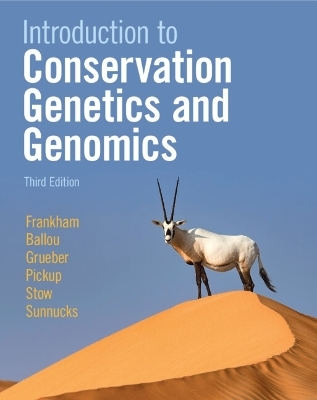
Introduction to Conservation Genetics and Genomics
Cambridge University Press (Verlag)
978-1-108-92741-3 (ISBN)
- Noch nicht erschienen (ca. August 2026)
- Versandkostenfrei
- Auch auf Rechnung
- Artikel merken
The third edition of this essential introductory text has been fully updated in light of the genomics revolution. Providing authoritative and engaging coverage for students and professionals of conservation genetics and genomics, conservation biology, and wildlife biology, the authors explain the underpinning mathematics clearly and accessibly throughout. The critical link between theory and practice, so often obscured in applied genetics, is illuminated in each chapter through examples of diverse conservation issues (including strengthened plant coverage), the solutions needed, and detailed step-by-step guides on how genetic principles can be applied. Self-learning is further facilitated through problem sets with solutions, case studies, main point boxes, symbol and software lists, and approximately 600 engaging full-color photos and 300 graphics which relate genetic processes to species level conservation. Highlighting the interdependence between 'ecology' and 'genetics,' this text is educationally rich and visually stunning.
Richard Frankham is a leading international figure in conservation genetics, through pioneering research on the genetic impacts of small population sizes and as senior author of the first textbooks in the field. Jonathan D. Ballou is a Research Scientist Emeritus at the Smithsonian Conservation Biology Institute in Washington, D.C. His research focuses on the genetic and demographic problems confronted by small populations, especially of threatened species. Catherine E. Grueber is an Associate Professor and coleads the Applied and Evolutionary Zoology Group at The University of Sydney. Her team investigates the interactions between population genetic problems and conservation actions. Melinda Pickup is a conservation geneticist who works as a research scientist at Greening Australia and is an adjunct fellow at Macquarie University. Melinda's core interests are in plant conservation and restoration genetics, plant mating systems, pollination ecology, plant traits, and seed biology. Adam J. Stow is a Professor at Macquarie University in Sydney, Australia, renowned for his expertise in science communication. He has made significant contributions to environmental education, including serving as the director of a Master's-level program in conservation. Paul Sunnucks has coled the Wildlife Genetic Management Group at Monash University since 2005. Paul's research applies ecological genomics to conservation-relevant population biology.
Preface; Acknowledgements; 1. Introduction; 2. Genetic factors contribute to extinction risk; Section I. Measuring and Characterizing Genetic and Genomic Diversity: List of symbols; 3. Genomic diversity; 4. Characterizing genetic and genomic diversity; 5. Characterizing quantitative genetic variation; Section II. Evolutionary Genetics of Natural Populations: 6. Evolution by natural selection in large populations; 7. Evolutionary impacts of mutation, gene flow, and selection in large populations; 8. Evolutionary consequences of small population sizes; 9. Maintenance of genetic and genomic diversity; Section III. Harmful Impacts of Population Size Reduction and Means to Reverse Them: 10. Inbreeding; 11. Inbreeding depression; 12. Loss of genetic diversity in small populations reduces ability to evolve; 13. Population fragmentation causes inadequate gene flow and increased extinction risk; 14. Genetic rescue resulting from gene flow; Section IV. Management Solutions to Genetic Problems: 15. Delineation of species and management units for conservation purposes; 16. Genetically viable populations; 17. Genetic management of ex situ populations; 18. Genetic management of wild populations; 19. Genetic management of reintroductions and translocations; 20. Modified genetic management for species with diverse mating systems and modes of inheritance; 21. Genetic management to assist species cope with climate change; 22. Genetic management to minimize the adverse impacts of invasive species; 23. Use of molecular genetics and genomics in wildlife forensics and to understand species' biology; 24. Integrating genetic management into the broader conservation context; Take home messages; Credits for figures, graphics, and photos; References; Index
| Erscheint lt. Verlag | 31.8.2026 |
|---|---|
| Zusatzinfo | Worked examples or Exercises |
| Verlagsort | Cambridge |
| Sprache | englisch |
| Themenwelt | Naturwissenschaften ► Biologie ► Ökologie / Naturschutz |
| ISBN-10 | 1-108-92741-6 / 1108927416 |
| ISBN-13 | 978-1-108-92741-3 / 9781108927413 |
| Zustand | Neuware |
| Informationen gemäß Produktsicherheitsverordnung (GPSR) | |
| Haben Sie eine Frage zum Produkt? |
aus dem Bereich