Printed Electronics for Smart Packaging (eBook)
570 Seiten
Wiley-VCH (Verlag)
978-3-527-84004-5 (ISBN)
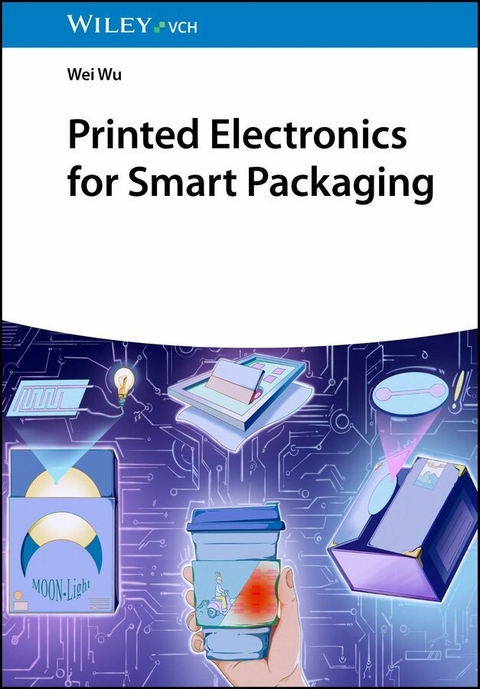
Cutting-edge information about materials, technologies, and mechanisms of printed electronics, and their applications for the smart packaging
Printed Electronics for Smart Packaging describes how and why to use printed electronic devices for application in smart packaging.
Written by a highly qualified academic, Printed Electronics for Smart Packaging covers sample topics such as:
- Applications of printed electronics, such as flexible screens, intelligent labels and packaging, interactive books and posters, and even upholstery
- Mechanisms of smart packaging, printing methods and integrated strategies, and functional inks and substrates for smart packaging
- Printed tracks for smart tags and IPES, printed optoelectronic devices and energy suppliers for smart packaging, and printed sensors and indicators
- Integrated printed electronics systems, and expert outlooks and perspectives on potential future directions for research and development in the field
A must-have resource for anyone to expand the knowledge of the latest developments for intelligent packaging, Printed Electronics for Smart Packaging is an essential read for not just related academics but also various intersecting industries and professionals due to the importance of packaging in all market sectors.
Wei Wu is full professor of School of Physics and Technology, Wuhan University. He received the State Scientific Innovation and Pioneer Award in 2023, the 15th Bi Sheng Award of Printing Technology in 2019, the STAM Best Paper Award in 2017, and the Hong Kong Scholars Award in 2014.
1
Introduction of Printed Electronics and Smart Packaging
1.1 Introduction
Smart packaging is a common solution to improve packaging value and functions, originating from the intersection of multidisciplinary fields and having distinct interdisciplinary characteristics. Smart packaging involves many research directions and application fields, including front-end knowledge of packaging design, and material science, printed technology, wireless communication technology, Internet of Things (IoT) technology, and so forth, as well as the basic knowledge of traditional packaging engineering.
The current research on smart packaging mainly focuses on two aspects: active packaging and smart packaging. The former mainly conveys and monitors information on products with life, such as packaging that uses time–temperature indicators (TTIs) labels. The latter uses various electronic technologies to provide an indication of status or convey other information about the product. Smart packaging has huge potential to improve product safety, quality, and traceability, as well as convenience for consumers.
In recent years, the safety of packaged contents in the logistics process has received extensive attention, especially the logistics and transportation of some valuable products. Monitoring the status of packaged products in the logistics process has become a challenge, and a large number of new technologies have been developed, adopted, and applied to traditional packaging, such as radio frequency identification (RFID) technology, infrared induction technology, global positioning system (GPS), and so forth. But it is noteworthy that these technologies have not been effectively integrated with packaging. Because of this, it is possible to solve these problems if we can combine packaging design and these electronic devices can be directly printed on the surface of packaging products during the graphic information printing process. Using traditional packaging-printing technology to manufacture thin-film electronic devices on packaging will also greatly reduce the production cost of smart packaging and promote its rapid development. As a highly interdisciplinary innovation field, printed electronics (PE) shows great breakthrough potential in promoting the development of ubiquitous electronic products and the innovation of traditional packaging technology [1].
1.2 PE Technologies
1.2.1 What Is PE Technologies?
Traditional printing technology is a very mature, fast, and efficient graphic information reproduction technology, and ink plays a very critical factor in it. As early as the 1980s, when organic conductors and organic semiconductor materials were discovered, people saw the hope that future electronic circuits might be fabricated by traditional printing technology. Because organic materials can generally be prepared in solution form, they have the typical characteristics of printing inks. It is hoped that by printing organic conductors and semiconducting inks, transistors in electronic devices can be fabricated and complex electronic systems can be constructed. However, among organic electronic materials, only a large class of organic small molecule materials have good electronic properties, and these organic small molecule materials must be prepared by vacuum evaporation to prepare electronic devices. The charge transport properties (charge mobility) of polymer organic electronic materials suitable for printing are always an order of magnitude worse than those of organic small molecule materials.
In recent years, PE has begun to develop rapidly, mainly because various inorganic micro-/nano-materials have been successfully transformed into functional inks and applied in the field of PE. Inorganic materials also have much higher charge mobilities than organic electronic materials [2–4]. Some inorganic nanomaterials (nanoparticles, nanowires, nanotubes, etc.) can be easily made into inks and then patterned using traditional printing methods [5–7]. The properties of micro-/nano-materials themselves endow these patterns with charge transport, dielectric, or optoelectronic properties to form various semiconductor, optoelectronic, and energy devices.
In this regard, PE becomes an emerging process technology that applies traditional printing methods to the manufacture of electronic circuits and complex multilayer electronic devices, requiring to formulate different functional materials into printing inks and deposit them onto various flexible or rigid substrates using traditional printing principles.
1.2.2 Why Should PE Technologies Be Developed?
- High throughput and low cost
The printing area and printing speed of the traditional printing technology are very amazing, and the use of this technology to manufacture electronic devices will significantly reduce the manufacturing cost of the device. For example, gravure printing is a widely used roll-to-roll (R2R) technology that can rapidly manufacture high-resolution printed patterns at speeds of more than 150 m/min (determined by the length of the transmission distance between the printing units of the printing press), and these printed patterns are engraved as a discrete cavity into a rotary printing cylinder. The maximum printing area of screen printing can reach 300 cm × 400 cm. Therefore, PE technology can greatly improve production efficiency, simplify production processes, and reduce production costs.
Figure 1.1 Schematic illustration of the printing electronics can be fabricated by roll-to-roll printing press and in-lined with other functional units, such as drying, coating, assembly, folding, and so forth.
PE technology is directly connected with flexible electronics and R2R technology (Figure 1.1), and the goal is to make various functional electronic devices like those meant for printing newspapers. This is unthinkable for traditional circuit board and complex electronic device manufacturing processes. Moreover, PE substrates are diverse, including plastic, paper, fabric, and so forth. These substrates can be flexibly selected and can also be performed in parallel.
- Additive process
PE manufacturing is an additive manufacturing process that generally does not require vacuum environmental conditions, but only requires printing functional inks where needed, which is an extremely material-saving manufacturing method [8]. As shown in Figure 1.2, the traditional photolithography involves a complex multistep process, including photoresist coating, mask exposure, development, and chemical etching. During the process, a lot of vacuum treatments are involved, which is time-consuming and requires a lot of expensive equipment. It belongs to a technology that first deposits and then removes unnecessary parts. Obviously, PE is a simplified process and material-saving technology. The development of flexible electronic devices is very rapid, and PE can realize circuit and device fabrication on curved substrates, which is also a very big advantage.
Figure 1.2 The fabrication methods and characteristics of metallic patterns by tradition lithography technology and printed electronic technology.
Figure 1.3 Printing methods have been applied to fabricate various types of electronic devices, which can also be directly integrated on flexible substrates by printing methods.
- Integration and customization
The pursuit of foldable and flexible consumer electronic products continues to stimulate innovations in materials and manufacturing technologies. Different functional thin-film electronic devices are integrated on substrates and used to realize various functional applications. These devices also often need to be endowed with higher mechanical durability and stretchability and the ability to measure a variety of complex sensations over large areas. Indeed, many electronic components and interconnect circuits can be integrated and printed, such as sensors, batteries, passive devices, active devices, display units, and the like (Figure 1.3). Recently, some new printable functional materials and manufacturing routes to realize the fabrication of multifunctional electronic skins with mechanical compatibility have been developed, which requires the integration of numerous sensors and data processing and signal transmission electronics [9]. The printing method can be used for the manufacture of customized electronic devices, especially the digital inkjet, for which PE technology will be more convenient.
1.3 Flexible PE Devices
The scale of the consumer electronics market continues to expand, and people's needs and concerns are gradually changing to the bendable and flexible electronic devices. The manufacturing and development of flexible electronic devices have also received a lot of attention, which refer to electronic devices that can still work under a certain range of deformation (bending, folding, torsion, compression, or tension) [10]. Flexible electronics is an emerging electronic technology, which mainly manufactures electronic devices on flexible/stretchable substrates or provides flexible mechanical properties through device structure design. Similar to traditional integrated circuit (IC) technology, the manufacturing process is the driving forces for the development of flexible electronics, and the difficulty is achieving high-throughput, large-area, and low-cost...
| Erscheint lt. Verlag | 5.11.2025 |
|---|---|
| Sprache | englisch |
| Themenwelt | Naturwissenschaften ► Chemie |
| Schlagworte | flexible screens • functional inks • functional substrates • intelligent labels • intelligent packaging • Interactive Books • interactive posters • Ipes • Mechanisms of smart packaging • printed optoelectronic devices • printed sensors • Smart Tags |
| ISBN-10 | 3-527-84004-4 / 3527840044 |
| ISBN-13 | 978-3-527-84004-5 / 9783527840045 |
| Informationen gemäß Produktsicherheitsverordnung (GPSR) | |
| Haben Sie eine Frage zum Produkt? |
 EPUB (Adobe DRM)
Kopierschutz: Adobe-DRM
Adobe-DRM ist ein Kopierschutz, der das eBook vor Mißbrauch schützen soll. Dabei wird das eBook bereits beim Download auf Ihre persönliche Adobe-ID autorisiert. Lesen können Sie das eBook dann nur auf den Geräten, welche ebenfalls auf Ihre Adobe-ID registriert sind.
Details zum Adobe-DRM
Dateiformat: EPUB (Electronic Publication)
EPUB ist ein offener Standard für eBooks und eignet sich besonders zur Darstellung von Belletristik und Sachbüchern. Der Fließtext wird dynamisch an die Display- und Schriftgröße angepasst. Auch für mobile Lesegeräte ist EPUB daher gut geeignet.
Systemvoraussetzungen:
PC/Mac: Mit einem PC oder Mac können Sie dieses eBook lesen. Sie benötigen eine
eReader: Dieses eBook kann mit (fast) allen eBook-Readern gelesen werden. Mit dem amazon-Kindle ist es aber nicht kompatibel.
Smartphone/Tablet: Egal ob Apple oder Android, dieses eBook können Sie lesen. Sie benötigen eine
Geräteliste und zusätzliche Hinweise
Buying eBooks from abroad
For tax law reasons we can sell eBooks just within Germany and Switzerland. Regrettably we cannot fulfill eBook-orders from other countries.
aus dem Bereich