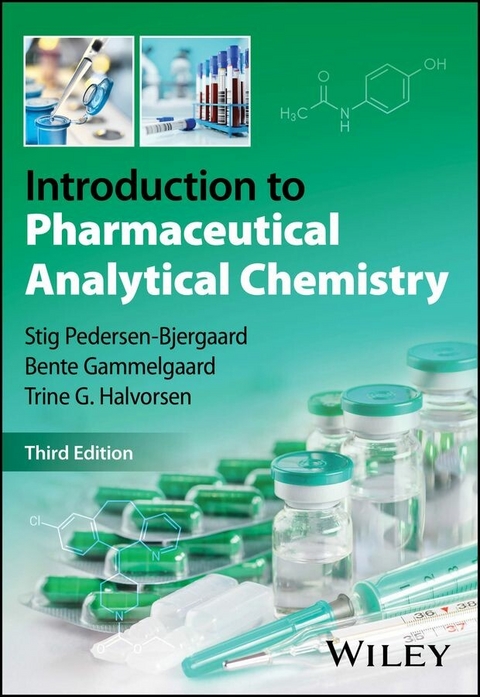
Introduction to Pharmaceutical Analytical Chemistry (eBook)
838 Seiten
Wiley (Verlag)
978-1-394-26331-8 (ISBN)
Primary source for learning pharmaceutical analytical chemistry, fully updated and revised to reflect current practice and Pharmacopoeia standards
Introduction to Pharmaceutical Analytical Chemistry enables students to gain fundamental knowledge of the vital concepts, techniques, and applications of the chemical analysis of pharmaceutical substances, final pharmaceutical products, and drug substances in biological fluids.
Extensively revised throughout to reflect the current European Pharmacopoeia (Ph. Eur.) and United States Pharmacopeia (USP), this Third Edition presents updated methodologies, practical examples, and calculations to reflect current pharmaceutical laboratory practice. Revisions to the chapter structure, text, and figures have been implemented to improve clarity and comprehension. New practice problems, up-to-date practical examples, and detailed illustrations are also included throughout the text.
Written by a team of experienced academics, Introduction to Pharmaceutical Analytical Chemistry explores topics including:
- Pharmacopoeias and the link between pharmaceuticals and analytical chemistry
- Fundamentals of bases, acids, solubility, polarity, partition, and stereochemistry
- Titration, UV-Vis spectrophotometry, IR spectrophotometry, and atomic spectrometry
- High-performance liquid chromatography, gas chromatography, electrophoretic methods, and mass spectrometry
- Quantitation, quality of analytical data, and validation
- Chemical analysis of pharmaceutical substances and products including biopharmaceuticals
- Sample preparation and determination of pharmaceutical substance in biological samples
Introduction to Pharmaceutical Analytical Chemistry is essential reading for undergraduate and graduate students enrolled in pharmaceutical courses, along with chemists, biochemists, and other scientists entering the pharmaceutical industry.
Stig Pedersen-Bjergaard is Professor at the Department of Pharmacy, University of Oslo, Norway and at the Department of Pharmacy, University of Copenhagen, Denmark.
Bente Gammelgaard is Professor at the Department of Pharmacy, University of Copenhagen, Denmark.
Trine G. Halvorsen is Professor at the Department of Pharmacy, University of Oslo, Norway.
The authors have long teaching and research experiences in pharmaceutical analytical chemistry.
Primary source for learning pharmaceutical analytical chemistry, fully updated and revised to reflect current practice and Pharmacopoeia standards Introduction to Pharmaceutical Analytical Chemistry enables students to gain fundamental knowledge of the vital concepts, techniques, and applications of the chemical analysis of pharmaceutical substances, final pharmaceutical products, and drug substances in biological fluids. Extensively revised throughout to reflect the current European Pharmacopoeia (Ph. Eur.) and United States Pharmacopeia (USP), this Third Edition presents updated methodologies, practical examples, and calculations to reflect current pharmaceutical laboratory practice. Revisions to the chapter structure, text, and figures have been implemented to improve clarity and comprehension. New practice problems, up-to-date practical examples, and detailed illustrations are also included throughout the text. Written by a team of experienced academics, Introduction to Pharmaceutical Analytical Chemistry explores topics including: Pharmacopoeias and the link between pharmaceuticals and analytical chemistryFundamentals of bases, acids, solubility, polarity, partition, and stereochemistryTitration, UV-Vis spectrophotometry, IR spectrophotometry, and atomic spectrometry High-performance liquid chromatography, gas chromatography, electrophoretic methods, and mass spectrometryQuantitation, quality of analytical data, and validation Chemical analysis of pharmaceutical substances and products including biopharmaceuticalsSample preparation and determination of pharmaceutical substance in biological samples Introduction to Pharmaceutical Analytical Chemistry is essential reading for undergraduate and graduate students enrolled in pharmaceutical courses, along with chemists, biochemists, and other scientists entering the pharmaceutical industry.
Symbols and Units
The units in the book are not strictly following the SI units. The units are adjusted to the dimensions in analytical work.
| Symbol | Unit |
|---|
| A | Absorbance | – |
| A(1%, 1 cm) | Specific absorbance | – |
| AS | Symmetry factor | – |
| AU | Absorbance units | – |
| a | Activity | – |
| α | Relative retention (separation factor) | – |
| Specific optical rotation | (o) degrees |
| c | Concentration | g/L, mol/L |
| d | Dextrorotary (optical rotation) | o (degrees) |
| D | Distribution ratio (also named distribution coefficient or partition coefficient) | – |
| E | Potential | V |
| E | Electrical field (CE) | V/cm |
| E0 | Standard electrode potential (standard reduction potential) | V |
| ε | Molar absorption coefficient | cm−1 · mol‐1 · L |
| εo | Relative elution strength | – |
| η | Viscosity | cPoise |
| F | Flow rate (chromatography) | mL/min |
| F | Fluorescence | – |
| h | Peak height | mm |
| H | Height Equivalent to Theoretical Plate | mm |
| I | Intensity | – |
| IA | Acid value | mg |
| II | Iodine value | mg |
| IOH | Hydroxyl value | mg |
| IS | Saponification value | mg |
| Ka | Acid ionisation constant (= acid dissociation constant, acidity constant) |
| Kb | Base ionisation constant (= basicity constant) |
| KD | Partition ratio (= Distribution constant) |
| Ksp | Solubility product |
| Kw | Autoproteolysis equilibrium constant of water (= ion product of water) |
| k | Retention factor | – |
| λ | Wavelength | nm |
| L | Length | m (mm) |
| l | Levorotary (optical rotation) | o (degrees) |
| μapp | Apparent mobility | cm2 · min−1 · V−1 |
| μe | Electrophoretic mobility | cm2 · min−1 · V−1 |
| μeo | Electroosmotic mobility | cm2 · min−1 · V−1 |
| M | Molarity | mol/L |
| M | Molar mass | g/mol |
| M | Molecular mass | u = Da |
| Mr | Relative molar mass | – |
| N | Number of theoretical plates | – |
| ν | Frequency | Hz (s−1) |
| pI | Isoelectric point | – |
| P | Distribution ratio between 1‐octanol and aqueous solution | – |
| P′ | Polarity index | – |
| ϕ | Quantum yield (fluorescence) | – |
| r | Radius | m (mm) |
| Rf | Retention factor (TLC) | – |
| RS | Resolution (chromatography) | – |
| ρ | Density | g/cm3 |
| σ | Standard deviation | – |
| s | Standard deviation |
| T | Temperature | K, C |
| T | Transmittance | – |
| tR | Retention time | min |
| tM | Hold‐up time | min |
| t'R | Adjusted retention time | min |
| u | Atomic mass units | u |
| u | Linear velocity (flow rate) | cm/s |
| v | Velocity | m/s |
| V | Volume | L, 1 mL = 1 cm3 |
| VM | Hold‐up volume (void volume) (LC); Total permeation volume (SEC) | mL |
| V0 | Exclusion volume | mL |
| VR | Retention volume | mL |
| W | Peak width | min |
| Wh | Peak width at half height | min |
| Mean | – |
| z | Charge | – |
Constants
| Avogadros number | N | 6.0221 · 1023 mol−1 |
| Faraday's constant | F | 9.649 · 104 · C(oulomb) · mol−1 = 96.485 kJ · mol−1 |
| Gas constant | R | 8.314 J · K‐1 · mol−1 |
| Speed of light in vacuum | c | 2.998 · 108 m/s |
| Planck's constant | h | 6.626 · 10−34 J · s |
Greek alphabet
| Upper case | Lower case | Name | English |
|---|
| A | α | Alpha | a |
| B | β | Beta | b |
| Γ | γ | Gamma | g |
| Δ | δ | Delta | d |
| E | ε | Epsilon | e |
| Z | ζ | Zeta | z |
| H | η | Eta | h |
| Θ | θ | Theta | th |
| I | ι | Iota | i |
| K | κ | Kappa | k |
| Λ | λ | Lambda | l |
| M | μ | Mu | m |
| N | ν | Nu | n |
| Ξ | ξ | Xi | x |
| O | o | Omicron | o |
| Π | π | Pi | p |
| P | ρ | Rho | r |
| Σ | σ | Sigma | s |
| T | τ | Tau | t |
| Y | υ | Upsilon | u |
| Φ | ϕ | Phi | ph |
| X | χ | Chi | ch |
| Ψ | ψ | Psi | ps |
| Ω | ω | Omega | o |
Abbreviations
- AAS
- Atomic Absorption Spectrometry
- ADME
- ...
| Erscheint lt. Verlag | 5.11.2025 |
|---|---|
| Sprache | englisch |
| Themenwelt | Naturwissenschaften ► Chemie ► Analytische Chemie |
| Schlagworte | biological fluids • drug substances • European Pharmacopoeia • final pharmaceutical products • pharmaceutical chemical analysis • pharmaceutical ingredients • Pharmaceutical manufacturing • Ph.Eur • United States Pharmacopeia • USP |
| ISBN-10 | 1-394-26331-7 / 1394263317 |
| ISBN-13 | 978-1-394-26331-8 / 9781394263318 |
| Informationen gemäß Produktsicherheitsverordnung (GPSR) | |
| Haben Sie eine Frage zum Produkt? |
 EPUB (Adobe DRM)
Kopierschutz: Adobe-DRM
Adobe-DRM ist ein Kopierschutz, der das eBook vor Mißbrauch schützen soll. Dabei wird das eBook bereits beim Download auf Ihre persönliche Adobe-ID autorisiert. Lesen können Sie das eBook dann nur auf den Geräten, welche ebenfalls auf Ihre Adobe-ID registriert sind.
Details zum Adobe-DRM
Dateiformat: EPUB (Electronic Publication)
EPUB ist ein offener Standard für eBooks und eignet sich besonders zur Darstellung von Belletristik und Sachbüchern. Der Fließtext wird dynamisch an die Display- und Schriftgröße angepasst. Auch für mobile Lesegeräte ist EPUB daher gut geeignet.
Systemvoraussetzungen:
PC/Mac: Mit einem PC oder Mac können Sie dieses eBook lesen. Sie benötigen eine
eReader: Dieses eBook kann mit (fast) allen eBook-Readern gelesen werden. Mit dem amazon-Kindle ist es aber nicht kompatibel.
Smartphone/Tablet: Egal ob Apple oder Android, dieses eBook können Sie lesen. Sie benötigen eine
Geräteliste und zusätzliche Hinweise
Buying eBooks from abroad
For tax law reasons we can sell eBooks just within Germany and Switzerland. Regrettably we cannot fulfill eBook-orders from other countries.
aus dem Bereich