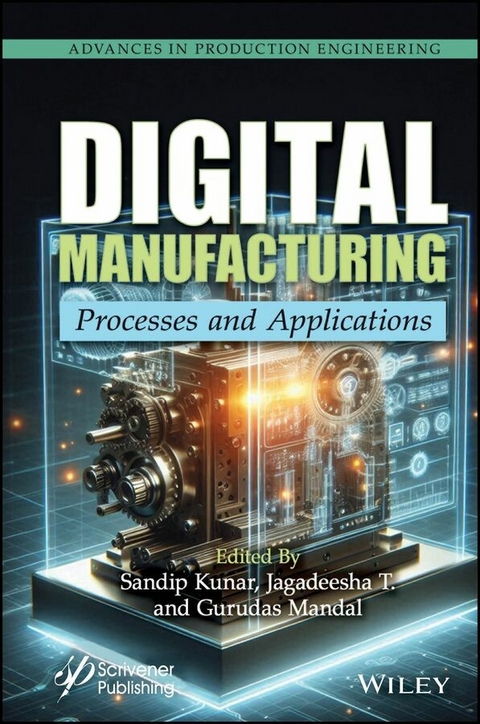
Digital Manufacturing (eBook)
950 Seiten
Wiley-Scrivener (Verlag)
978-1-394-36535-7 (ISBN)
Drive innovation and efficiency in your manufacturing processes with this comprehensive guide that explores the transformative impact of digital manufacturing technologies, from robotics to Industry 4.0.
Digital manufacturing refers to the use of a computer-based system consisting of various tools and software for simulation, analytics, 3D visualization, and business and manufacturing collaboration. Often, these tools and software programs are cloud-based. They enable a manufacturer to connect and integrate manufacturing operations into a streamlined whole. With this centralized computer system, manufacturers have a seamless, connected flow of data related to all their processes and products. This comprehensive volume explores the transformative impact of digital technologies on the manufacturing industry. It delves into the core concepts of digital manufacturing, including automation, additive manufacturing, robotics, digital twins, and Industry 4.0. Covering both the theoretical foundations and practical applications of these technologies, this book provides a detailed understanding of how these technologies are reshaping production processes, improving efficiency, and driving innovation. It highlights the challenges and opportunities of adopting these advancements in the context of modern manufacturing environments. With real-world case studies and insights from industry experts, this book serves as an essential resource for professionals, students, and researchers aiming to understand and implement digital manufacturing solutions.
Readers will find the volume:
- Introduces technologies for successful improvement in advanced processes and applications of digital manufacturing;
- Explores recently developed digital manufacturing technologies;
- Discusses the successful fabrication of multipurpose digital manufacturing technologies, the sustainability of digital manufacturing technologies, and the future scope and challenges presented by digital manufacturing technologies.
Audience
Engineers, researchers, academics, and industry professionals invested in digital manufacturing technologies.
Sandip Kunar, PhD, is an Associate Professor in the Department of Mechanical Engineering, Aditya Engineering College, Surampalem, Andhra Pradesh, India. He has published 12 books, 35 book chapters, one patent, and more than 50 research papers in reputed international journals and conferences. His research interests include non-conventional machining processes, micromachining processes, advanced manufacturing technology, and industrial engineering.
Jagadeesha T., PhD is an Associate Professor in the Mechanical Engineering Department at the National Institute of Technology Calicut, Kerala, India with more than 25 years of experience. He has published seven textbooks, four patents, and more than 75 articles in international journals and conferences. His research interests include advanced machining, additive manufacturing, fluid power control, advanced materials, and vibration and noise control.
Gurudas Mandal, PhD is an Assistant Professor in the Department of Metallurgical Engineering at Kazi Nazrul University, West Bengal, India. He has published nine book chapters, one patent, and more than 20 articles in international journals and conferences. His research focus is on alloy steel and cast iron, composite materials, magnetic materials, hydrogen energy, and archaeometallurgy.
1
Introduction to Digital Manufacturing System
Sandip Kunar1* and Gurudas Mandal2
1Department of Mechanical Engineering, Aditya University, Surampalem, India
2Department of Metallurgical Engineering, Kazi Nazrul University, Asansol, India
Abstract
Manufacturing digitization is now again a top research priority for industry application, and digital manufacturing is essential to this process. Regarding the goal of digital manufacturing, there is, nevertheless, a dearth of consensus in the literature. This study aims to explore the idea and field of applications of digital manufacturing (DM) utilizing the acquiring traction of Industry 4.0 paradigm. The concepts are formulated, and new technological features are found based on a content analysis. The conceptual positioning of digital manufacturing and the delimitation of its application contribute the better perception of the future issues that organizations will confront.
Keywords: Digital manufacturing, smart manufacturing, Industry 4.0, digital factory, manufacturing life cycle
1.1 Introduction
Manufacturing has transitioned from single technology to integrated systems because of the digital revolution. The term “Industry 4.0” concerns the fourth industrial revolution, which brings about intellectual, linked, and decentralized production. It represents a new degree of structure and control over the whole value chain of a product during its life cycle. As a matter of fact, the content and nature of manufacturing itself are changing due to innovations being unleashed by advancements in data storage, human–machine interaction robotics, new computing capacities, and additive manufacturing [1, 2].
Emerging technologies have recently a revolutionary effect on manufacturing concepts, techniques, models, and even enterprises. The phrase “Industry 4.0” concerns the new technological developments that are being incorporated into the industry to address various global concerns. These developments are focused on virtual and digital technologies and are fueled by real-time data interchange and flexible manufacturing, which allows for customized production [3–5]. Industry leaders concur that digital manufacturing techniques will revolutionize every facet of value chains’ manufacturing systems, as digital manufacturing falls under the purview of Industry 4.0 technologies. Computer integrated manufacturing (CIM), which was created in the 1980s when computing costs dropped and computers could be widely utilized for planning, scheduling, and machine and automation control, is the forerunner of digital manufacturing technology. Manufacturing science and other relevant topics are integrated into the manufacturing business through the work of CIM [6]. The interdisciplinary nature of manufacturing is perhaps unavoidable. The perception of digital manufacturing, which emphasized the prerequisite for process design and more collaborative product, emerged from the combination of engineering science of CIM and organizational sciences like total quality management, concurrent engineering, and lean manufacturing. The literature on digital manufacturing mentions two aspects, even though they are not new. First, it is still unclear what digital manufacturing is and what makes it special. The main concept of digital manufacturing, which is production improvement through technological integration, is shared by all its definitions. There is a distinction between the application domain and this convergence, though. Another widespread misconception is that “digital factory” and “digital manufacturing” are interchangeable terms. It is troublesome when terms connected to digital manufacturing lack a clear meaning since it hinders researcher-to-researcher communication and makes it more challenging for managers to design, plan, and carry out digital manufacturing efforts. It is yet unknown how Industry 4.0 factors affect digital production and whether advancements in technology have an impact on its use. Therefore, the idea of this study is to explore what digital manufacturing means in relation to Industry 4.0. A thorough assessment of the literature was done to provide answers to these queries. Different concepts related to digital manufacturing were evaluated by means of content analysis of technical and scientific journals. The paper discusses the better understanding of the future challenges that companies face by positioning digital manufacturing theoretically and delimiting its application domain.
1.2 Manufacturing as Craft and Technique
Manufacturing has always been a skill in the lengthy historical process. To stay warm, early humans hand-processed raw fur, developed crude tools for hunting, and created the first cooking implements. Mankind advanced because of these basic tools and abilities. Early skills and handcrafts established European production methods; for instance, the ancient paraffin casting process was frequently utilized in advanced rapid prototyping manufacturing. Manufacturing evolved into a skill that allowed human history to progress from the Stone Age into the Bronze Age. Ancient manufacturing technologies made enormous contributions to human civilization in addition to bringing great glory to feudal rulers. Manufacturing began as a skill and progressively evolved into a technology in the seventeenth century. The social division of labor saw significant changes with the introduction of the steam engine and the metal cutting machine. Eventually, hand workers were no longer employed in manufacturing.
1.3 Manufacturing Becoming a Science
The West invented the advanced manufacturing processes. In the nineteenth century, it progressively moved toward mechanization and electrification, leading to the development of mechanical production. The production saw significant growth beginning in the 1980s, when several innovative production concepts and techniques were introduced. These novel ideas—such as agile manufacturing, automated manufacturing, intelligent manufacturing, concurrent engineering (CE), etc.—help us to analyze and project the future of manufacturing. These ideas also support and advance one another’s growth in terms of analysis and forward-looking thinking. As a result, the manufacturing is now a science, encompassing engineering, organization, information, and other sciences rather than a single technology or talent.
1.3.1 Engineering Science in Manufacturing
Computers were employed in manufacturing from the beginning by Harrington, Merchant, and Bjorke, who suggested automating, optimizing, and integrating all manufacturing system functions with the CIM concept. CIM grew organically into the robotics and artificial intelligence (AI) domains in the 1980s. The manufacturing industry is integrating the formation of CIM, which has served as a link between manufacturing, systematic science, and other significant topics. The CIM age, which uses Harrington, Bjorke, and Merchant as examples, covers the scheduling of Flexible Manufacturing Systems (FMS) as well as the controlled problems associated with various production machines, such as servocontrol on robots. It also covers the substantial processes of each manufacturing technology, such as semiconductor manufacturing, welding, and machining. By linking the original CIM idea with relevant scientific problems, its structural scheduling advances in manufacturing from engineering to manufacturing science.
First, the original scientific principles and methodologies for the study of manufacturing techniques can be applied to the physical process of manufacturing. Physical theory, such as how plastic deformation is interpreted from atomic dislocation theory and how transistors are interpreted from lattice physics, can be used to describe the physical processes involved in materials processing and semiconductor manufacturing.
Furthermore, there exists an extensive body of scientific information pertaining to solid mechanics, materials science, and optics. To explain the precision, steady time, and stability of manufacturing machines, there are several well-developed control theories. Furthermore, by fusing tribology and dynamic analysis regarding cam, linkage, and propelling equipment, a theory has been developed regarding mechanical control in a different settings.
The analysis techniques including statistical modelling, optimization, queuing theory, and discrete event simulation are used in FMS planning. These are only the department of industrial and operational research’s primary techniques. The scientific method of constraint-based reasoning has been added to the field of artificial intelligence in recent years. In conclusion, dispatching activities are now well supported by a developed mathematical theory, which is crucial to the production scheduling process. Even though the manufacturing industry uses a lot of the engineering scientific procedures mentioned above, they truly cannot function properly without merging with the organizational approaches.
1.3.2 Organizational Science in Manufacturing
CIM is a representation of the fusion of engineering science and organizational sciences such as lean production (LP), concurrent engineering (CE), and total quality management (TQM). In contrast to traditional machining, which involves packing unneeded parts into a packed production line, the “Toyota production system,” as promoted by Toyota Motor Corporation, employs FMS to increase production with reducing work in process. This method of working is...
| Erscheint lt. Verlag | 6.11.2025 |
|---|---|
| Reihe/Serie | Advances in Production Engineering |
| Sprache | englisch |
| Themenwelt | Naturwissenschaften ► Chemie |
| ISBN-10 | 1-394-36535-7 / 1394365357 |
| ISBN-13 | 978-1-394-36535-7 / 9781394365357 |
| Informationen gemäß Produktsicherheitsverordnung (GPSR) | |
| Haben Sie eine Frage zum Produkt? |
 EPUB (Adobe DRM)
Kopierschutz: Adobe-DRM
Adobe-DRM ist ein Kopierschutz, der das eBook vor Mißbrauch schützen soll. Dabei wird das eBook bereits beim Download auf Ihre persönliche Adobe-ID autorisiert. Lesen können Sie das eBook dann nur auf den Geräten, welche ebenfalls auf Ihre Adobe-ID registriert sind.
Details zum Adobe-DRM
Dateiformat: EPUB (Electronic Publication)
EPUB ist ein offener Standard für eBooks und eignet sich besonders zur Darstellung von Belletristik und Sachbüchern. Der Fließtext wird dynamisch an die Display- und Schriftgröße angepasst. Auch für mobile Lesegeräte ist EPUB daher gut geeignet.
Systemvoraussetzungen:
PC/Mac: Mit einem PC oder Mac können Sie dieses eBook lesen. Sie benötigen eine
eReader: Dieses eBook kann mit (fast) allen eBook-Readern gelesen werden. Mit dem amazon-Kindle ist es aber nicht kompatibel.
Smartphone/Tablet: Egal ob Apple oder Android, dieses eBook können Sie lesen. Sie benötigen eine
Geräteliste und zusätzliche Hinweise
Buying eBooks from abroad
For tax law reasons we can sell eBooks just within Germany and Switzerland. Regrettably we cannot fulfill eBook-orders from other countries.
aus dem Bereich