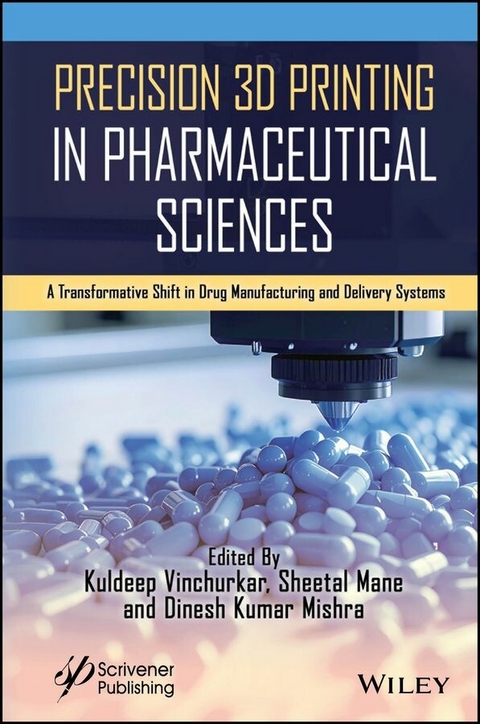
Precision 3D Printing in Pharmaceutical Sciences (eBook)
724 Seiten
Wiley-Scrivener (Verlag)
978-1-394-33755-2 (ISBN)
This book provides a roadmap for creating customized, precision drug delivery systems and advancing personalized medicine by introducing the revolutionary, transformative role of 3D printing technology in medicine.
The convergence of advanced manufacturing techniques with the complexities of pharmaceutical formulation has opened new frontiers of innovation, enabling unprecedented precision in drug delivery, tailored therapies, and complex dosage designs. From the creation of personalized drug formulations designed to meet the specific needs of individual patients to the development of complex, multi-functional drug delivery systems, the chapters within this volume explore a wide array of applications. This book is a groundbreaking resource that delves into the transformative role of 3D printing technology in the pharmaceutical field. Offering insights into customized and precision drug delivery systems, it highlights the synergy between advanced manufacturing techniques and pharmaceutical sciences. The book provides a balanced blend of theory and practical applications, presenting a roadmap for researchers and professionals to integrate 3D printing into their pharmaceutical processes. It discusses the role of innovative materials, cutting-edge technologies, and regulatory perspectives while highlighting the challenges and future trends in the field. By offering contributions from distinguished experts, the book serves as a comprehensive reference for understanding the potential of 3D printing to revolutionize drug delivery and advance personalized medicine.
Readers will find this volume:
- Explores cutting-edge 3D printing applications in pharmaceutical sciences, emphasizing precision and innovation;
- Covers practical and theoretical insights into customized drug delivery systems using 3D printing;
- Includes detailed case studies and emerging trends for academic and industrial professionals;
- Features contributions from leading experts and researchers in the field.
Audience
Pharmaceutical scientists, academics, industrial researchers, formulation chemists, biotechnology professionals, and students specializing in pharmaceutical technology, drug delivery systems, and biopharmaceuticals.
Kuldeep Vinchurkar, PhD, works in the Department of Pharmaceutics, Sandip Institute of Pharmaceutical Sciences, affiliated to Savitribai Phule Pune University, Nashik, Maharashtra, India with more than 11 years of research and teaching experience. He has published five books, seven patents, and more than 30 research and review publications in national and international journals. His research interests include 3D printing, artificial intelligence, and novel drug delivery systems, especially gastroretentive drug delivery.
Sheetal Mane, PhD is an Assistant Professor of Pharmaceutics at NMT Gujarati College of Pharmacy, Indore, Madhya Pradesh, India and has more than nine years of experience. She has published eight book chapters and 17 research papers in reputed journals and conferences. Her research focuses on novel drug delivery systems.
Dinesh Kumar Mishra, PhD is a Professor in the Department of Pharmacy at Guru Ghasidas Vishwavidyalaya with more than 20 years of experience in teaching, research, and administration. He holds three national patents and has authored five books, ten chapters, and more than 80 publications in peer-reviewed national and international journals. He specializes in novel drug delivery systems, particularly lipid-based nanocarriers, transdermal drug delivery, vaccines, and product development.
1
Introduction to 3D Printing in Pharmaceuticals
Sachin Joshi1, Priya Jindal1, Balak Das Kurmi2, Manish Kumar2* and Kuldeep Vinchurkar3
1Department of Quality Assurance, ISF College of Pharmacy, Moga, Punjab, India
2Department of Pharmaceutics, ISF College of Pharmacy, Moga, Punjab, India
3Department of Pharmaceutics, Sandip Institute of Pharmaceutical Sciences (SIPS), Affiliated To Savitribai Phule Pune University (SPPU, Pune), Nashik, Maharashtra, India
Abstract
Pharmaceutical product development is continually advancing, with innovative delivery systems aimed at enhancing the therapeutic efficacy of drugs. Since its emergence in the 1980s, 3D printing has transformed numerous research fields, including the pharmaceutical industry. The main goal is to produce complex, personalized products through an affordable and on-demand process. In recent years, the advancement of drug delivery systems (DDS) has garnered significant attention. The food and drug administration (FDA’s) approval of the first 3D-printed tablet set a landmark for integrating 3D printing into the preparation of drug delivery systems. This technology facilitates the precise deposition of active pharmaceutical ingredients and excipients and has the potential to revolutionize drug design, application, and production. It affects every stage of medication development, from preclinical research and clinical trials to frontline healthcare delivery. Furthermore, 3D printing has been utilized to create biomedical devices, revolutionizing the healthcare industry.
Various 3D printing techniques have been applied in drug delivery based on the dosage form and materials, with polymers, glasses, and hydrogels being the most commonly used. This innovative method facilitates the production of personalized doses for individual patient needs. The exceptional flexibility and control offered by 3D printing also allow for the development of dosage forms incorporating multiple active pharmaceutical ingredients with intricate and customized release profiles. 3D-printed formulations can enhance drug bioavailability and improve absorption and distribution within the body by carefully controlling factors such as porosity, surface area, and dissolution kinetics. Furthermore, this technique enables the direct incorporation of controlled and sustained release mechanisms into dosage forms, providing precise regulation of drug release kinetics and enhancing therapeutic efficacy. Research has also highlighted the potential of using 3D printing to adapt medication delivery systems according to unique patient preferences and characteristics. By utilizing patient-specific data, including anatomy, physiology, and genetic profiles, 3D-printed dosage forms can be customized to maximize treatment outcomes and minimize side effects. As this technology advances in pharmaceutical manufacturing, addressing quality assurance and regulatory challenges is essential. Ensuring the safety, efficacy, and compliance of 3D-printed pharmaceuticals requires careful consideration of these critical aspects. In summary, integrating 3D printing technology into drug delivery systems has immense potential to improve therapeutic outcomes and patient care. 3D printing offers transformative potential by enabling the production of personalized dosage forms with precise medication doses, controlled release profiles, and patient-specific designs. However, to fully harness this potential, overcoming regulatory and quality assurance hurdles is imperative to guarantee the quality, safety, and effectiveness of 3D-printed medications.
Keywords: Drug delivery system, dosage form, drug bioavailability, controlled release, therapeutic outcomes, 3D printing, quality assurance
1.1 Introduction
Three-dimensional (3D) printing, also known as additive manufacturing, fast prototyping, or solid free-form fabrication, uses material layering and fusion to build 3D items from digital models. The layer-by-layer technique enables the creation of objects with complex geometry [1]. The American Society for Testing and Materials divides 3D printing processes into seven groups based on their fundamental technological principles: material extrusion, binder jetting, powder bed fusion, vat photopolymerization, material jetting, directed energy deposition, and sheet lamination. These classifications result from the distinct materials, deposition processes, layer-manufacturing mechanisms, and product properties connected with each technology [2].
3D printing is widely used across a variety of industries, including automotive, medical, aerospace, and construction [3]. Pharmaceuticals offer the potential to reduce the risk of failure during the later stages of drug development by enabling the development of more predictable drug-screening platforms. Owing to its advantages over traditional methods, such as customization, precise fabrication of complicated solid dosage forms, on-demand production, cost-effectiveness, and personalization of medicines, 3D printing has gained significant attention for pharmaceutical drug product manufacturing. Applications of 3D printing in this field include dispersible films, microneedles, implants, transdermal patches, and controlled- or immediate-release tablets [4].
Personalized dosage forms are highly desirable to minimize unnecessary side effects, optimize dosing regimens, and achieve individualized release profiles. Rapid advancements in 3D printing technologies have facilitated the development of personalized drug delivery systems. In 2015, levetiracetam (SPRITAM) became the first FDA-approved drug manufactured using a 3D printing process. Developed by the Aprecia Pharmaceuticals Company for oral use, SPRITAM rapidly disintegrates with a sip of liquid and is used to treat epileptic seizures [5]. The timeline illustrated in Figure 1.1 highlights the key milestones in the advancements of 3D printing in the pharmaceutical and medical industries. Moreover, the overall process workflow of 3D printing covering pre-processing, processing, and post-processing stages is presented in Figure 1.2, detailing the essential steps such as CAD modeling, printing, powder removal, heating, curing, and material infiltration.
Figure 1.1 Evolution of 3D printing technology.
Figure 1.2 Workflow.
1.2 Categories of 3D Printing Methods in Drug Delivery
In the pharmaceutical industry, numerous 3D printing processes have been utilized, with the choice of method determined by the intended application and type of product being developed. Among the numerous available 3D printing techniques, only a few have been adopted in this field. The chosen technique depends on the specific requirements of the product and materials involved. Table 1.1 provides an overview of key 3D printing technologies used in pharmaceuticals, including their technical features, advantages, and limitations. Below are examples of these techniques used in pharmaceutical manufacturing [6].
1.2.1 Powder-Based 3D Printing
In this process, a laser or binder solution is applied to a powder bed to bind the particles and form a printed structure in 3D. The setup typically includes a powder reservoir, a printing platform, and a binder reservoir solution for storing ink or binder. This technique has been used to develop various pharmaceutical products, including tablets with innovative shapes, complex drugs with zero-order release profiles, and fast-dissolving tablets [7].
1.2.2 Extrusion-Based 3D Printer
This technique uses a heated nozzle to extrude a continuous strand of molten polymer, which is subsequently stacked and cooled to make a three-dimensional object. It includes two main approaches: fused deposition modeling and semi-solid extrusion. This method is user-friendly and allows precise control over printing parameters, making it widely used in pharmaceutical research [7, 8].
This technique has been used to develop a variety of pharmaceutical products such as modified-release tablets, immediate-release tablets, floating tablets, and colonic drug delivery systems. However, certain challenges are associated with its use. The heated nozzle requires the active ingredients to be stable at high temperatures, and pharmaceuticals must be prepared as filaments prior to printing.
1.2.3 Inkjet-Based 3D Printing or Digital Inkjet Printing
This system uses two technologies: continuous inkjet printing (CIJ) and dropon-demand (DOD). CIJ technology uses a high-pressure pump to produce a continuous stream of ink that passes through a 50–80-micron aperture. DOD printing yields droplets that have volumes between 1 to 70 picolitres and sizes between 10 and 50 microns. In order to generate a 3D object, photopolymer resin is layered using an inkjet printhead and cured under a UV light source. It is particularly effective for processing heat-sensitive compounds or labile drugs. This method has been applied to produce various pharmaceutical dosage forms, such as pills, implants, and orodispersible films [9].
Table 1.1 Overview of 3D printing technologies: features, pros, and cons.
| 3D printing technology and its types | Technical features | Pros | Cons |
|---|
| Pre-processing | Print processing | Post-processing |
|---|
| BJ-3DP | Pre-prepared powder bed or ink containing the... |
| Erscheint lt. Verlag | 6.11.2025 |
|---|---|
| Reihe/Serie | Sustainable Computing and Optimization |
| Sprache | englisch |
| Themenwelt | Naturwissenschaften ► Chemie |
| ISBN-10 | 1-394-33755-8 / 1394337558 |
| ISBN-13 | 978-1-394-33755-2 / 9781394337552 |
| Informationen gemäß Produktsicherheitsverordnung (GPSR) | |
| Haben Sie eine Frage zum Produkt? |
 EPUB (Adobe DRM)
Kopierschutz: Adobe-DRM
Adobe-DRM ist ein Kopierschutz, der das eBook vor Mißbrauch schützen soll. Dabei wird das eBook bereits beim Download auf Ihre persönliche Adobe-ID autorisiert. Lesen können Sie das eBook dann nur auf den Geräten, welche ebenfalls auf Ihre Adobe-ID registriert sind.
Details zum Adobe-DRM
Dateiformat: EPUB (Electronic Publication)
EPUB ist ein offener Standard für eBooks und eignet sich besonders zur Darstellung von Belletristik und Sachbüchern. Der Fließtext wird dynamisch an die Display- und Schriftgröße angepasst. Auch für mobile Lesegeräte ist EPUB daher gut geeignet.
Systemvoraussetzungen:
PC/Mac: Mit einem PC oder Mac können Sie dieses eBook lesen. Sie benötigen eine
eReader: Dieses eBook kann mit (fast) allen eBook-Readern gelesen werden. Mit dem amazon-Kindle ist es aber nicht kompatibel.
Smartphone/Tablet: Egal ob Apple oder Android, dieses eBook können Sie lesen. Sie benötigen eine
Geräteliste und zusätzliche Hinweise
Buying eBooks from abroad
For tax law reasons we can sell eBooks just within Germany and Switzerland. Regrettably we cannot fulfill eBook-orders from other countries.
aus dem Bereich