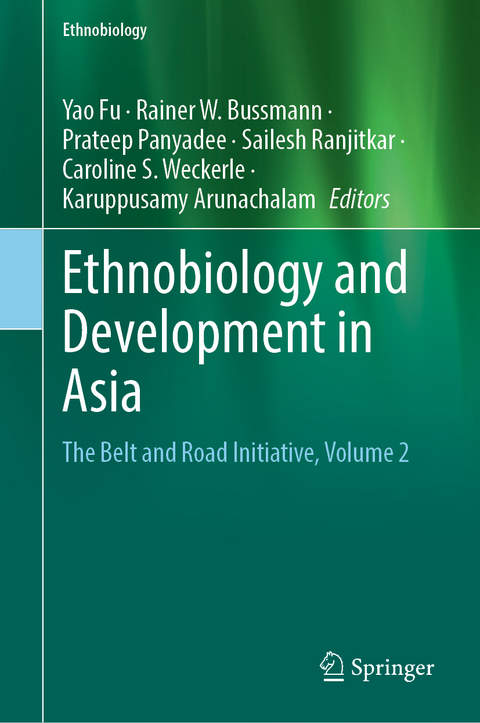
Ethnobiology and Development in Asia
Springer International Publishing (Verlag)
978-3-032-13572-8 (ISBN)
- Noch nicht erschienen - erscheint am 20.02.2026
- Versandkostenfrei
- Auch auf Rechnung
- Artikel merken
Ethnobiology and Development in Asia: The Belt and Road Initiative offers a groundbreaking perspective on the interplay between traditional knowledge, cultural practices, and biological resources along historical and contemporary trade routes across Asia. Against the backdrop of an interlinked climate, biodiversity, and land degradation crisis, generating robust knowledge that includes local and indigenous perspectives is crucial. This book explores how communities across diverse ecological zones interact with their environment, how species and cultures have moved along the Belt and Road, and how grassroots initiatives are driving sustainable development.
Structured into three key sections - Common species and cultures along the Belt and Road, Flows of species and cultures, and Community-based initiatives - this volume presents a novel interpretation of the Belt and Road Initiative through an ethnobiological lens. From the Arctic tundra to tropical rainforests, from ancient silk routes to maritime trading paths, from rural places to urban settings, 49 in-depth chapters document how people have developed sophisticated relationships with local species and ecosystems, creating a rich traditional knowledge of biological and cultural diversity. The book also emphasizes how local communities together with various stakeholders explore vibrant and innovative ways of living in harmony with nature.
Aimed at researchers, policymakers, and the wider public, this book underscores the value of traditional knowledge in global discussions on climate change and biodiversity conservation. It calls for urgent action to respect and protect indigenous knowledge systems and contributes to the implementation of the Convention on Biological Diversity (CBD) and the Intergovernmental Science-Policy Platform on Biodiversity and Ecosystem Services (IPBES)' integrated approach to biodiversity and ecosystem services. Through its detailed ethnobiological analysis, this book offers a practical guide for integrating traditional knowledge into mainstream conservation and development strategies, thereby supporting sustainable community development along the Belt and Road.
Yao Fu earned her M.Sc. in Environment and Development study at University of East Anglia, UK in 2006 and her doctorate at Kunming Institute of Botany (KIB), Chinese Academy of Sciences in 2013. She is an ethnobotanist, and currently working as an assistant professor in Key Laboratory of Economic Plants and Biotechnology of KIB, China.
Rainer W. Bussmann earned his M.Sc. (Diploma) in Biology at Universität Tübingen, in 1993 and his doctorate at Universität Bayreuth in 1994. He is an ethnobotanist and vegetation ecologist, and currently Head of the Department of Botany at the State Museum of Natural History in Karlsruhe, Germany. He is also a Full Professor of Ethnobotany at the Department of Ethnobotany, Institute of Botany, Ilia State University.
Prateep Panyadee, serving at the Queen Sirikit Botanic Garden in Thailand, is an ethnobotanist with a background in both Bachelor s and Doctoral studies in the field. His work largely revolves around understanding the intricate links between plants and human cultures, focusing especially on plant conservation, and detailed database management and taxonomy. He is also contributing to the integration of ethnobotany with ecotourism. In his journey as an ethnobotanist, Dr. Panyadee has been involved in extensive research and has had the opportunity to work with diverse cultural groups, particularly in Thailand.
Sailesh Ranjitkar is an Ethnobiologist and Agro-ecologist, with a remarkable academic and professional trajectory. Holding a doctorate from the Kunming Institute of Botany and currently serving as Research Director at N.Gene Solution of Natural Innovation in Nepal, he bridges traditional knowledge with cutting-edge agricultural strategies.
Caroline S. Weckerle has served as the Head of the Botanical Garden at the University of Zurich since January 2020 and as a Senior Lecturer (Privatdozentin) in Ethnobotany since December 2018. She earned her Ph.D. in Natural Sciences at the University of Zurich in 2003, completing a dissertation on the morphology, taxonomy, and phytochemistry of selected genera of the Sapindaceae. In 2018, she achieved her habilitation in Ethnobotany.
Karuppusamy Arunachalam, Graduated in Botany at Gobi Arts and Science College, Post-Graduation (M.Sc.,) in Plant Science and Doctorate in Botany (Ph.D.) from Bharathiar University. He received the National Fellowship from the University Grant Commission (UGC) in New Delhi and served as a junior/senior research fellow (2011-2014) in the Department of Botany at Bharathiar University, Coimbatore.
Food of Eyebrow: Local Knowledge and Mechanism of Hair Growth Promotion of Isatis tinctoria L. along the Silk Road.- The Potential Distribution and Plant Community Structure of Tea Forests in Guizhou, China.- How a Traditional Chinese Herbal Medicine Goji Enters the Global Market and Its Benefits for Local Community Development.- Research of Lycium ruthenicum Murr. (Black Goji Berry): Distribution, Economic-ecological interactions, Medicinal Applications and Cultivation.- The Ecology, Cultural and Economic Values of the Prized Matsutake Mushroom in Japan.- Local Collectors Economic Dependence and Management Practices of the Prized Matsutake Mushroom in China.- New Trends in the Consumption and Trade of the Prized Matsutake Mushroom in China.- Java Kapok: Pioneering a New Ecological Sphere for the Belt and Road Cotton Industry.- Medicinal Plant Wealth of Northeastern India: Diversity, Conservation, Trade and Bioprospection for Sustainable Livelihoods.- The Belt and Road with Access and Benefit-Sharing: Theory, Practice, and Potential.- Conservation and livelihood through medicinal plants: a case study from Naxi Communities in Ludian of Yulong County, Northwest Yunnan, China.- Empowering Sustainable Livelihoods and Ethno-ecological Conservation in Nepal's Karnali Region.- Community-based Conservation with Partnership of Ethnobotanical Researchers: A Sustainable Exploration of Piper magen.- Cultural Forest Restoration in a Rubber Plantation Context: A Case study of an Akha Village in Xishuangbanna, China.- Community-based Actions for Climate Change Adaptation: Case study from a Bulang Village in Xishuangbanna, China.- Integrating Ethnobotany and Ecotourism in Chiang Mai, Thailand A Case Study of Tinniyom Group.- Embracing Daily Dose of Nature: The Shanghai Habitat Garden Network.
| Erscheint lt. Verlag | 20.2.2026 |
|---|---|
| Reihe/Serie | Ethnobiology |
| Zusatzinfo | XL, 348 p. 155 illus., 134 illus. in color. |
| Verlagsort | Cham |
| Sprache | englisch |
| Maße | 155 x 235 mm |
| Themenwelt | Naturwissenschaften ► Biologie ► Botanik |
| Schlagworte | Asia • Belt and Road Initiative • Biodiversity conservation • ethnobiology • sustainability |
| ISBN-10 | 3-032-13572-9 / 3032135729 |
| ISBN-13 | 978-3-032-13572-8 / 9783032135728 |
| Zustand | Neuware |
| Informationen gemäß Produktsicherheitsverordnung (GPSR) | |
| Haben Sie eine Frage zum Produkt? |
aus dem Bereich