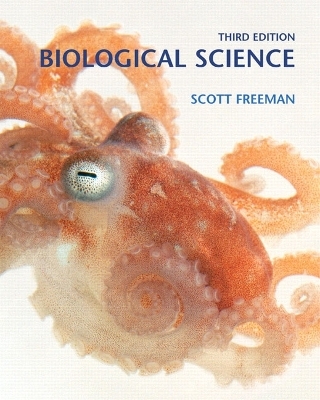
Biological Science with MasteringBiology
Benjamin-Cummings Publishing Company, Subs of Addison Wesley Longman, Inc
978-0-321-54327-1 (ISBN)
- Titel erscheint in neuer Auflage
- Artikel merken
This pioneering text combines research-focused storytelling with the Socratic method to get students to think like practicing scientists. Each page of the book is designed in the spirit of active learning, asking students to apply critical thinking skills as they learn key concepts. Accounts of real researchers designing and analyzing real experiments, carefully punctuated by thoughtful questions and exercises, train introductory students in the process of DOING biology.
With input from over 20 student focus groups and an advisory board of expert biology educators, Scott Freeman has refined the Third Edition to fully tap into students’ interest, imagination, and learning abilities. The clear writing, lucid illustrations, and active-learning features of previous editions have been strengthened as a result of the meticulous research and revision process conducted with students and the advisory board. New study tools directly address two of the biggest learning challenges for introductory students: finding important information and recognizing whether or not they truly understand a concept. Praised for its sensible use of evolutionary analysis and molecular biology as unifying themes, the new edition has also been thoroughly revised for accuracy, clarity, and currency. The supplements package now includes exciting new BioFlix, the groundbreaking MasteringBiology self-tutoring and assessment system, and more.
Scott Freeman Scott Freeman received his Ph.D. in Zoology from the University of Washington and was subsequently awarded an Albert Sloan Postdoctoral Fellowship in Molecular Evolution at Princeton University. His research publications explore a range of topics, including the behavioral ecology of nest parasitism and the molecular systematics of the blackbird family. Scott teaches the majors' general biology course as a Lecturer at the University of Washington. He assisted in the groundbreaking and influential redesign of the course, which emphasizes an inquiry-based appraoch and the logic of experimental design. With Jon Herron, Scott is co-author of the standard-setting Evolutionary Analysis, which over 50,000 students have used to explore evolution with the same spirit of inquiry. He is currently conducting research on how active learning and peer teaching techniques affect student learning. Kim Quillin Illustrator, Kim Quillin, combines expertise in biology and information design to create lucid and scientifically accurate visual representations of biological principles. She received her B.A. in Biology at Oberlin College and her Ph.D. in Integrative Biology (as a National Science Foundation Graduate Fellow) from the University of California, Berkeley, and has taught undergraduate biology at both schools.
1 Biology and the Tree of Life
Unit 1:The Molecules of Life
2. Water and Carbon: The Chemical Basis of Life
3. Protein Structure and Function
4. Nucleic Acids and the RNA World
5. An Introduction to Carbohydrates
6. Lipids, Membranes, and the First Cells
Unit 2: Cell Structure and Function
7. Inside the Cell
8. Cell-Cell Interactions
9. Cellular Respiration and Fermentation
10. Photosynthesis
11. The Cell Cycle
Unit 3: Gene Structure and Expression
12. Meiosis
13. Mendel and the Gene
14. DNA and the Gene: Synthesis and Repair
15. How Genes Work
16. Transcription and Translation
17. Control of Gene Expression in Bacteria
18.Control of Gene Expression in Eukaryotes
19. Analyzing and Engineering Genes
20. Genomics
Unit 4: Developmental Biology
21. Principles of Development
22. An Introduction to Animal Development
23. An Introduction to Plant Development
Unit 5: Evolutionary Processes and Patterns
24. Evolution by Natural Selection
25. Evolutionary Processes
26. Speciation
27. Phylogenies and the History of Life
Unit 6: The Diversification of Life
28. Bacteria and Archaea
29. Protists
30. Green Plants
31. Fungi
32. An Introduction to Animals
33. Protostome Animals
34. Deuterostome Animals
35. Viruses
Unit 7: How Plants Work
36. Plant Form and Function
37. Water and Sugar Transport in Plants
38. Plant Nutrition
39. Plant Sensory Systems, Signals, and Responses
40. Plant Reproduction
Unit 8: How Animals Work
41. Animal Form and Function
42. Water and Electrolyte Balance in Animals
43. Animal Nutrition
44. Gas Exchange and Circulation
45. Electrical Signals in Animals
46. Animal Sensory Systems and Movement
47. Chemical Signals in Animals
48. Animal Reproduction
49. The Immune System in Animals
Unit 9: Ecology
50. An Introduction to Ecology
51. Behavior
52. Population Ecology
53. Community Ecology
54. Ecosystems
55. Biodiversity and Conservation
| Erscheint lt. Verlag | 9.1.2008 |
|---|---|
| Verlagsort | San Francisco |
| Sprache | englisch |
| Gewicht | 3190 g |
| Themenwelt | Naturwissenschaften ► Biologie |
| ISBN-10 | 0-321-54327-0 / 0321543270 |
| ISBN-13 | 978-0-321-54327-1 / 9780321543271 |
| Zustand | Neuware |
| Informationen gemäß Produktsicherheitsverordnung (GPSR) | |
| Haben Sie eine Frage zum Produkt? |
aus dem Bereich