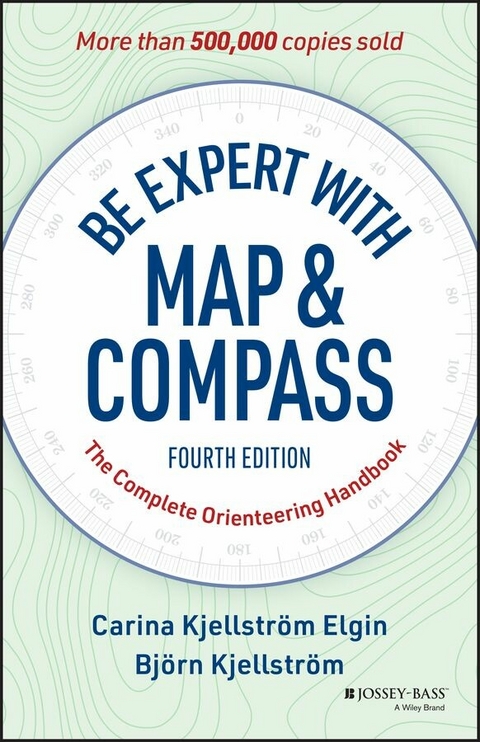
Be Expert with Map and Compass (eBook)
382 Seiten
Jossey-Bass (Verlag)
978-1-394-37562-2 (ISBN)
The classic map and compass navigation guide, updated with new features and tips
Be Expert with Map and Compass is a popular, easy-to-use orienteering handbook that has been helping people find their way for more than 70 years. This new edition contains a variety of updates on the essentials of map reading, with new photos and stories included throughout. In this refreshed, modern take on the classic outdoor navigation guide, readers will learn:
- How to read a map, map symbols, traveling by map and compass alone or by map and compass together, finding bearings, sketching maps, and traveling in the wilderness
- Compass design basics, how to test your compass skills, understand declination, and special uses of your compass in fishing and hunting
- Competitive orienteering basics, with information on how to organize an orienteering event and prepare the course beforehand
The Fourth Edition of Be Expert with Map and Compass remains the book of choice for professional outdoorsmen, novice orienteers, and outdoor organizations as well as teachers, scout leaders, recreational hikers, hunters, and others around the world seeking to feel more comfortable in the wilderness.
The classic map and compass navigation guide, updated with new features and tips Be Expert with Map and Compass is a popular, easy-to-use orienteering handbook that has been helping people find their way for more than 70 years. This new edition contains a variety of updates on the essentials of map reading, with new photos and stories included throughout. In this refreshed, modern take on the classic outdoor navigation guide, readers will learn: How to read a map, map symbols, traveling by map and compass alone or by map and compass together, finding bearings, sketching maps, and traveling in the wilderness Compass design basics, how to test your compass skills, understand declination, and special uses of your compass in fishing and hunting Competitive orienteering basics, with information on how to organize an orienteering event and prepare the course beforehand The Fourth Edition of Be Expert with Map and Compass remains the book of choice for professional outdoorsmen, novice orienteers, and outdoor organizations as well as teachers, scout leaders, recreational hikers, hunters, and others around the world seeking to feel more comfortable in the wilderness.
PART 2
DISCOVERY: Fun with Maps Alone
To get the most out of the lessons in this book, please download a copy of the TRAINING MAP. It can easily be downloaded and printed on letter-sized paper from www.beexpertwithmapandcompass.com. A full-size version can also be downloaded or ordered from USGS Topo Maps (Ticonderoga Quadrangle, New York-Vermont, 7.5 minute series).
There are many ways to imagine looking down upon Earth from above. You've probably peered down through an airplane window and tried to figure out where you were; or you've fooled around on Google Earth (www.googleearth.com) and been fascinated as you've been able to zoom in closer and closer and get more and more detail.
Photos from the Space Shuttle are equally intriguing, as one can see shifting sands and the boot of Italy from so far away. It is also fun to imagine what birds see, especially hawks as they use the currents way up in the sky to glide seemingly effortlessly over our planet.
Imagine you are that hawk or are in an airplane or even on a magic carpet. It is a bright day, with unlimited visibility. The sky above is blue. Below, the ground spreads out like a multicolored quilt. First, everything is just a jumble, but soon you are able to make out details.
That straight ribbon down there, for example, could be a highway—Route 66, or whatever it happens to be. The wide, winding band must be a river. You can even make out a railroad track as two parallel lines—the rails. The smaller rectangles are rooftops, the blue spots are clearly swimming pools, and those brown and green diamonds are, obviously, baseball fields. The dark green masses must be forests. Things look different from what you are accustomed to, and yet you can recognize them.
What Is a Map?
If you took a picture of what you saw on your adventure in the sky and later printed it out, you would have a photographic “map” of sorts of the area over which you flew. There would be a lot of confusing details that would be hard to interpret, and there would be some distortion near the edges because of perspective. Nevertheless, it would be a map: a reduced representation of a portion of the surface of Earth.
Modern mapmakers use aerial and satellite photographs and then check them using surveying equipment from the ground. In the final version of the map, they simplify details into representative signs they call map symbols. They also flatten out the perspective so the map looks the way it would appear looking straight down on it so that all the distances are in the same proportion on the map as they are in the landscape.
How Were the Earliest Maps Made?
It wasn't very easy for the earliest mapmakers to get a good base for their maps. They couldn't even dream of being up in an airplane to get the bird's-eye view. According to historians in this field, some people today, including the Inuit tribes of the North and indigenous desert tribesmen, show an incredible natural ability to make map sketches showing relative locations and distances between points in an area known to them. Instead of using longitude and latitude lines and compass directions as we do, they usually use a landmark they are familiar with—a road, a shoreline, a ridge, or some other terrain feature—as their orienting baseline for such a map.
The oldest known maps are something like those sketches. The earliest maps were probably first etched in dirt with sticks to show prime hunting grounds. These early maps were very generalized, showing major trails, coastlines, mountain ridges, and possible settlements. The maps would have been greatly affected by the mapmaker's impressions. Ever notice how one member of your family remembers that intersection because that's where the auto parts store is, while another remembers it because of the nail salon?
It wasn't until the discovery of magnetism and the subsequent invention of magnetic compasses that mapmakers could more precisely relate the location of a mapped area to the corresponding land and give precise, scientific information on directions and distances between different points on the map. The first maps or charts produced with the help of magnetic compasses appeared near the end of the thirteenth century, providing a great improvement in accuracy. Improvements in production methods followed with the further technical development of compasses. Mapping methods improved step-by-step until the revolutionary new method based on aerial photography became the standard, now joined by satellite technology.
(Courtesy of Quantico Orienteering Club)
What Kind of Map to Get
Today there are many kinds of maps to suit a variety of purposes. Almost every person has to make use of city maps, general road maps, or geographic maps. Global Positioning Systems in our cars and cell phones and computer programs such as MapQuest have revolutionized how we find our way around every day, but the ability to read a map will never lose its significance.
Anyone can use a city map or a street map with a little practice. The major streets are named, as are most buildings of interest, such as public offices and churches, or places of special interest to camera-toting tourists. Signs with bus and subway maps are everyday necessities in larger cities, so you know where your stop is.
Paper road maps, or atlases, are becoming a thing of the past. It seems even car rental companies no longer regularly hand them out, helpfully scribbling where to go. But using a paper road map helps give a better perspective on “where you're going and where you've been” and can help you get a better overall sense of direction. Looking at a phone screen cannot do that, and a younger generation that has no idea of east or west or north or south faces directional illiteracy.
The majority of road maps are designed to cover a whole state, while others may cover several states or the main cities of a state. In designing state maps, the scale (the proportion of the distance between points on the map and the actual distance between the corresponding points in the field) is decided so that the map will fold (after several attempts) into the familiar rectangles that are shoved into so many automobile glove compartments. A map of New Jersey, for example, may be scaled so that 1 inch on the map equals 5.2 miles of highway. On a New York map, 1 inch may equal 11.2 miles of roads. A Michigan map may have a scale of 1 inch equaling 14 miles, while a map of California may have 1 inch on the map equaling 21 actual miles.
Such maps will help you find your way from town to town, but they will not tell you if you have to travel uphill or downhill. Nor will they provide any information on the topography, the elevations and depressions on the land's surface. Automobile maps are all planimetric—from the Latin planum, “flat ground,” and metria, “measurement.” Usually these maps do not show elevations, such as hills or mountains. They contain enough detail to help you navigate the highways and roads in your car, but they will not be of enough assistance when you are hiking or involved in the sport of orienteering.
Topographic Maps
The type of map that will best serve you in the great outdoors is called a topographic map—from the Greek topos, “place,” and graphein, “to write”—hence, to write or draw a picture of a place or area.
Topographic maps are available for large areas of the United States and Canada. In the United States, they are prepared by the U.S. Geological Survey of the Department of the Interior and are called USGS maps, available free. In Canada, they are prepared by the Surveys and Mapping Branch of the Department of Mines and Technical Survey.
Generally, map symbols on topographical maps (nicknamed “topos”) from different countries are similar. If you learn to read U.S. topographical maps, you'll be able to interpret maps from other countries.
Orienteering or Recreation Maps
As the sport of orienteering grew internationally, it became necessary to standardize the maps used for competitions. The representatives from 48 member nations belonging to the International Orienteering Foundation (IOF) decided on specific rules and standards for the production of orienteering maps, including colors, symbols, and scales used. They provide much greater detail than regular topographical maps, such as reference to vegetation cover and landforms. They show many small but clearly identifiable terrain features, including small depressions and knolls, stream beds, and distinct vegetation changes, even boulders 6–8 feet in diameter.
The development of these internationally standardized maps not only contributed to the growing popularity of the sport among orienteers but also has increased the interest in map and compass use for hiking, hunting, and backpacking. To indicate their practical use for a variety of purposes, some mapmakers call them recreation maps. Information on areas covered by such detailed orienteering maps can be obtained from the orienteering association of the country you are in. They can also refer you to local orienteering clubs.
It is no exaggeration to say that it is more fun to travel in unknown terrain with an orienteering map than with a regular topographical map, because it is easier to identify a wide...
| Erscheint lt. Verlag | 27.10.2025 |
|---|---|
| Sprache | englisch |
| Themenwelt | Sachbuch/Ratgeber ► Sport |
| Reisen ► Karten / Stadtpläne / Atlanten | |
| Naturwissenschaften ► Geowissenschaften ► Geografie / Kartografie | |
| Schlagworte | compass fishing • compass hunting • compass reading • compass skills • compass travel • hiking navigation • map reading • navigation skills • Orienteering • orienteering course • orienteering environment • orienteering event • orienteering guide • wilderness navigation • wilderness safety • wilderness travel |
| ISBN-10 | 1-394-37562-X / 139437562X |
| ISBN-13 | 978-1-394-37562-2 / 9781394375622 |
| Informationen gemäß Produktsicherheitsverordnung (GPSR) | |
| Haben Sie eine Frage zum Produkt? |
 EPUB (Adobe DRM)
Kopierschutz: Adobe-DRM
Adobe-DRM ist ein Kopierschutz, der das eBook vor Mißbrauch schützen soll. Dabei wird das eBook bereits beim Download auf Ihre persönliche Adobe-ID autorisiert. Lesen können Sie das eBook dann nur auf den Geräten, welche ebenfalls auf Ihre Adobe-ID registriert sind.
Details zum Adobe-DRM
Dateiformat: EPUB (Electronic Publication)
EPUB ist ein offener Standard für eBooks und eignet sich besonders zur Darstellung von Belletristik und Sachbüchern. Der Fließtext wird dynamisch an die Display- und Schriftgröße angepasst. Auch für mobile Lesegeräte ist EPUB daher gut geeignet.
Systemvoraussetzungen:
PC/Mac: Mit einem PC oder Mac können Sie dieses eBook lesen. Sie benötigen eine
eReader: Dieses eBook kann mit (fast) allen eBook-Readern gelesen werden. Mit dem amazon-Kindle ist es aber nicht kompatibel.
Smartphone/Tablet: Egal ob Apple oder Android, dieses eBook können Sie lesen. Sie benötigen eine
Geräteliste und zusätzliche Hinweise
Buying eBooks from abroad
For tax law reasons we can sell eBooks just within Germany and Switzerland. Regrettably we cannot fulfill eBook-orders from other countries.
aus dem Bereich