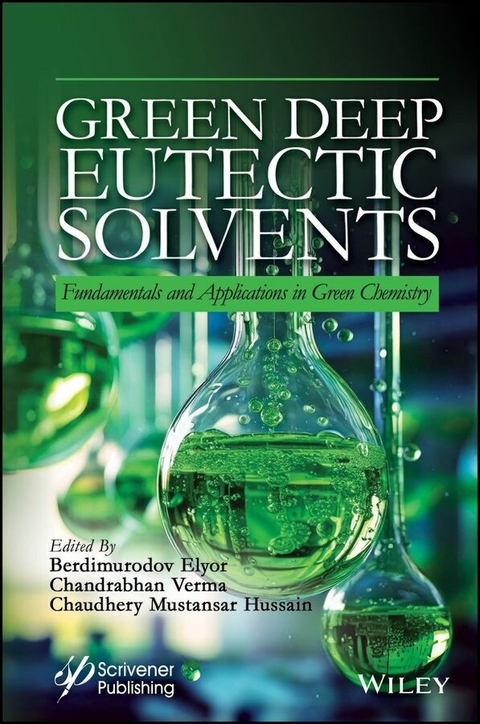
Green Deep Eutectic Solvents (eBook)
638 Seiten
Wiley-Scrivener (Verlag)
978-1-394-27212-9 (ISBN)
Lead the way in sustainable innovation with this comprehensive guide, offering an in-depth exploration of deep eutectic solvents (DESs) and their groundbreaking applications in green chemistry and industrial solutions.
Deep eutectic solvents (DESs) represent a groundbreaking development in green chemistry, offering tunable properties, low toxicity, and biodegradability. Unlike conventional solvents, DESs are highly versatile, finding applications in sustainable energy, industrial catalysis, separation processes, and drug development. As industries and researchers increasingly shift toward sustainable technologies, DESs provide a critical framework for addressing environmental and industrial challenges. This book offers a comprehensive overview of green deep eutectic solvents, starting with the fundamental principles and exploring their synthesis, structural characteristics, and physicochemical properties. Serving as a foundational guide, it provides advanced applications and solutions for experienced professionals and focuses on environmental impact, scalability, and cutting-edge research, making it a vital resource for advancing green chemistry practices in academia and industry.
Readers will find the volume:
- Comprehensively covers the full spectrum of green deep eutectic solvents (DESs);
- Provides practical insights into DES synthesis, characterization, and industrial applications;
- Explores applications in catalysis, gas capture, nanotechnology, pharmaceuticals, and metallurgy;
- Offers up-to-date research and solutions for sustainability challenges.
Audience
Researchers, scientists, academics, engineers, and professionals in green chemistry, materials science, environmental chemistry, analytical chemistry, and nanotechnology.
Berdimurodov Elyor, PhD is an Associate Professor at the National University of Uzbekistan, Tashkent, University. He has published five books, 50 book chapters, and more than 200 articles in international journals. His research areas include corrosion science, electrochemistry, quantum chemistry, materials science, green chemistry, and nanochemistry.
Chandrabhan Verma, PhD works at the Department of Chemical and Petroleum Engineering, Khalifa University of Science and Technology Abu Dhabi, United Arab Emirates. He is a member of the American Chemical Society and authors reviews studies for several journals. His research focuses on synthesizing and designing environmentally-friendly corrosion inhibitors for use in several industrial applications.
Chaudhery Mustansar Hussain, PhD is an adjunct professor and Director of Laboratories in the Department of Chemistry and Environmental Sciences at the New Jersey Institute of Technology, USA. He has published numerous papers in peer-reviewed journals and more than 100 books. His research is focused on the applications of nanotechnology and advanced materials, environmental management, and analytical chemistry.
Lead the way in sustainable innovation with this comprehensive guide, offering an in-depth exploration of deep eutectic solvents (DESs) and their groundbreaking applications in green chemistry and industrial solutions. Deep eutectic solvents (DESs) represent a groundbreaking development in green chemistry, offering tunable properties, low toxicity, and biodegradability. Unlike conventional solvents, DESs are highly versatile, finding applications in sustainable energy, industrial catalysis, separation processes, and drug development. As industries and researchers increasingly shift toward sustainable technologies, DESs provide a critical framework for addressing environmental and industrial challenges. This book offers a comprehensive overview of green deep eutectic solvents, starting with the fundamental principles and exploring their synthesis, structural characteristics, and physicochemical properties. Serving as a foundational guide, it provides advanced applications and solutions for experienced professionals and focuses on environmental impact, scalability, and cutting-edge research, making it a vital resource for advancing green chemistry practices in academia and industry. Readers will find the volume: Comprehensively covers the full spectrum of green deep eutectic solvents (DESs); Provides practical insights into DES synthesis, characterization, and industrial applications; Explores applications in catalysis, gas capture, nanotechnology, pharmaceuticals, and metallurgy; Offers up-to-date research and solutions for sustainability challenges. Audience Researchers, scientists, academics, engineers, and professionals in green chemistry, materials science, environmental chemistry, analytical chemistry, and nanotechnology.
1
Green Deep Eutectic Solvents: Fundamental, Properties, and Applications
Baiju Chenthamara†, M. Shaibuna† and Ramesh L. Gardas*
Department of Chemistry, Indian Institute of Technology Madras, Chennai, India
Abstract
Deep eutectic solvents (DESs) are newly developed, environmentally benign solvents formed by combining two or more substances via noncovalent interaction. The present chapter offers a broad overview and updates on DESs. The chapter begins with the concept and general introduction, including the history and definition of DESs. Subsequently, it delves into the classification, various preparation methods, and a detailed analysis of the fundamental physicochemical properties. Moreover, the chapter briefly recaps the characterization methods used for DESs, including spectroscopic techniques (nuclear magnetic resonance, infrared, and Raman) and thermal analysis (thermogravimetric analysis and differential scanning calorimetry). Likewise, the chapter discusses the applications of DESs in diverse areas, such as organic synthesis, metal separation and recovery, electrochemistry, extraction of micropollutants, and gas capture. Finally, the chapter concludes by addressing the challenges that prevent the application of DESs at the industrial level. Ultimately, the chapter aims to give insight into the potential of DESs, empowering researchers and advancing sustainable solutions in chemistry and beyond.
Keywords: Benign solvent, green chemistry, deep eutectic solvent, sustainable development goals, physicochemical properties
1.1 Introduction
Green chemistry has recently become a focal point of discussions and research. This field of research aims to design processes that reduce the utilization and production of harmful substances by considering human health and the ecosystem. Green solvents are a prominent topic at the forefront of discussions in green chemistry, which is guided by a set of 12 principles [1]. Various characteristics of liquids, such as inexpensiveness, recyclability, appropriate liquid range, tunability, etc., contribute to their suitability as solvents. Various kinds of green solvents exist; these include water, PEG (polyethylene glycol), supercritical fluids, fluorous solvents, ionic liquids (ILs), and deep eutectic solvents (DESs) [2]. Water is, of course, a universal solvent for a diverse range of solutes because of its favorable characteristics and minimal adverse effects [2]. However, under ambient conditions, water exhibits poor solvent properties for nonpolar substances (such as permanent gases and industrial polymers). In addition, water’s higher reactivity toward many solutes limits its applicability in such processes. Supercritical solvents are also involved with notable drawbacks such as corrosion issues, energy costs associated with achieving the necessary elevated temperature and/or pressure, and so on [3]. Hence, alternative solvents have been widely utilized for certain chemicals where water is insufficient as a solvent.
ILs and DESs are innovative designer solvents and contribute significantly to diverse applications [4–7]. An important myth about DES is that it is a type of IL or IL-related compound. Smith et al. opposed this statement, stating that IL and DES terms have been used interchangeably in the literature, so it is crucial to clarify that these represent two different types of solvents [4]. DESs are homogeneous mixtures composed of various constituents, typically a hydrogen bond donor (HBD) and a hydrogen bond acceptor (HBA), offering versatile properties and are greener substitutes for conventional solvents [8]. When these components are combined, they interact through intermolecular hydrogen bonding to form a homogeneous mixture with a lower melting temperature than that of the pure constituents [9]. The ideal proportion of HBAs to HBDs in the eutectic is influenced by the respective hydrogen bonding capabilities of the components involved. The general procedure for preparing DESs entails mixing the components at 40°C to 100°C until they transform into a uniform liquid [10]. The features of the resultant DES can be tailored by selectively choosing the constituents and adjusting their mole ratios to meet specific requirements in various applications.
1.2 History of DESs
Abbott et al. introduced the terminology “deep eutectic solvents” in the early 2000s. In 2001, the group observed that specific combinations of metal chlorides and quaternary ammonium salts (QASs) had the capability to produce a liquid exhibiting a diminished melting point compared to that of the constituent components and termed as “Lewis-acidic ionic liquids” [11]. Their chemical/electrochemical characteristics were thoroughly investigated. As an extension of this, the same group successfully investigated the catalytic application of the mixture, choline chloride (ChCl):MCl2, in the Diels–Alder reaction [12]. Subsequently, the concept was expanded to other hydrated metal salts (CrCl3·6H2O) and categorized as an IL analog [13]. One promising development in this field was the introduction of ChCl–urea mixture (at 1:2 ratio) with a melting point of 12°C, where hydrogen bonding between the components causes significant freezing point depression [14]. A pronounced decrease in melting point was noted in their phase diagram, which directed to the discovery of DES. The term “deep” was used to correlate this phenomenon. The depression in melting point offers a wide liquid range to the mixture and makes it an attractive solvent. Initially, the term “deep eutectic solvent” was used to express the mixtures derived from QASs and HBDs, but later, the term was utilized for all eutectic-based mixtures. The researchers soon realized that various substances can be used as HBAs (metal salts, quaternary ammonium/phosphonium salts, some neutral molecules, etc.) and HBDs to develop various DES systems. This diversity allowed for the tailoring of DES properties to fit particular applications.
1.3 Definition of DES
The term “eutectic” originates from the Greek word “eutēktos,” meaning “easily melted,” and was introduced by the British physicist Frederick Guthrie in 1884 [15]. The term inherently clarifies the substantial lowering in the melting point of eutectic mixtures, exceeding 100°C in comparison to that of individual components [16]. The liquidus range of the two-component mixture is depicted in the phase diagrams, which are crucial for various applications and processes involving these solvents. Figure 1.1 illustrates the solid–liquid phase diagram for a two-component system, where points X and Y denote the melting points of pure components A and B, respectively. Apart from that, each point on the line XZ and YZ represents the lowest melting point on the liquidus curve, signifying the equilibrium between a liquid phase and two crystalline phases. Point C represents a eutectic composition, denoted as a deep eutectic point, with the lowest melting point. The remaining region above lines XYZ indicates the existence of eutectic liquid. Recently, DES based on ILs (as HBAs) has obtained great attention due to their similar properties to ILs, such as minimal vapor pressure, structural tunability, broad electrochemical window, etc. Quaternary ammonium halides, including ChCl, betaine hydrochloride, and tetrabutylammonium halides, are commonly used ILs for DES preparation. The HBA-HBD composition, lattice energy of individual molecules, and the extent of hydrogen bonding are crucial factors that impact the mixture’s melting point. Furthermore, the extent of hydrogen bonds also plays a pivotal role in achieving a low melting point, and the halide anions within the ILs serve a crucial role in promoting the efficient formation of hydrogen bonds via charge delocalization among HBA (ILs) and HBD [17].
Figure 1.1 Schematic representation of solid-liquid phase diagram of a two-component system.
DESs derived from ILs have primarily been classified into three categories, expressed by a basic formula Cat+X−·zY, where cat+ denotes any cation belonging to the ammonium, phosphonium, or sulfonium group, accompanied by any lewis base x−, typically halide ions. the term y represents either a lewis or brønsted acid (acts as HBD), capable of forming intermolecular hydrogen bonding with x−, and z indicates their number [18]. In contrast, the fourth category of DES comprises metal halides, which are one of the components that act as HBA instead of ILs. Recently, a fifth category of DES, derived from naturally occurring compounds, has been included in conjunction with the four categories outlined in Table 1.1.
Table 1.1 Classification of DESs and their general formula.
| Type | General formula | Terms |
|---|
| Type I | Cat+X−.zMClx | M = Zn, Sn, Fe, Al, Ga, In |
| Type II | Cat+X−. zMClx.yH2O | M = Cr, Co, Cu, Ni, Fe |
| Type III | Cat+X−.zRZ | Z = -OH, -COOH, -CONH2 |
| Type IV | MClx. RZ = MCl(x-1)+. RZ + MCl(x+1)− | M = Al, Zn and Z = -OH, -CONH2 |
| Type... |
| Erscheint lt. Verlag | 24.10.2025 |
|---|---|
| Sprache | englisch |
| Themenwelt | Naturwissenschaften ► Chemie |
| ISBN-10 | 1-394-27212-X / 139427212X |
| ISBN-13 | 978-1-394-27212-9 / 9781394272129 |
| Informationen gemäß Produktsicherheitsverordnung (GPSR) | |
| Haben Sie eine Frage zum Produkt? |
 EPUB (Adobe DRM)
Kopierschutz: Adobe-DRM
Adobe-DRM ist ein Kopierschutz, der das eBook vor Mißbrauch schützen soll. Dabei wird das eBook bereits beim Download auf Ihre persönliche Adobe-ID autorisiert. Lesen können Sie das eBook dann nur auf den Geräten, welche ebenfalls auf Ihre Adobe-ID registriert sind.
Details zum Adobe-DRM
Dateiformat: EPUB (Electronic Publication)
EPUB ist ein offener Standard für eBooks und eignet sich besonders zur Darstellung von Belletristik und Sachbüchern. Der Fließtext wird dynamisch an die Display- und Schriftgröße angepasst. Auch für mobile Lesegeräte ist EPUB daher gut geeignet.
Systemvoraussetzungen:
PC/Mac: Mit einem PC oder Mac können Sie dieses eBook lesen. Sie benötigen eine
eReader: Dieses eBook kann mit (fast) allen eBook-Readern gelesen werden. Mit dem amazon-Kindle ist es aber nicht kompatibel.
Smartphone/Tablet: Egal ob Apple oder Android, dieses eBook können Sie lesen. Sie benötigen eine
Geräteliste und zusätzliche Hinweise
Buying eBooks from abroad
For tax law reasons we can sell eBooks just within Germany and Switzerland. Regrettably we cannot fulfill eBook-orders from other countries.
aus dem Bereich