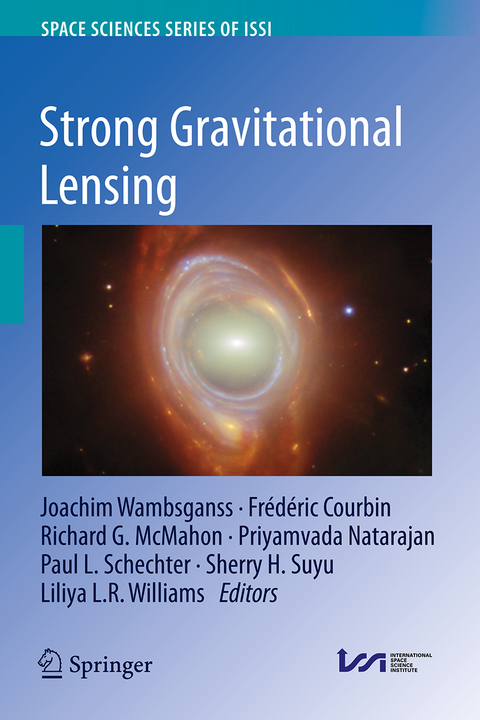
Strong Gravitational Lensing
Springer Netherland (Verlag)
978-94-024-2356-3 (ISBN)
- Noch nicht erschienen - erscheint am 19.01.2026
- Versandkostenfrei
- Auch auf Rechnung
- Artikel merken
This book contains up-to-date review articles on all important aspects of strong gravitational lensing, written by the top experts in the field. The chapters cover themes like the search for strong lenses, lensing as a probe for dark matter, lensing and microlensing of supernovae, to name just a few. The topical reviews are framed by two complementary introductory articles on Essentials and Basic Elements , respectively, of strong gravitational lensing.
This book is aimed both at front-line researchers and at newcomers and students, offering a comprehensive treatment that bridges fundamental concepts with the latest advances in gravitational lensing
Reprinted from the journal Space Science Reviews, Topical Collection: Strong Gravitational Lensing, 2025
Joachim Wambsganss studied in Heidelberg and Munich, he received his PhD in 1990 with a thesis on Gravitational Microlensing . After postdoc positions at Princeton University, MPA Garching and AIP Potsdam, he became professor at Potsdam University in 1999. In 2004, he moved to Heidelberg University as director of Astronomisches Rechen-Institut (ARI) and Zentrum für Astronomie der Universität Heidelberg (ZAH).
Wambsganss has worked on many aspects of gravitational lensing, he is also active in public outreach.
Frédéric Courbin is French and Swiss, he earned his PhD from the University of Liège in strong gravitational lensing and image deconvolution. He worked at ESO Garching, spent three years in Chile as a postdoc, and returned to Belgium as a Marie Curie fellow. He was a professor at the Swiss Federal Institute of Technology in Lausanne (EPFL-Switzerland) for 20 years before joining ICCUB in Barcelona in 2024. His research centers on time delay cosmography and the Hubble tension, spanning all lensing regimes. He is deeply involved in the ESA Euclid mission.
Richard McMahon is Professor of Astronomy at the University of Cambridge. He holds a Physics degree from Queens University Belfast and a PhD in Astronomy from University of Cambridge. He specializes in discovering gravitationally lensed quasars using large multiwavelength imaging and spectroscopic sky surveys. He also studies high-redshift quasars and active galaxies with accreting supermassive black holes. He was a founding member of the team awarded the 2015 Breakthrough Prize in Fundamental Physics for the discovery that the Universe's expansion is accelerating, contrary to prior expectations.
Priyamvada Natarajan is Joseph S. and Sophia S. Fruton Professor of Astronomy and Physics at Yale, where she chairs the Astronomy Department and directs the Franke Program in Science and the Humanities. Since 2022, she has been an external PI at Harvard s Black Hole Initiative. Her research has advanced our understanding of dark matter via gravitational lensing and of the growth of supermassive black holes. Her honors include Guggenheim and Radcliffe Fellowships, the 2022 Liberty Science Center Genius Award, the Dannie Heineman Prize in Astrophysics (2025), and recognition by TIME100 and Carnegie s Great Immigrants lists. She is a fellow of the American Physical Society, the American Astronomical Society, the American Academy of Arts and Sciences, and the AAAS.
Paul Schechter received his PhD in physics from the California Institute of Technology in 1975. He held postdoctoral positions at the Institute for Advanced Study and the University of Arizona, faculty positions at Harvard and the Massachusetts Institute of Technology, and scientific staff positions at Kitt Peak National Observatory and the Carnegie Observatories.
Sherry Suyu earned her PhD from Caltech in 2008 and held postdoctoral positions at the Universities of Bonn, UC Santa Barbara, and Stanford, before joining the Academia Sinica Institute of Astronomy and Astrophysics as faculty. In 2016, she became a Research Group Leader at Max Planck Institute for Astrophysics and Assistant Professor at TUM, where she is now Associate Professor and a Max Planck Fellow. Her research focuses on measuring the Universe s expansion, probing dark energy, studying galaxy and halo evolution, and observing lensed supernovae.
Liliya Williams obtained her Bachelor's degree at Princeton, and went on to get her PhD in 1995, at the Univ. of Washington (Seattle), on the topic of Weak Magnification Lensing of Quasars. She held two postdoctoral positions, at Cambridge University, UK, and Univ. of Victoria, Canada. She joined her current position at the Univ. of Minnesota in 2000. She continues to do research in various aspects of strong gravitational lensing, as well as theory of dark matter halos.
Editorial/Introduction.- Basic Elements of Strong Gravitational Lensing.- Essentials of Strong Gravitational Lensing.- Strong Lensing by Galaxies.- Strong Lensing by Galaxy Clusters.- Searching for Strong Gravitational Lenses.- Time-Delay Cosmography: Measuring the Hubble Constant and Other Cosmological Parameters with Strong Gravitational Lensing.- Strong Gravitational Lensing as a Probe of Dark Matter.- Microlensing of Strongly Lensed Quasars.- Strong Gravitational Lensing and Microlensing of Supernovae.- Microlensing Near Macro-Caustics.- Wave Optics, Interference, and Decoherence in Strong.
| Erscheint lt. Verlag | 3.4.2026 |
|---|---|
| Reihe/Serie | Space Sciences Series of ISSI |
| Zusatzinfo | Approx. 510 p. 135 illus., 124 illus. in color. |
| Verlagsort | Dordrecht |
| Sprache | englisch |
| Maße | 155 x 235 mm |
| Themenwelt | Naturwissenschaften ► Physik / Astronomie ► Astronomie / Astrophysik |
| Naturwissenschaften ► Physik / Astronomie ► Relativitätstheorie | |
| Naturwissenschaften ► Physik / Astronomie ► Theoretische Physik | |
| Schlagworte | Dark Matter • Einstein rings • Galaxy Clusters • gravitational lens caustics • Gravitational Lensing • hubble constant • lensing by black holes • light bending by gravity • Microlensing • Quasars lensing • strong lensing cosmology • Supernovae • Time delay in lensing |
| ISBN-10 | 94-024-2356-7 / 9402423567 |
| ISBN-13 | 978-94-024-2356-3 / 9789402423563 |
| Zustand | Neuware |
| Informationen gemäß Produktsicherheitsverordnung (GPSR) | |
| Haben Sie eine Frage zum Produkt? |
aus dem Bereich