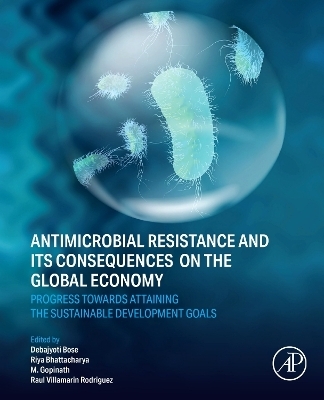
Antimicrobial Resistance and its Consequences on the Global Economy
Academic Press Inc (Verlag)
978-0-443-27781-8 (ISBN)
- Noch nicht erschienen (ca. Juni 2026)
- Versandkostenfrei
- Auch auf Rechnung
- Artikel merken
The book begins with an introduction on the global challenges of AMR before exploring the profound economic repercussions and the role of various sectors, including the pharmaceutical industry, agricultural practices, and food production. It also discusses ethical considerations in tackling AMR, as well as biotechnological and integrative approaches to AMR management. International responses and experiences in low- and middle-income countries are covered, in addition to the sustainable development goals and future directions and recommendations. By promoting responsible antibiotic use, enhancing surveillance systems, and investing in the research and development of new antimicrobial agents, this book aims to preserve the effectiveness of existing treatments and safeguard public health for future generations.
Through detailed case studies, policy recommendations, and innovative solutions, Antimicrobial Resistance and Its Consequences on the Global Economy serves as an essential resource for professionals working across microbiology, healthcare, agriculture and related fields, equipping them with the knowledge and tools needed to implement effective AMR management practices. It also serves as a valuable resource for students across these areas, fostering a new generation of experts dedicated to preserving the efficacy of antimicrobial treatments and combating AMR effectively.
Antimicrobial Resistance and its Consequences on the Global economy: Progress towards Attaining the Sustainable Development Goals examines the threat that antimicrobial resistance (AMR) poses to public health, considering its impact upon prolonged illnesses, increased healthcare costs, and higher mortality rates.
The book begins with an introduction on the global challenges of AMR before exploring the profound economic repercussions and the role of various sectors, including the pharmaceutical industry, agricultural practices, and food production. It also discusses ethical considerations in tackling AMR, as well as biotechnological and integrative approaches to AMR management. International responses and experiences in low- and middle-income countries are covered, in addition to the sustainable development goals and future directions and recommendations. By promoting responsible antibiotic use, enhancing surveillance systems, and investing in the research and development of new antimicrobial agents, this book aims to preserve the effectiveness of existing treatments and safeguard public health for future generations.
Through detailed case studies, policy recommendations, and innovative solutions, Antimicrobial Resistance and Its Consequences on the Global Economy serves as an essential resource for professionals working across microbiology, healthcare, agriculture and related fields, equipping them with the knowledge and tools needed to implement effective AMR management practices. It also serves as a valuable resource for students across these areas, fostering a new generation of experts dedicated to preserving the efficacy of antimicrobial treatments and combating AMR effectively.
Dr. Debajyoti Bose is an energy, water and biotechnology professional with a passion for understanding the intersection of science, technology, and health. He is currently affiliated with Woxsen University in Hyderabad, India. With close to nine years of experience in diverse fields such as bioenergy, water access, sanitation, and treatment, as well as exploration research into novel Himalayan plant species that can cure waterborne infections, he is uniquely positioned to tackle the complex issue of antimicrobial resistance and its global implications. He has been associated with the West Bengal University of Technology and the University of Petroleum and Energy Studies in India, as well as the St. Petersburg National Research University in Russia and the University of Saskatchewan in Canada. He is a member of multiple international bodies relating to energy, water and sustainability and is part of the editorial board and review committee of several top tier Q1 journals. He has close to 100 publications, and he has been significantly involved with UNICEF for ground level implementation of various action plans in India. Dr Riya Bhattacharya is a biotechnologist who has been working actively in the field of multidrug resistance, novel drug design and development, essential oil-based novel formulations, and related allied areas of health sciences. She leads the biotechnology research vertical under the School of Technology at Woxsen University, Hyderabad, India. Currently she is working on projects collaborating with Himachal Pradesh University, India and Ruhr-Universität Bochum, Germany. Dr M. Gopinath possesses a PhD in Chemical Engineering and a strong foundation in Chemical and Bio Engineering with 15 years of experience in top academic institutions. He is an effective communicator with excellent management skills and strong analytical, problem solving, leadership and decision making. Currently he is serving as Associate Dean (IIC) at Vel Tech HighTech Dr. Rangarajan Dr. Sakunthala Engineering College in Avadi, Tamil Nadu, India. He is an active member of various bodies such as IIChE, BRSI, CAPS and various other review committees. Dr. Raul Villamarin Rodriguez is the Vice President of Woxsen University, where he holds the Steven Pinker Professorship in Cognitive Psychology and the Classavo Chair in Integrative Research and Digital Learning. He is also an Adjunct Professor at Universidad del Externado in Colombia and serves on the International Advisory Boards of IBS Ranepa in Russia and the University of Pécs Faculty of Business and Economics. Dr. Rodriguez represents India on the PRME i5 Expert Pedagogy Group and holds a Ph.D. in Artificial Intelligence and Robotics Process Automation in Human Resources. His expertise includes machine learning, deep learning, natural language processing, and quantum artificial intelligence. He is a registered expert in these fields with the European Commission and was nominated for the Forbes 30 Under 30 Europe 2020 list. Dr. Rodriguez has co-authored two reference books, published over 70 research papers, and is a regular contributor to various magazines on analytics and emerging technologies. He also serves as a journal reviewer and associate editor for several publications, including IEEE.
1. Global Governance of Antimicrobial Resistance: An Assessment of International Coordination Mechanisms and National Policy Responses to AMR
2. Assessing the Global Innovation Gap in Antibiotic Development and Alternative Therapies for Combating Antimicrobial Resistance
3. Molecular and computational synergies in antimicrobial resistance and their complexities
4. Sustainable Agricultural Practices to Combat Antimicrobial Resistance: Key Strategies and Global Implications
5. Synthetic Biology and Genetic Engineering for AMR Management
6. The role of globalization in accelerating antimicrobial resistance
7. Enhancing Global Health Security: Addressing Antimicrobial Resistance in Resource-Limited Regions through Comprehensive Strategies
8. Ethics meets innovation: Navigating public health and sustainable agriculture in the battle against AMR
9. Interactions between Plants and Human Pathogens: Mechanisms of Transmission, Antimicrobial Resistance, and Global Health Challenges
10. Combating Antimicrobial Resistance in Cancer Management for public health management
11. Addressing AMR in agriculture through biotechnological innovations and strategies for a sustainable global economy
12. Cutting Edge Biotechnological Innovations in Managing Antimicrobial Resistance (AMR): Transforming Global Strategies
13. The Critical Role of Natural Ecosystems in Mitigating Antimicrobial Resistance: A One Health Approach
14. Combatting AMR with antimicrobial peptides: Perspectives on discovery and development
15. Investment in Research and Development for AMR Solutions: A Comprehensive Review
16. Complexities, challenges and opportunities: The global response to antimicrobial resistance
17. Enhancing antimicrobial stewardship through interprofessional education and its impact for healthcare professionals
18. Holistic approaches to combat Antimicrobial Resistance
19. Tackling antimicrobial resistance in resource-limited settings through innovation and its impact on sustainable development goals
20. Innovative Technological Approaches in Diagnosing and Treating Antimicrobial Resistance: The Role of Nanotechnology, Artificial Intelligence, and Microfluidics
21. The Role of the Pharmaceutical Industry, Innovative Therapies, and Strategies for Sustainable Solutions to AMR
| Erscheint lt. Verlag | 1.6.2026 |
|---|---|
| Verlagsort | San Diego |
| Sprache | englisch |
| Maße | 191 x 235 mm |
| Gewicht | 450 g |
| Themenwelt | Naturwissenschaften ► Biologie ► Mikrobiologie / Immunologie |
| ISBN-10 | 0-443-27781-8 / 0443277818 |
| ISBN-13 | 978-0-443-27781-8 / 9780443277818 |
| Zustand | Neuware |
| Informationen gemäß Produktsicherheitsverordnung (GPSR) | |
| Haben Sie eine Frage zum Produkt? |
aus dem Bereich