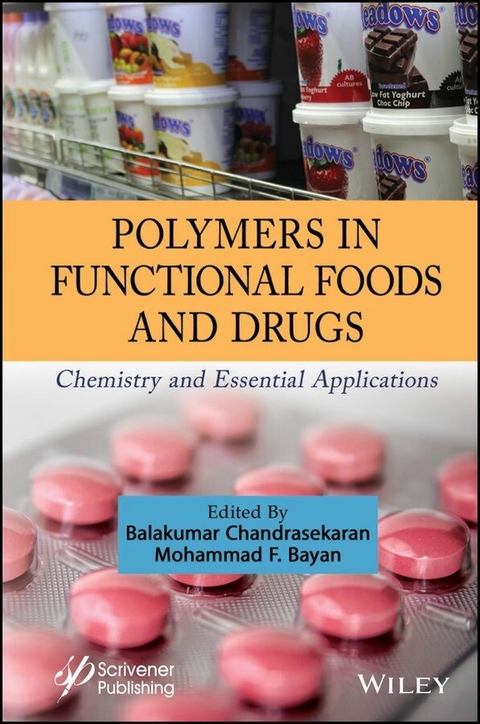
Polymers in Functional Foods and Drugs (eBook)
914 Seiten
Wiley-Scrivener (Verlag)
978-1-394-21451-8 (ISBN)
Master the cutting-edge intersection of polymers and medicine with this essential guide, offering both a theoretical understanding and practical applications for innovative drug and food product development.
Polymers are showing promise as a solution in a number of fields, including pharmaceuticals, medicine, diagnostics, medical devices, and biotechnology. In the development of drug products, polymers play an important role in nano-formulation development. Also, polymers contribute significantly to functional foods, nutraceuticals, and nutritional supplements. They are used as preservatives, enhancing the shelf life of foods, supplements, and herbal nutraceutical products.
This book provides readers with a theoretical understanding and practical applications of polymers in new drug discovery and food product development. It covers a broad spectrum of topics, from fundamental principles and concepts to applications, discussing natural, synthetic, and semi-synthetic polymeric materials. The chapters explore in-depth applications in medical devices, implants, nanosponges, and biological delivery systems, all of which are increasingly important in today's industry. Discussions on specialized topics, such as natural micropolymers in functional foods and dietary supplements, makes this an essential guide for anyone looking to stay up-to-date with the current trends in pharmaceutical and biotechnology research and development.
Readers will find the book:
- Comprehensively covers natural polymers and their applications in controlled drug delivery;
- Encompasses interdisciplinary science around polymers in functional food;
- Explores the delivery of drugs in the current practice of using synthetic polymers.
Audience
Researchers, scientists, and industry experts working with polymers in the field of pharmaceuticals medicine, diagnostics, medical devices, biotechnology, and nutrition.
Balakumar Chandrasekaran, PhD is a Professor in the Faculty of Pharmacy at Philadelphia University, Amman, Jordan. He has published more than 80 papers, authored 23 book chapters, edited two books and three journal issues as a guest editor, and holds nine international patents. His research focuses on pharmaceutical and medicinal chemistry, drug design, AI in pharmacy, and antimicrobials.
Mohammad F. Bayan, PhD Associate Professor of Pharmaceutics in the faculty of Pharmacy at Philadelphia University, Amman, Jordan and is currently the Head of Pharmacy Department. His major focus of research involves the development of controlled and triggered drug delivery systems using advanced and novel technologies. His work also involves organic synthesis, synthesis, characterization of polymeric smart materials and performing drug release studies. He is an author of more than 50 publications and received funding from national and international grants.
1
Smart Polymeric Carriers for Efficient Drug Delivery
Mohammad F. Bayan* and Balakumar Chandrasekaran
Faculty of Pharmacy, Philadelphia University, Amman, Jordan
Abstract
Smart polymeric materials are usually made with synthetic monomers rather than natural ones. They have the ability to swell/shrink according to the conditions of their aqueous/biological environments and thus affecting their release kinetics. These conditions can be changed chemically (such as pH) or physically (such as temperature). The thermoresponsive hydrogel systems are based on the ability of polymers to exhibit a volume phase transition or a sol-gel phase transition at their characteristic critical temperature. Photoresponsive hydrogels have photoreactive cross-links or pendant groups attached to their primary polymeric backbone. Enzyme-sensitive hydrogels have enzyme-reactive cross-links or pendant groups attached to their polymeric backbone, which react with a specific enzyme to elicit a stimulus-responsive hydrogel swelling or collapse. Different body parts have different pH values, and different tissues have different pH values under both healthy and unhealthy circumstances. This supports developing pH-responsive polymeric systems for targeted and controlled delivery of pharmaceuticals and biotechnological agents. Smart polymers can also display either a volume phase transition or a sol-gel phase transition at a specific temperature, which is the basis for thermoresponsive polymeric systems. Reactive cross-links or pendant groups coupled to their main polymeric backbone are characteristics of photoresponsive polymeric systems. Enzyme-reactive cross-links, or pendant groups, are affixed to the polymeric backbone of enzyme-sensitive polymeric systems. These cross-links allow the polymeric system to react to an external stimulus by either contracting or swelling when a specific enzyme is present. The development of smart polymeric carriers and their use in drug delivery are covered in this chapter.
Keywords: Polymers, drug delivery, hydrogels, p-HEMA, smart carrier
1.1 Introduction
Polymers are essential to human life, from commonplace items to sophisticated polymers [1]. The potential applications of new generations of polymers with well-controlled architecture and microstructure have expanded due to advancements in their design and commercialization [2]. Early research on polymer materials focused largely on their potential application as static structural components. But in the present era, sophisticated polymer materials that display unique properties in response to environmental factors have gained increasing interest [3]. This kind of activity resembles the biological intelligence found in the natural world. Because of this, these polymers are also known as smart polymers, or stimuli-responsive polymers. Three-dimensional (3D) cross-linked polymeric chain structures known as “smart polymers” have the ability to swell in biological fluids and water [4]. The attachment of the hydrophilic functional groups in their backbone structure is primarily to blame for this. They are easily produced by a cross-linking reaction between a single monomer set or a group of monomers to form homopolymers or copolymers [5]. They can participate in hydrogen bonds, ionic contacts, covalent bonds, and van der Waals interactions in addition to becoming insoluble in water as a result of this cross-linking. They also exhibit good biocompatibility and resemble living tissues due to their capacity to absorb biological fluids and water, which further supports their use in a variety of drug delivery methods [4]. The idea of Flory and Rehner states that a polymer’s swelling behavior is contingent upon the polymeric chains’ elastic properties and their interactions with water [5]. The swelling process involves three main phases. Water initially permeates the polymer matrix, which is followed by the polymeric chains relaxing and the polymeric network expanding. Primary-bound water is created when the hydrophilic moieties of the polymer are drawn to water, causing the polymer to swell. Next, secondary-bound water refers to the interaction between the hydrophobic moieties and the water. The osmotic pressure or osmotic pressure-driven force will then cause the free water to enter the matrix in order to reach the equilibrium state, which is the result of the elastic forces of the polymeric chains and the osmotic pressure being balanced [6]. Smart polymers find extensive use in implants and soft contact lenses [7]. The clinical investigation of hydrogels based on poly(2-hydroxyethyl methacrylate) (p-HEMA) in rhinoplasty has established this [8]. Because of their (i) high swelling ability, (ii) reproducibility of the swelling behavior, (iii) ease of removing unreacted species after polymerization by solvent extraction, (iv) ability to modify the polymer structure and cross-linking density, (v) ability to protect drugs from degradation, and (vi) ability to achieve a stimuli-responsive drug release, smart polymers are widely used in controlled and targeted drug delivery [9]. One particular family of “smart” polymers that are known to react to temperature changes is known as thermoresponsive polymers. These temperature-responsive polymers display a volume phase transition upon application of a specific temperature, leading to an abrupt alteration in their solvation state [10]. Some of these polymers have been reported to have a lower critical solution temperature, which causes them to become insoluble when heated. Conversely, the polymers have an upper critical solution temperature at which they become soluble when heated. Though only the aqueous systems are interesting for biological applications, these two systems are not limited to an aqueous solvent environment. The primary cause of the volume phase transition is the alteration in the hydration state. The development of smart polymers with cavities that can extract particular analytes from a mixture of possible interferents has been made possible by advances in molecular imprinting technology [11]. Because of this, these polymers—also known as molecularly imprinted polymers, or MIPs—have found use in a number of scientific domains. One of the intriguing uses is in sample preparation, where MIPs are employed as organic analyte adsorbents prior to chromatographic analysis. In order to extract and preconcentrate the target analyte(s) from a variety of complicated samples where they exist in low concentrations and as mixes with other substances of similar physicochemical properties. There are a number of classifications for smart polymers: p-HEMA is a manufactured substance, while starch and gelatin are natural sources. Depending on whether the cross-linked chain has an electrical charge or not, the substance can be classified as neutral, cationic, or anionic. Depending on the polymeric makeup, either homopolymers or copolymers. Depending on the kind of cross-linking, chemically or physically cross-linked. Depending on the level of crystallinity, amorphous, semicrystalline, or crystalline. Film, microgels, or nanogels depending on how they look and how the polymer was prepared by polymerization [12].
1.2 Techniques for Manufacturing Smart Polymers
Smart polymers can be made using any process that produces cross-linked polymers. While hydrophilic monomers are commonly used in the synthesis of smart polymers, hydrophobic monomers are also used to control the characteristics of polymers in particular therapeutic applications [13]. Synthetic monomers, rather than natural ones, are usually employed to manufacture smart polymers because they have several advantages such as longer service life, superior gel strength, and higher water absorption capacity. Natural and synthetic monomers can thus be mixed to create the necessary polymers [14]. Otto Wichterle and Drahoslav Lim reported the first synthetic smart polymer in the early 1950s [15]. They synthesized and investigated poly(2-hydroxyethyl) methacrylate (p-HEMA) for soft contact lenses. Free radical cross-linking polymerization techniques (bulk, solution, suspension, and emulsion polymerization) have been widely used to prepare smart polymers. The process of forming a polymeric chain by successively adding monomer molecules to a free radical active terminal is known as free radical polymerization [16]. It consists mostly of three steps (Figure 1.1).
In free radical polymerization, the three critical stages are initiation, propagation, and termination. During the initiation stage, free radicals are produced from an initiator and subsequently transported to the monomer molecules. This reaction can be started thermally, chemically, or by radiation. During the propagation process, the polymeric chain expands by adding monomer units to the active terminal site. Finally, the polymeric chain’s expansion will be halted. There are three distinct pathways for termination: (1) Connecting two active terminals or connecting an active terminal to an initiator radical. (2) Radical disproportionation, which involves transferring a hydrogen atom from one terminal to another, resulting in a polymer with an unsaturated end and a polymer with a saturated end. (3) Interactions with inhibitors like oxygen [17]. Monomer, cross-linker, and polymerization initiator are the three key components in the production of smart polymers. The polymers are routinely cleaned after polymerization to eliminate any unreacted or undesirable species. Figure 1.2 depicts a...
| Erscheint lt. Verlag | 22.10.2025 |
|---|---|
| Sprache | englisch |
| Themenwelt | Naturwissenschaften ► Chemie ► Organische Chemie |
| ISBN-10 | 1-394-21451-0 / 1394214510 |
| ISBN-13 | 978-1-394-21451-8 / 9781394214518 |
| Informationen gemäß Produktsicherheitsverordnung (GPSR) | |
| Haben Sie eine Frage zum Produkt? |
 EPUB (Adobe DRM)
Kopierschutz: Adobe-DRM
Adobe-DRM ist ein Kopierschutz, der das eBook vor Mißbrauch schützen soll. Dabei wird das eBook bereits beim Download auf Ihre persönliche Adobe-ID autorisiert. Lesen können Sie das eBook dann nur auf den Geräten, welche ebenfalls auf Ihre Adobe-ID registriert sind.
Details zum Adobe-DRM
Dateiformat: EPUB (Electronic Publication)
EPUB ist ein offener Standard für eBooks und eignet sich besonders zur Darstellung von Belletristik und Sachbüchern. Der Fließtext wird dynamisch an die Display- und Schriftgröße angepasst. Auch für mobile Lesegeräte ist EPUB daher gut geeignet.
Systemvoraussetzungen:
PC/Mac: Mit einem PC oder Mac können Sie dieses eBook lesen. Sie benötigen eine
eReader: Dieses eBook kann mit (fast) allen eBook-Readern gelesen werden. Mit dem amazon-Kindle ist es aber nicht kompatibel.
Smartphone/Tablet: Egal ob Apple oder Android, dieses eBook können Sie lesen. Sie benötigen eine
Geräteliste und zusätzliche Hinweise
Buying eBooks from abroad
For tax law reasons we can sell eBooks just within Germany and Switzerland. Regrettably we cannot fulfill eBook-orders from other countries.
aus dem Bereich