


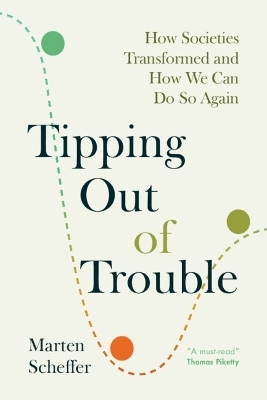
Tipping Out of Trouble
How Societies Transformed and How We Can Do So Again
Seiten
2026
Cambridge University Press (Verlag)
978-1-009-69975-4 (ISBN)
Cambridge University Press (Verlag)
978-1-009-69975-4 (ISBN)
- Noch nicht erschienen (ca. April 2026)
- Versandkostenfrei
- Auch auf Rechnung
- Artikel merken
How can we successfully transition towards a sustainable future? Drawing on broad insights from science and history, Marten Scheffer reveals how societies have transformed in the past and sets out a roadmap for how we might steer ourselves away from collapse-and toward renewal.
What kind of trouble lies ahead? How can we successfully transition towards a sustainable future? Drawing on a remarkably broad range of insights from complex systems and the functioning of the brain to the history of civilizations and the workings of modern societies, the distinguished scientist Marten Scheffer addresses these key questions of our times. He looks to the past to show how societies have tipped out of trouble before, the mechanisms that drive social transformations and the invisible hands holding us back. He traces how long-standing practices such as the slave trade and foot-binding were suddenly abandoned and how entire civilizations have collapsed to make way for something new. Could we be heading for a similarly dramatic change? Marten Scheffer argues that a dark future is plausible but not yet inevitable and he provides us instead with a hopeful roadmap to steer ourselves away from collapse-and toward renewal.
What kind of trouble lies ahead? How can we successfully transition towards a sustainable future? Drawing on a remarkably broad range of insights from complex systems and the functioning of the brain to the history of civilizations and the workings of modern societies, the distinguished scientist Marten Scheffer addresses these key questions of our times. He looks to the past to show how societies have tipped out of trouble before, the mechanisms that drive social transformations and the invisible hands holding us back. He traces how long-standing practices such as the slave trade and foot-binding were suddenly abandoned and how entire civilizations have collapsed to make way for something new. Could we be heading for a similarly dramatic change? Marten Scheffer argues that a dark future is plausible but not yet inevitable and he provides us instead with a hopeful roadmap to steer ourselves away from collapse-and toward renewal.
Marten Scheffer is a distinguished professor at Wageningen University and an expert on stability of complex systems ranging from the climate and the brain to societies and ecosystems. His work is highly cited and he is associated to the Dutch as well as the US academies of sciences.
Prologue: Change is in the Air; 1. The Trouble; 2. The Tipping; 3. How Civilizations Transformed; 4. How Social Tipping Works; 5. Reading Our Times; 6. Three Plausible Futures; 7. The Invisible Strangling Hand; 8. What Can Be Done; Epilogue; Acknowledgements; List of Figures; Reference; Index.
| Erscheint lt. Verlag | 2.4.2026 |
|---|---|
| Zusatzinfo | Worked examples or Exercises; 30 Line drawings, black and white |
| Verlagsort | Cambridge |
| Sprache | englisch |
| Gewicht | 500 g |
| Themenwelt | Geisteswissenschaften ► Geschichte ► Allgemeine Geschichte |
| Naturwissenschaften ► Biologie ► Ökologie / Naturschutz | |
| ISBN-10 | 1-009-69975-X / 100969975X |
| ISBN-13 | 978-1-009-69975-4 / 9781009699754 |
| Zustand | Neuware |
| Informationen gemäß Produktsicherheitsverordnung (GPSR) | |
| Haben Sie eine Frage zum Produkt? |
Mehr entdecken
aus dem Bereich



aus dem Bereich
Siedler, Händler, Philosophen : eine globale Geschichte vom …
Buch | Hardcover (2024)
DVA (Verlag)
CHF 58,75
eine Reise um die Welt zu außergewöhnlichen Persönlichkeiten, …
Buch | Softcover (2023)
Piper (Verlag)
CHF 25,20


