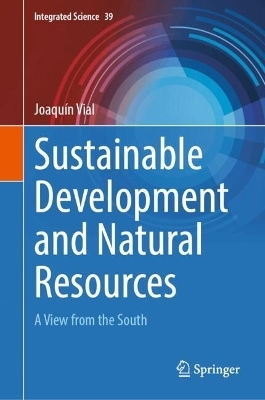
Sustainable Development and Natural Resources
Springer International Publishing (Verlag)
978-3-032-12262-9 (ISBN)
- Noch nicht erschienen - erscheint am 19.02.2026
- Versandkostenfrei
- Auch auf Rechnung
- Artikel merken
The book focuses on the tensions and challenges faced by emerging economies, which, although rich in natural resources, struggle to achieve economic and social development amid a global environmental crisis. An orderly demographic transition is needed to reduce the human footprint, but right now it is creating tensions in ageing societies, while still pressuring nature in the poorest areas of the world, where fertility rates remain high. If per capita consumption in emerging countries replicates the patterns of the rich ones, and the latter do not change theirs, there will be a collapse of many ecosystem services, with dire consequences for human welfare across the world. Innovation and charging the correct pricing of goods and services, reflecting their environmental costs, are critical to improve efficiency in the use of natural wealth.
There are ways to deal with all these challenges, but international cooperation and strong national commitments leveraged by netter institutions are needed to prevent a chaotic resolution of the environmental crisis. Time is running out.
Dr Joaquín Vial R-T. studied economics at the University of Chile during a period of great political upheaval and a major economic crisis, so he specialized in macroeconomics. In the early 80s, he went to UPenn to pursue a PhD in Economics. Upon completion of his doctoral thesis an econometric model of the world copper market in the 1990s, after his return to Chile, he became involved in the definition of fisheries and forestry policies, during the transition to democracy. Thereafter, he participated in the definition and practical application of fiscal policy in the Ministry of Finance, where he was Budget Director. After that, he went to Harvard, and then to Columbia, to work with Jeff Sachs on a project to improve competitiveness in the Andean countries, in close collaboration with the governments of the region. Subsequently, he spent 8 years in the BBVA Research Department, where he led a group to study the main global trends that would shape financial markets in the coming decades. At the time of the Global Financial Crisis in 2008, he was asked to lead BBVA s Research teams in South America. In 2012, he left BBVA to become a member of the Board of the Central Bank, where he was deputy governor between 2017 and 2022. At the end of his term, he concentrated on teaching at the Catholic University.
Introduction.- Part I. Global economic development and the impacts on Nature. A historical perspective.- Chapter 1. Challenges for economic convergence from Natural limits.- 1.1. The double explosion of the human footprint and the pressure on Nature's services.- 1.2. From Malthus to Solow: Why did Nature disappear from the analysis of economic development?- 1.3. Restoring the role of Nature: Lewis, Nordhaus and Dasgupta.- 1.4. Three levers to rescue a sustainable trajectory of economic progress at a global level.- Chapter 2. Economic development in a historical perspective.- 2.1. The Industrial Revolution and the second takeoff of Humanity.- 2.2. Industrial Revolution, international trade and the Great Divergence .- 2.3. Globalization, convergence and new actors in the 21st century Economy.- 2.4. Economic globalization and its environmental impacts.- Chapter 3. Development experiences of Latin America.- 3.1. A quick look at the Development of Latin America.- 3.2. Trends and evolution of foreign trade in the region.- 3.4. Is specialization in natural resources an anomaly?- 3.5. Latin American development, natural capital and weak sustainability .- Chapter 4. Challenges of natural resource dependence.- 4.1. Non-renewable natural resources, rising costs and rent capture.- 4.2. Interactions and tensions and between natural resources and other resources.- 4.3. Macroeconomic challenges of natural resource dependence.- Part II. The demographic lever : moving towards a sustainable trajectory of the population.- Chapter 5. Demographic transition and economic development.- 5.1. Trends in the demographic transition and its determinants.- 5.2. Demographic transition and its possible effects on economic growth.- 5.3 Demographic transition, population aging and social security.- Chapter6. Population evolution, human footprint and sustainability.- 6.1 . Is Latin America an underpopulated region?- 6.2. Population, land use and sustainability.- 6.3. Demographic crisis and sustainable development.- Part III. The lever of material consumption and the services of Nature.- Chapter 7. Trends in global consumption and human footprint.- 7.1. Global trends in consumption and human footprint.- 7.2. Tensions between global economic convergence and sustainability.- 7.3. Future consumption patterns and human footprint.- Chapter 8. Non-renewable resources and sustainability of economic growth.- 8.1. How much do we depend on Nature's resources?- 8.2. Is there evidence of scarcity of non-renewable resources?- 8.3. Role of technology in alleviating shortages.- 8.4. Limitations of markets to signal scarcity of non-renewable resources.- Chapter 9. Renewable resources: Why are they overexploited?- 9.1. Challenges for an efficient exploitation of renewable resources.- 9.2. Is there evidence of scarcity of renewable resources?.- 9.3. Overexploitation of renewable resources: impatience and the cost of waiting.- 9.4. Overexploitation of renewable resources : common property.- 9.5. Overexploitation of renewable resources: externalities.- Part IV. The lever of efficiency in the use of Nature.- Chapter 10. Human footprint and deterioration of ecosystem services.- 10.1. Panorama of the state of Nature and ecosystem services.- 10.2. Economic development, poverty and deterioration of Nature.- 10.3. Measuring the value of ecosystem services.- 10.4. Protection and recovery of the integrity of ecosystems.- Chapter 11. Global warming: origin and nature of the problem.- 11.1. Level and origins of GHG emissions.- 11.2. Direct impacts of climate change.- 11.3. Climate change mitigation and the risks of transition.- 11.4. The challenges of adaptation in the region.- 11.5. Tensions between economic convergence and global sustainability.- Chapter 12. A possible trajectory for sustainable socio-economic convergence.- 12.1. Synergies between nature preservation and emissions mitigation.-
| Erscheint lt. Verlag | 19.2.2026 |
|---|---|
| Reihe/Serie | Integrated Science |
| Zusatzinfo | XV, 285 p. 117 illus., 116 illus. in color. |
| Verlagsort | Cham |
| Sprache | englisch |
| Maße | 155 x 235 mm |
| Themenwelt | Naturwissenschaften ► Biologie ► Ökologie / Naturschutz |
| Schlagworte | biodiversity • Bioeconomy • Ecosystem services • emerging countries • Human Footprint • natural resources • Sustainable Growth |
| ISBN-10 | 3-032-12262-7 / 3032122627 |
| ISBN-13 | 978-3-032-12262-9 / 9783032122629 |
| Zustand | Neuware |
| Informationen gemäß Produktsicherheitsverordnung (GPSR) | |
| Haben Sie eine Frage zum Produkt? |
aus dem Bereich