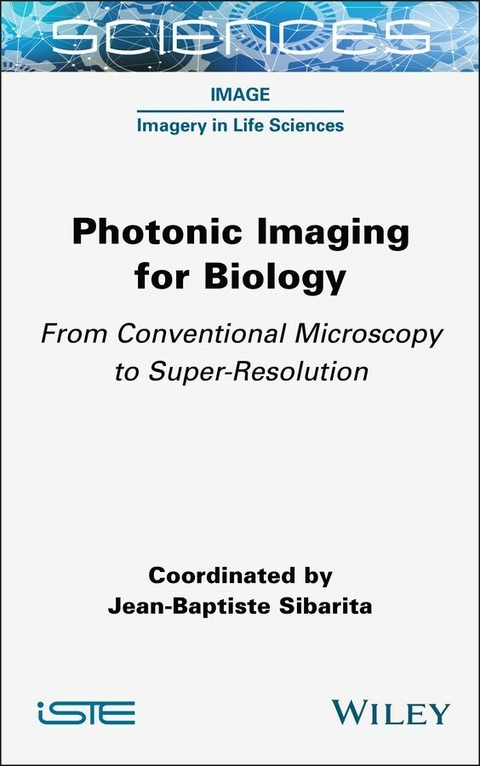
Photonic Imaging for Biology (eBook)
387 Seiten
Wiley-Iste (Verlag)
978-1-394-41788-9 (ISBN)
The discovery of Green Fluorescent Protein (GFP) revolutionized molecular biology, while 21st-century advances, such as super-resolution microscopy and artificial intelligence, have pushed imaging capabilities even further. Modern microscopes now integrate digital imaging, advanced optics and computational analysis for enhanced visualization and interpretation.
Photonic Imaging for Biology outlines major microscopy techniques that have driven biological discoveries, starting with fundamental principles and covering a range of methods, including brightfield, fluorescence, confocal, light-sheet, single particle tracking, photoperturbation, fluorescence correlation spectroscopy and super-resolution microscopy. The book concludes with a chapter on image analysis, highlighting recent progress in artificial intelligence. Each chapter focuses on specific techniques and their applications, strengths and limitations.
Jean-Baptiste Sibarita is a physicist and expert in quantitative live-cell microscopy. He leads a CNRS R&D team at the University of Bordeaux, France. He has developed several innovative imaging techniques and software, authored over 100 peer-reviewed publications and patents in the fields of microscopy, image analysis, cell biology and neuroscience, and has led multiple academic and industrial collaborations.
Light microscopy is a central tool in biological research, allowing scientists to observe living cells and organisms with details invisible to the naked eye. Since its inception in the 17th century, it has evolved through key innovations in optics, staining, electronics and informatics. Major milestones include phase contrast, differential interference contrast, immunofluorescence, genetically encoded fluorescent proteins, confocal microscopy and super-resolution microscopy. The discovery of Green Fluorescent Protein (GFP) revolutionized molecular biology, while 21st-century advances, such as super-resolution microscopy and artificial intelligence, have pushed imaging capabilities even further. Modern microscopes now integrate digital imaging, advanced optics and computational analysis for enhanced visualization and interpretation. Photonic Imaging for Biology outlines major microscopy techniques that have driven biological discoveries, starting with fundamental principles and covering a range of methods, including brightfield, fluorescence, confocal, light-sheet, single particle tracking, photoperturbation, fluorescence correlation spectroscopy and super-resolution microscopy. The book concludes with a chapter on image analysis, highlighting recent progress in artificial intelligence. Each chapter focuses on specific techniques and their applications, strengths and limitations.
1
Principles of Light Microscopy
Guillaume DUPUIS
Institut des Sciences Moléculaires d’Orsay, Université Paris-Saclay, France
1.1 Introduction
Since its invention in the 17th century, the optical microscope has become an essential instrument widely used in many fields of application, from metallurgy to biology and medicine. More specifically, in the field of life sciences, despite the considerable progress achieved by electron microscopes and local probe microscopes, the broadly preferred imaging techniques are still, at the current time, optical techniques that make use of combinations of conventional lenses and mirrors, as well as visible light sources. This is because cells, as the preferred objects of study in the life sciences, are indeed optically transparent: only light microscopy provides a three-dimensional noninvasive imaging of the inside of cells, under conditions compatible with living organisms.
In addition, mainly through the use of various fluorescent labeling techniques, light microscopy allows for the detection of specific cell constituents, such as proteins or lipids. Fluorescence light microscopy would almost be the ideal imaging technique for studying biological objects if it were able to distinguish between details smaller than about 200 nm. Unfortunately, it has been established since the studies of Ernst Abbe (1840–1905), a German optician, that the spatial resolution of any optical instrument is intrinsically limited by the diffraction of light.
In fact, due to the diffraction of light by the limited aperture of a lens, a perfect source point cannot yield an equally point image, but merely a diffraction pattern that is all the larger when the aperture is small and the desired magnification is high. Conversely, a large aperture will result in a shallow depth of field: this quickly becomes a problem for thick samples, especially in fluorescence microscopy, when the fluorescence from out-of-focus planes degrades the contrast of the plane of focus.
The main developments therefore consist of the following:
- improving the contrast of specific objects, especially thick samples, by implementing optical sectioning techniques such as, in particular, confocal microscopy, structured illumination techniques, light sheet illumination and total internal reflection microscopy;
- implementing strategies for overcoming the diffraction limit using super-resolution techniques.
Figure 1.1 Schematic diagram of a compound microscope. The magnified image of the object is formed by the objective lens whose focal length is small (about a few millimeters). The object is placed in front of and at a short distance from the object focal plane of the objective Fobj so that the absolute value of the magnification is large. The aperture diaphragm is placed in the back focal plane of the lens to provide telecentricity in object space. The intermediate image is formed in the object focal plane Feye of the eyepiece and the final image is projected to infinity.
1.2 Principle of image formation
1.2.1 Geometric approach
In a traditional compound microscope such as the one shown in Figure 1.1, the magnified image of the object is formed by a first optical group called the objective lens. The objective lens is the crucial element of the microscope that usually determines the overall performance of the instrument. The object to be observed is placed in the vicinity of the object focal plane Fobj of the lens. The magnified image is formed in an image plane located well beyond the image focus plane lens. Obviously, the magnification will be greater the shorter the object focal length of the lens and the shorter the object plane. The magnified image formed by the objective lens is real and inverted and it traverses a second optical group called the eyepiece. The eyepiece is positioned so that the intermediate image falls within its focal object plane Feye. Thereby, the eye observes an image projected to infinity (for a standard observer), thus relaxing the muscles responsible for accommodation, resulting in better visual comfort. Eyepieces are generally characterized by their commercial magnification, i.e. the ratio between the angle from which the final image is viewed and the angle from which the object would be seen if it were placed at the least distance of distinct vision of the eye (at 250 mm). The commercial magnification of the global microscope is therefore the product between the magnification of the objective and the commercial magnification of the eyepiece.
Figure 1.2 Schematic diagram of a microscope using an infinity-corrected objective lens. The object is placed in the object focal plane Fobj of the lens, which is associated with a tube lens with a focal length of about 20 cm.
In microscopes that use “infinity-corrected” optics (in the sense of aberration correction) such as the one represented schematically in Figure 1.2, the object is in the object focal plane of the objective lens, which consequently provides an image projected to infinity. An additional lens called a tube lens reforms the intermediate image in the object focal plane of the eyepiece. The object focus plane of the tube lens is coincident with the back focal plane of the objective lens so that the whole forms an afocal conjugation whose magnification is that indicated on the objective lens. In this type of configuration, the eyepiece circle, i.e. the exit pupil of the microscope, is located in the image focal plane of the eyepiece: the size of the image is then independent of the instrument setting. If the sample is observed with a matrix detector, the matrix detector is placed in the image focal plane of the tube lens or in a conjugate plane therewith.
The aperture diaphragm of the microscope is placed in the back focal plane of the lens so that the system is telecentric in object space. The main rays (namely the oblique rays that travel through the center of the aperture diaphragm) are then parallel to the optical axis in the object space, thus producing an orthographic view of the sample: the magnification is independent of the position of the sample in the field.
1.2.2 Wave approach
Geometric optics do not take into account the wave character of light. Nonetheless, diffraction phenomena are central to the process of image formation in a microscope, particularly in terms of the spatial resolution of the images.
Diffraction is a general characteristic of wave phenomena and occurs when a portion of the wavefront meets an obstacle: from the moment a wave is altered, whether in phase or amplitude, due to an obstacle, it is diffracted. The different parts of the wavefront that propagate beyond the obstacle recombine and interfere with one another, resulting in an illumination distribution that is called a diffraction pattern. Diffraction can be studied within the very general context of Maxwell’s equations for the propagation of electromagnetic waves or even in the context of quantum electrodynamics. Nevertheless, these approaches would be extremely cumbersome and would provide few additional explanations for the experimental observations. The classical scalar wave theory used in the Huygens–Fresnel principle provides a simple and efficient formalism that proves to be more than sufficient.
1.2.2.1 The Huygens–Fresnel principle
The theory of diffraction, in its elementary form, is based on a principle proposed by Christiaan Huygens (1629–1695) in his Treatise on Light. According to this principle, each point reached by a wave behaves as a secondary source of spherical wavelets, so that a moment later, the resulting wavefront is the envelope of those wavelets. Another crucial point of his proposal is that this propagation occurs without any change in wavelength or wave velocity, provided that there is no change in medium. Augustin Jean Fresnel (1788–1827), in the 1800s, modified this Huygens principle to successfully introduce the concept of interference between secondary wavelets. The combined contribution of these two physicists is called the Huygens–Fresnel principle.
About 50 years later, Gustav Robert Kirchhoff (1824–1887) showed that the Huygens–Fresnel principle was a direct consequence of the scalar differential equation of wave propagation. One hundred years later, it was Arnold Sommerfeld (1868–1951) who reproved the whole Huygens–Fresnel principle in the more rigorous context of vector electromagnetism, i.e. of the solution of Maxwell’s vector equations. In summary, the Huygens–Fresnel principle is an approximation of the rigorous solution to the diffraction problem given by solving Maxwell’s equations. It is valid in the context of the scalar approximation, i.e. in the context of the paraxial approximation. The rays are therefore not very far away and slightly sloped with respect to the optical axis (typically, less than ~ 18°), and the distance between the object and the diffraction pattern is large in comparison to both the size of the object and the size of the diffraction pattern.
Figure 1.3 Diffraction of a plane wave on an obstacle according to the Huygens–Fresnel principle.
NOTATIONS.– The obstacle is denoted as Ω, M is a point of...
| Erscheint lt. Verlag | 15.10.2025 |
|---|---|
| Reihe/Serie | ISTE Invoiced |
| Sprache | englisch |
| Themenwelt | Naturwissenschaften ► Chemie |
| Schlagworte | Confocal microscopy • digital imaging • Fluorescent proteins • Green Fluorescent Protein (GFP) • immunofluorescence • interference contrast • Microscopy • photoperturbation • spectroscopy • Super-resolution Microscopy |
| ISBN-10 | 1-394-41788-8 / 1394417888 |
| ISBN-13 | 978-1-394-41788-9 / 9781394417889 |
| Informationen gemäß Produktsicherheitsverordnung (GPSR) | |
| Haben Sie eine Frage zum Produkt? |
 EPUB (Adobe DRM)
Kopierschutz: Adobe-DRM
Adobe-DRM ist ein Kopierschutz, der das eBook vor Mißbrauch schützen soll. Dabei wird das eBook bereits beim Download auf Ihre persönliche Adobe-ID autorisiert. Lesen können Sie das eBook dann nur auf den Geräten, welche ebenfalls auf Ihre Adobe-ID registriert sind.
Details zum Adobe-DRM
Dateiformat: EPUB (Electronic Publication)
EPUB ist ein offener Standard für eBooks und eignet sich besonders zur Darstellung von Belletristik und Sachbüchern. Der Fließtext wird dynamisch an die Display- und Schriftgröße angepasst. Auch für mobile Lesegeräte ist EPUB daher gut geeignet.
Systemvoraussetzungen:
PC/Mac: Mit einem PC oder Mac können Sie dieses eBook lesen. Sie benötigen eine
eReader: Dieses eBook kann mit (fast) allen eBook-Readern gelesen werden. Mit dem amazon-Kindle ist es aber nicht kompatibel.
Smartphone/Tablet: Egal ob Apple oder Android, dieses eBook können Sie lesen. Sie benötigen eine
Geräteliste und zusätzliche Hinweise
Buying eBooks from abroad
For tax law reasons we can sell eBooks just within Germany and Switzerland. Regrettably we cannot fulfill eBook-orders from other countries.
aus dem Bereich