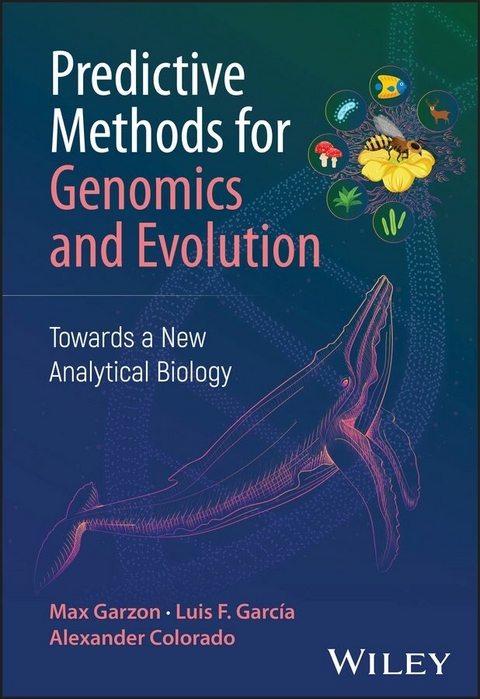
Predictive Methods for Genomics and Evolution (eBook)
500 Seiten
Wiley (Verlag)
978-1-394-31743-1 (ISBN)
Innovative title providing a systematic account of new alignment-free methods in genomics and bioinformatics, emphasizing their potential to add predictive capabilities to address major and current questions in the science of biology
Predictive Methods for Genomics and Evolution provides a cohesive overview of major alignment-based and alignment-free methods in genomics and bioinformatics, primarily based on DNA/RNA. Throughout the book, contrasts between current conventional methods and novel alignment-free methods are presented and evaluated across a wide range of topics.
Written by a team of experienced academics with significant research experience in the field, Predictive Methods for Genomics and Evolution discusses major topics including:
- Major unresolved problems in biology including the most fundamental concept of species, the nature of evolution and speciation, phylogenetic inference, pathogenicity, and the origin of life
- Novel interpretations of current hypotheses from a biological perspective with wide-ranging applications in bioinformatics and medicine
- Insights on the shift in the research status quo towards a wider application of more efficient alignment-free methodologies, fueled by the increased availability of data, deeper knowledge of DNA/RNA structure and powerful methods from the fields of machine learning and data science.
Predictive Methods for Genomics and Evolution is an essential guide on the subject for professionals, academics, researchers, and students within the fields of genomics, evolutionary biology, phylogenetics and taxonomy, and computational biology and bioinformatics, as well as medical practitioners in related fields.
A companion website for this text can be found here: bmc.memphis.edu/predBiology
Max Garzon is Professor of computer science and bioinformatics at the University of Memphis, where he teaches both undergraduate and graduate courses in data science, neurocomputing, bioinformatics, foundations of computing and cyber ethics.
Luis F. García is an Associate Professor at the National University of Colombia, where he teaches and advises both undergraduate and graduate students in evolution, molecular systematics, phylogenetics, genetics and computational biology.
Alexander Colorado is a researcher and educator who has spent doctoral stays at Clemson University and the University of Alberta, Canada, and served as mentor in programs for aspiring young biologists in Colombia. His main research interest is the integrative taxonomy of black flies (Diptera: Simuliidae).
Chapter 1
What Is Biology?
Life is a wondrous phenomenon to anyone who experiences, observes, or contemplates it. The science of biology aims to encompass and understand the phenomenon of life on Earth, not only as it exists and could be observed today but, perhaps more importantly, also as it has existed in the Earth’s past, simply because past life may provide insights to help understand what it is today and what it will become in the future. Furthermore, it includes the much harder “cosmic” question of its origin. How does life that occurs in ephemeral time for units of life (e.g. a living cell or a mayfly for one day) manage to persist as long as billions of years (even in ensembles such as species), despite ever-changing conditions (sometimes radically) for organisms and their environment? Given the physical nature of time in limited human minds, questions about the past are difficult; questions about the future are even harder. In the absence of a time machine that would allow travel into the past to ascertain what actually happened, what methods and tools has biology used or could use to attempt to provide answers about the past? How can it anticipate the range of possible outcomes through predictive approaches? Some specific questions of interest are:
- How did life come to exist? What are its origins? How did the most basic unit of life, a living cell, come about? Is life possible on other planets? If so, can they evolve? If so, what is their mode of “evolution”?
- What patterns shape macroevolution, the process that explains the diversity of life forms? What leads to the origins of major groups (taxa)? What is the cause of mass extinctions? Can these patterns be used to predict evolutionary changes?
- What processes lead to the formation of new species (speciation)? What mechanisms shape microevolution in general?
- How do complex traits such as behavior and culture evolve? Is there a major “force” leading to a trait? Is it just the synthesized expression of multigenic effects combined with environmental factors?
- Is the microbiome’s effect on human health, disease, and the environment larger or smaller than suggested to date?
Where to begin to address these questions was not ideal (it never is in science), but a lot of knowledge about them has been gained. Progress in every science usually depends on progress in others that can be used as new tools (like telescopes in physics and microarrays in biotechnology). That knowledge can be used to rethink and refine approaches to the questions for better answers, as will be further illustrated in every chapter of this book.
As it happens in most sciences, biology has started with a globally observable macro-phenomenon that is evident around us, (living) organisms. How can these organisms exist, i.e. function in and interact with others and with their environments? (Other objects like rocks and planets do not behave in the same dynamic fashion on the same scales of time). Progress in science is made by attempting to explain the reasons and causal chains why this phenomenology occurs as it does, from more fundamental forces in the universe. Physics has demonstrated that most phenomena (physical and even metaphysical) are a consequence of a few far more primitive and fundamental forces, namely global gravitational and more local electric and magnetic forces. However, the gap between them and biological phenomena has remained wide because of the complexity of the interactions and their cumulative effect over space and time. Developments in biology (e.g. genetics and systematics) and in other sciences as well (data science, machine learning) have now made it possible to tackle this problem, as is already evident in the field of bioinformatics.
Fortunately for biology, there is a pervasive feature across all organisms (living or extinct), both in space and time: deoxyribonucleic acid (DNA). It is known now that its structure has remained essentially unchanged for billions of years (despite drastic changes in the physical conditions on Earth), resulting in significant changes in the existing biodiversity it supports. DNA enables replication (the ability to produce an identical copy of itself), the (re)generation of the entire gene expression machinery, and its self-regulation in a complex organization of life at different levels, including unicellular to multicellular organisms, generation after generation. However, different levels of complexity in the molecule play a fundamental role in the structure and function of different biological groups. Therefore, a deep examination of the nature and complexity of DNA probably offers a novel and the best chance to make inroads into these questions. That is the approach taken in this book to the science of biology. (Answers of a divine origin are a logical possibility and, although briefly discussed in Chapter 9, fall outside the scope of this book. A more extensive discussion of the relationship between science and religion can be found in Runehow et al. (2013).)
The goal of this first chapter is to describe the nature and the role of DNA as responsible for life’s continuity and the transmission of genetic information across generations. This role is fundamental to the survival and persistence of all known organisms and forms of life. A major objective is to describe the local physical interactions among basic biomolecules that make this role possible and give rise to life. In particular, recent results about its structure (the so-called deep structure of DNA) enable the extraction of the information contained in DNA that can eventually be leveraged to make fairly accurate predictions at different biological levels about the past and the future. Third, the relatively straightforward novel ways to sequence genomic DNA (e.g. next-generation sequencing – NGS) have recently enabled biologists, as never before, to explore further questions about how species evolve and investigate the evolutionary relationships among organisms as more species are described and others have become extinct. Thus, traditional methods in biology have used comparison through so-called sequence alignments to make inferences about major questions in biology (e.g. to define species and to infer phylogenetic relationships through the past and the origin of evolutionary novelties, among others). However, they do not come without limitations. Therefore, this chapter also reviews available alternative alignment-free methods that can address the same questions but may offer better or different answers to these major and intriguing questions. Both approaches offer their own advantages and disadvantages, so they must be explored comparatively throughout the book.
1.1 DNA: Nature, Role, and Function
Life has existed and persisted on a changing planet for about 4.5 billion years. It is diverse and can be found in a variety of conditions (e.g. extreme hot or cold, light or dark, basic or acidic environments). How does the complex organization of life work to bring about the variations that exist for all kinds of organisms to survive in these environments? Several major landmarks in evolution have allowed these increased levels of complexity in the organization of life (see Figure 1.1), including:
- Self-replication that allows the genetic material, with the aid of other molecules, to produce a (nearly) identical copy of itself.
- A nuclear membrane that holds the genetic material inside it and isolates it from the rest of the cell. Many organisms on the planet are single-celled, but the formation of tissues (ensembles of cells) makes possible the existence of multicellular organisms.
- Tissues that make up organs, which in turn organize themselves into organ systems and give rise to complex organisms.
- Organisms that interact and have adaptations to organize into populations (individuals of the same species living in the same area), communities (populations of different species living in the same area), and ecosystems (communities of organisms in a given environment, with both living and nonliving elements).
Figure 1.1 Life exhibits a very complex organization. Different disciplines in biology approach biodiversity at various scales in a hierarchical way. (a) RNA and DNA, the first self-replicating molecules, and DNA condensation. (b) Combinations of cells may form multicellular individual organisms (at first with no nuclear membrane), such as membranes and tissues. (c) Tissues make up organs and systems, and organs form organisms. (d) Organisms self-organize into populations, communities, and ecosystems.
The goal of this section is to summarize basic biological knowledge about DNA, the most important molecule that every single organism contains in abundance and is responsible for the maintenance of life and the transmission of genetic information to offspring through generations.
The self-replicating property of DNA is practically identical in all organisms, although the complexity of how it occurs may vary, particularly among divergent groups. Without these properties, life is unlikely to exist. What are the processes and mechanisms that bring about these properties?
DNA goes through replication, only certain regions with particular functions (called genes) undergo a process of transcription to a similar, shorter-lived molecule, RNA that acts as a messenger for the translation of the original DNA into its expression, a protein. Gene regulation controls the timing at...
| Erscheint lt. Verlag | 15.10.2025 |
|---|---|
| Sprache | englisch |
| Themenwelt | Naturwissenschaften ► Biologie ► Genetik / Molekularbiologie |
| Schlagworte | alignment based genomics • alignment free genomics • bioinformatics alignment based • bioinformatics alignment free • Computational Biology • DNA Alignment • evolutionary biology • Pathogenicity • phylogenetic inference • rna alignment |
| ISBN-10 | 1-394-31743-3 / 1394317433 |
| ISBN-13 | 978-1-394-31743-1 / 9781394317431 |
| Informationen gemäß Produktsicherheitsverordnung (GPSR) | |
| Haben Sie eine Frage zum Produkt? |
 EPUB (Adobe DRM)
Kopierschutz: Adobe-DRM
Adobe-DRM ist ein Kopierschutz, der das eBook vor Mißbrauch schützen soll. Dabei wird das eBook bereits beim Download auf Ihre persönliche Adobe-ID autorisiert. Lesen können Sie das eBook dann nur auf den Geräten, welche ebenfalls auf Ihre Adobe-ID registriert sind.
Details zum Adobe-DRM
Dateiformat: EPUB (Electronic Publication)
EPUB ist ein offener Standard für eBooks und eignet sich besonders zur Darstellung von Belletristik und Sachbüchern. Der Fließtext wird dynamisch an die Display- und Schriftgröße angepasst. Auch für mobile Lesegeräte ist EPUB daher gut geeignet.
Systemvoraussetzungen:
PC/Mac: Mit einem PC oder Mac können Sie dieses eBook lesen. Sie benötigen eine
eReader: Dieses eBook kann mit (fast) allen eBook-Readern gelesen werden. Mit dem amazon-Kindle ist es aber nicht kompatibel.
Smartphone/Tablet: Egal ob Apple oder Android, dieses eBook können Sie lesen. Sie benötigen eine
Geräteliste und zusätzliche Hinweise
Buying eBooks from abroad
For tax law reasons we can sell eBooks just within Germany and Switzerland. Regrettably we cannot fulfill eBook-orders from other countries.
aus dem Bereich