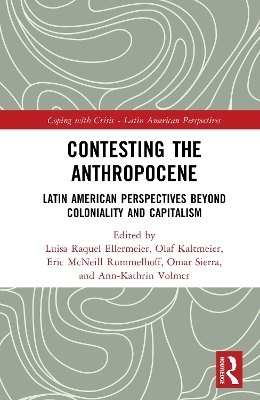
Contesting the Anthropocene
Routledge (Verlag)
978-1-041-11893-0 (ISBN)
- Noch nicht erschienen (ca. April 2026)
- Versandkostenfrei
- Auch auf Rechnung
- Artikel merken
This book provides refreshing and critical conceptualizations of the Anthropocene from Latin American perspectives, addressing questions of coloniality and capitalism. Researchers from different disciplines introduce a variety of new concepts and approaches to explore the social, political and epistemological causes of the multiple socio-ecological crises and showcase alternative foci to cope with them.
The first key issue at the heart of the crisis of the Anthropocene is a reflection on life on Earth. This dimension includes biodiversity, the web of life, bio-centered cosmovisions, and the politics and ethics of care. Then, the focus shifts to mining and related extractivist development schemes. These perspectives place significant emphasis on Latin America’s colonial history and its enduring legacies as well on the fundamental metabolic rupture. Technology, science, and infrastructure are also crucial to the Anthropocene. The contributions examine the question of agency related to infrastructure arguing that ideas of development and growth manifest in infrastructure and alternatives or change, and that they must always be considered in relation to existing structures. The volume concludes with discussion on urban spaces.
By offering a rich array of contributors from Latin America, the book provides students and researchers with new perspectives from the Global South on the new era of the Anthropocene.
Luisa Raquel Ellermeier is a researcher at the Center for Inter-American Studies (CIAS) and an editor at Bielefeld University, Germany. Her work combines research, teaching, and editorial expertise, with an interdisciplinary focus on film representations of gender, Indigenous resistance, human–animal relations, alterity, and subalternity in the Inter-American context Olaf Kaltmeier, Prof. Dr., is chair of Ibero-American history at Bielefeld University, Director of the Maria Sibylla Merian Center for Advanced Latin American Studies in the Humanities and Social Sciences (CALAS) and founding director of the Center for the Center for InterAmerican Studies (CIAS). He conducts the international collaborative research project “Turning Land into Capital” funded by the Volkswagen Stiftung. Eric McNeill Rummelhoff earned his Masters in InterAmerican Studies at Bielefeld University. Since then, his work has focused on translating and editing the results of work done at the Merian Sibylla Maria Center for Advanced Latin American Studies (CALAS), particularly the Handbook Series: “The Anthropocene as a Multiple Crisis: Perspectives from Latin America.” Omar Sierra Cháves is a PhD. candidate in Latin American History (Bielefeld University/University of the Basque Country),. His research examines land appropriations, cacao, and coloniality in 19th-century Venezuela, and is part of the project "Turning Land into Capital". His professional experience includes editorial work on the Handbook "The Anthropocene as Multiple Crisis: Perspectives from Latin America" at CALAS. Ann-Kathrin Volmer, PhD, is a guest researcher at the Department for Geography at the University of Bonn. Her research is centered on the subjects of water governance and socio-ecological conflicts in Colombia and Ecuador. She has served as co-manager of the Center for Advanced Latin American Studies (CALAS) at the University of Guadalajara in Mexico.
1. Contesting the Anthropocene: Latin American Perspectives beyond Coloniality and Capitalism 2. The Anthropocene: A New Geological Era or Sociohistorical Shift? Critical Reflections from Latin America 3. Conquistal Mineralocene: Potosí, the Earth Eaters, and the World’s Mechanization 4. Livestock, Commodity Frontier, and Plantationocene in Latin America and the Caribbean 5. Old and New Sacrifice Zones in Latin America 6. Care(full)! The Anthropocene: Between Exaltation of Life and Necropolitics 7. Aesthetics of Care and Urbanocene 8. Biocentrism in the Anthropocene: An Alternative from Mexico? 9. Agency in Posthumanism: The Role of Infrastructure in the Anthropocene 10. Science and Technology for Solar Energy Harvesting: South America and its Sustainability Laboratory (1872-1948) 11. After Pristine Nature: Exploring Posthumanist Approaches to the Urban in South America 12. The Anthropocene Settles in the Urban. The Urbanocene in the Global South 13. Green Urbanocene and Parks, Urban Forests, and Springs in the Twentieth Century as Narratives for Reading the City, Metropolitan Area of Guadalajara, Mexico
| Erscheint lt. Verlag | 20.4.2026 |
|---|---|
| Reihe/Serie | Coping with Crisis - Latin American Perspectives |
| Zusatzinfo | 14 Halftones, black and white; 14 Illustrations, black and white |
| Verlagsort | London |
| Sprache | englisch |
| Maße | 152 x 229 mm |
| Themenwelt | Naturwissenschaften ► Biologie ► Ökologie / Naturschutz |
| Sozialwissenschaften ► Politik / Verwaltung | |
| Sozialwissenschaften ► Soziologie ► Spezielle Soziologien | |
| ISBN-10 | 1-041-11893-7 / 1041118937 |
| ISBN-13 | 978-1-041-11893-0 / 9781041118930 |
| Zustand | Neuware |
| Informationen gemäß Produktsicherheitsverordnung (GPSR) | |
| Haben Sie eine Frage zum Produkt? |
aus dem Bereich