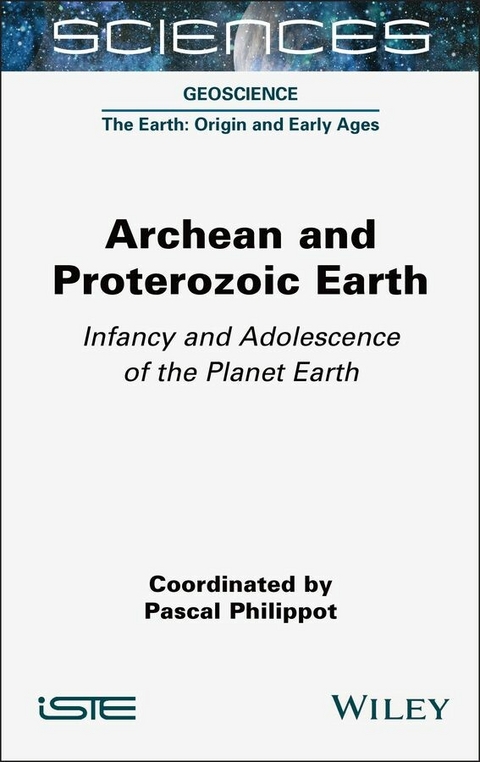
Archean and Proterozoic Earth (eBook)
575 Seiten
Wiley-Iste (Verlag)
978-1-394-41785-8 (ISBN)
This book looks at the planet's secular cooling and its implications for the dynamics of the Earth's mantle and the development of plate tectonics, as well as the evolution of magma composition and the formation of a differentiated continental crust. It shows how variations in the intensity of the Earth's magnetic field have proved useful in reconstructing the movement of continents across the surface of the globe. The book also documents the origin of the oceans and the appearance of the first traces of life, and describes the evolution of the major biogeochemical cycles that led to the oxygenation of the atmosphere, the diversification of living organisms and the concentration of substances of economic interest, particularly metals.
Pascal Philippot works as CNRS Research Director at Géosciences Montpellier, France. His research interests include the relationships between geodynamics and biogeochemical cycles during the Precambrian, and in particular, the processes that led to the oxygenation of the atmosphere and oceans during the Archean-Proterozoic transition.
It took nearly four billion years for the Earth to become a hospitable planet. Archean and Proterozoic Earth traces the geodynamic, biological, climatic and environmental upheavals that accompanied this evolution. This book looks at the planet s secular cooling and its implications for the dynamics of the Earth s mantle and the development of plate tectonics, as well as the evolution of magma composition and the formation of a differentiated continental crust. It shows how variations in the intensity of the Earth s magnetic field have proved useful in reconstructing the movement of continents across the surface of the globe. The book also documents the origin of the oceans and the appearance of the first traces of life, and describes the evolution of the major biogeochemical cycles that led to the oxygenation of the atmosphere, the diversification of living organisms and the concentration of substances of economic interest, particularly metals.
1
Thermal Evolution of the Earth
Stéphane LABROSSE
LGL TPE, ENS, Lyon, France
1.1. Brief historical note
The fact that temperature increases with depth inside the Earth has been known for thousands of years, since humans began mining. This observation, along with the study of volcanoes, undoubtedly led to the idea of Earth’s internal fire proposed by Athanasius Kircher in 1664 (Figure 1.1). Descartes, then Leibniz, later suggested that the Earth formed like a small Sun, with its surface freezing over as it cooled. Fourier, in his foundational 1822 book The Analytical Theory of Heat, developed the theory of heat transfer by conduction and demonstrated how this theory could be used to calculate the thermal evolution of the Earth and its age. The idea is simple: starting with a hot Earth at its formation, one can calculate the temperature evolution over time by cooling of the surface, assuming that heat transfer occurs through conduction. From this calculation, the surface temperature gradient, which decreases over time, can be determined, and Earth’s age is the time required to reach the currently observed value. This approach was later adopted by Kelvin Thomson (1862), who obtained an age of 98 Myr for the Earth. This led geologists of the time to develop their own methods for determining Earth’s age (for a historical account of these debates, see Burchfield 1975). Although it is often stated that Kelvin’s determination of Earth’s age was incorrect because he was unaware of radioactive heating, Richter (1986) demonstrated that this was not the case: the cooling model of Fourier and Kelvin only considers heat loss by conduction. If we assume a present-day surface temperature gradient of about 30 K km−1, it is easy to see that cooling affects only the upper part of the Earth, down to a depth of about 100 km. Radioactive heating within such a thin layer contributes little to the surface heat flux. What is actually missing from this simple model is a more efficient heat transport mechanism, mantle convection, to sustain surface heat flux for a longer period. It is particularly interesting to note that Perry (1895) highlighted this specific point by proposing a modification to the model in which the conductivity of the deep Earth is greater than that assumed for the upper layer – an approximate way of considering convection in the deep Earth.
Figure 1.1. A model of Earth by Athanasius Kircher in his Mundus subterraneus in 1664
The discovery of radioactivity, however, changed the situation, as it allowed rocks to be dated directly and independently of thermal evolution models. The question then shifted toward understanding heat transfer within the Earth, enabling reconciliation between constraints on the Earth’s age, its formation conditions and its current thermal balance. A major paradigm shift followed in the second half of the 20th century with the establishment of seafloor spreading and plate tectonics, which highlighted convection as the primary mode of heart transfer in the mantle. Since convection is a much more efficient heat transfer mechanism than conduction, the heat stored in the Earth’s depths is available to sustain a significant surface heat flux for a longer time than predicted by the Fourier–Kelvin model. The question of whether a specific heat transfer model can satisfy constraints on the Earth’s age and surface heat flux then depends on the Earth’s radioactive element content, as the entire mantle is involved in supplying the surface flux. This topic has been the subject of many studies over several decades and remains largely an open question. This chapter presents the current understanding of this long-standing problem and discusses the proposed solutions.
1.2. The present-day heat budget
The current energy budget of the Earth’s mantle can be established with reasonable error margins based on multiple data sources. This topic is covered in detail in Chapter 5, “Heat Flow and Secular Cooling of the Mantle”, in Monteux (2024). It is also addressed in several earlier references (Jaupart and Mareschal 2011; Jaupart et al. 2015). Only the main results are briefly summarized in this section.
Starting with the heat flux at Earth’s surface, the energy budget can be determined with fairly good accuracy using a combination of direct measurements and some models. Oceans and continents require different approaches, both in terms of measurements and modeling. Oceanic plates essentially represent the upper boundary layer of mantle convection, and their behavior can be modeled, for most of their surface, as an infinite half-space cooling in contact with the ocean. The mathematical solution to this problem is exactly that of the Fourier model, where age corresponds to that of the oceanic crust, that is, the time elapsed since its formation at the ridge. This model provides a prediction for the surface heat flux and the depth of the ocean as function of its age and the model explains very well the observations in oceans younger than about 90 Myr. Both the heat flux and depth are observed to not evolve anymore with age for older oceans, which has been attributed to the effect of small-scale convection under the lithosphere (Davaille and Jaupart 1994). Using the seafloor age map derived from magnetic anomaly measurements, we obtain a total heat flux of 29 TW for oceans unaffected by intraplate volcanism. Assuming that intraplate volcanism is associated with the arrival and spreading of mantle plumes, it adds a small contribution of around 3 TW, bringing the total oceanic heat flux to approximately 32 TW (Jaupart et al. 2015). In addition to providing an estimate of the oceanic heat flux, the good agreement between the model and observations permits the determination of the mantle temperature beneath the oceanic lithosphere, within the range of 1,300–1,370°C. This temperature is sometimes referred to as the mantle’s potential temperature.
Continents are geologically more complex than oceans because, once formed, they generally remain at the Earth’s surface and undergo numerous deformation and thermal alteration events. For this reason, no simple theory can relate surface heat flux to a more easily determinable quantity. Although heat flux in ancient cratons is generally lower than in recently active regions, the heat flux anomaly map does not precisely correlate with geological age, unlike in the oceans. The continental surface heat flux can only be determined by compiling measurements from various locations and integrating the resulting map. There are evident issues of poor coverage in difficult or nearly inaccessible regions (e.g. the center of Antarctica), but statistical analysis of well-sampled areas (such as North America and Europe) allows the prediction of possible heat flux values in poorly sampled regions. The result of such an analysis gives a total continental heat flux of 14 TW (Jaupart et al. 2015).
By combining oceanic and continental results, the Earth’s total heat loss is found to be in the range of 43 TW to 49 TW, with a central estimate of 46 TW (Jaupart et al. 2015).
By writing the Earth’s overall energy balance, we can see that the total heat loss just discussed must be largely compensated (Jaupart et al. 2015), neglecting a small contribution from contraction, by the sum of radioactive heating and the secular change in enthalpy. Turning first to the radioactive heating, it can be calculated as a function of time if the concentrations of heat-producing isotopes, 238U, 235U, 232Th and 40K, are known. Direct sampling of surface rocks clearly provides limited information about the composition of Earth’s deep interior, so we must rely on models for a more comprehensive view. Earth composition models are primarily based on the use of meteorites as records of planetary formation processes. The most primitive meteorites, CI-type chondrites, have compositions very similar to that of the Sun’s photosphere and are classically considered the starting point of the process. Other classes of meteorites can also help us understand different stages of Earth’s formation and differentiation. This subject remains debated within the geochemical community, leading to some variability in Earth’s compositional models for heat-producing elements (see Jaupart et al. 2015 for a review). The net result of these models is that the current total radiogenic heat production rate for the silicate Earth (assuming little to none in the core) ranges from about 13 TW to 23 TW with a central value of H = 18 TW. The development of neutrino detectors and their use in detecting neutrinos produced by U and Th decay offers hope for a direct measurement of this quantity. Results obtained from two independent detectors (Kamland Collaboration et al. 2011; Bellini et al. 2013) are compatible with the value just quoted but are not yet helping to decrease the uncertainty. However, future detectors in regions better suited for studies of Earth’s interior provide great promise for a more refined estimate of Earth’s radiogenic heating.
The study of surface rocks shows that the continental crust is highly enriched in heat-producing elements (U, Th, K) compared to the average concentration predicted by geochemical models. This is easily explained by two well-established facts: the continental crust was formed through partial...
| Erscheint lt. Verlag | 14.10.2025 |
|---|---|
| Reihe/Serie | ISTE Invoiced |
| Sprache | englisch |
| Themenwelt | Naturwissenschaften ► Geowissenschaften ► Geologie |
| Schlagworte | Archean Earth • Biogeochemical cycles • Geodynamics • geoscience • magma composition • Magnetic field • Oxygenation • Proterozoic Earth • secular cooling |
| ISBN-10 | 1-394-41785-3 / 1394417853 |
| ISBN-13 | 978-1-394-41785-8 / 9781394417858 |
| Informationen gemäß Produktsicherheitsverordnung (GPSR) | |
| Haben Sie eine Frage zum Produkt? |
 EPUB (Adobe DRM)
Kopierschutz: Adobe-DRM
Adobe-DRM ist ein Kopierschutz, der das eBook vor Mißbrauch schützen soll. Dabei wird das eBook bereits beim Download auf Ihre persönliche Adobe-ID autorisiert. Lesen können Sie das eBook dann nur auf den Geräten, welche ebenfalls auf Ihre Adobe-ID registriert sind.
Details zum Adobe-DRM
Dateiformat: EPUB (Electronic Publication)
EPUB ist ein offener Standard für eBooks und eignet sich besonders zur Darstellung von Belletristik und Sachbüchern. Der Fließtext wird dynamisch an die Display- und Schriftgröße angepasst. Auch für mobile Lesegeräte ist EPUB daher gut geeignet.
Systemvoraussetzungen:
PC/Mac: Mit einem PC oder Mac können Sie dieses eBook lesen. Sie benötigen eine
eReader: Dieses eBook kann mit (fast) allen eBook-Readern gelesen werden. Mit dem amazon-Kindle ist es aber nicht kompatibel.
Smartphone/Tablet: Egal ob Apple oder Android, dieses eBook können Sie lesen. Sie benötigen eine
Geräteliste und zusätzliche Hinweise
Buying eBooks from abroad
For tax law reasons we can sell eBooks just within Germany and Switzerland. Regrettably we cannot fulfill eBook-orders from other countries.
aus dem Bereich