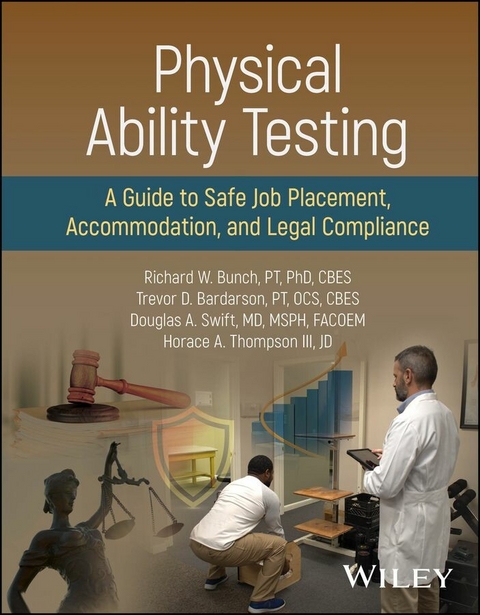
Physical Ability Testing (eBook)
1263 Seiten
Wiley (Verlag)
978-1-119-27230-4 (ISBN)
A guide to implementing legally compliant physical ability testing (PAT) programs that prevent injuries, optimize performance, and ensure reasonable accommodations
In Physical Ability Testing: A Guide to Safe Job Placement, Accommodation, and Legal Compliance, a team of distinguished medical professionals delivers an expert discussion of the fundamentals of creating a PAT program. Explaining the perspectives of the employer, the authors detail the systematic steps in developing and administering legally valid, job-specific PATs and providing proper interactive accommodation reviews for new hires and incumbent employees.
The book covers testing policies and procedures that address methods to avoid discrimination and minimize disparate impact on protected classes such as individuals with disabilities, older adults, women (including those who are pregnant), and individuals affected by medical or behavioral health conditions such as substance use disorders or recent surgeries. It also provides critical information on defending test failure determinations based on the 'direct threat' and 'undue hardship' defenses.
Readers will find:
- A thorough introduction to the validation process best suited for a defensible PAT program
- Comprehensive explorations of PAT programs in a variety of industries
- Practical discussions of administering PATs, legal cases covering them, and published scientific literature related to work physiology
- Complete treatments of the validation processes used in ensuring PAT programs remain legally defensible
This book is perfect for human resource professionals, occupational physicians and nurses, physical therapists, occupational therapists, chiropractors, safety professionals, industrial hygienists, ergonomists, human factors specialists, and risk managers.
A guide to implementing legally compliant physical ability testing (PAT) programs that prevent injuries, optimize performance, and ensure reasonable accommodations In Physical Ability Testing: A Guide to Safe Job Placement, Accommodation, and Legal Compliance, a team of distinguished medical professionals delivers an expert discussion of the fundamentals of creating a PAT program. Explaining the perspectives of the employer, the authors detail the systematic steps in developing and administering legally valid, job-specific PATs and providing proper interactive accommodation reviews for new hires and incumbent employees. The book covers testing policies and procedures that address methods to avoid discrimination and minimize disparate impact on protected classes such as individuals with disabilities, older adults, women (including those who are pregnant), and individuals affected by medical or behavioral health conditions such as substance use disorders or recent surgeries. It also provides critical information on defending test failure determinations based on the direct threat and undue hardship defenses. Readers will find: A thorough introduction to the validation process best suited for a defensible PAT programComprehensive explorations of PAT programs in a variety of industriesPractical discussions of administering PATs, legal cases covering them, and published scientific literature related to work physiologyComplete treatments of the validation processes used in ensuring PAT programs remain legally defensible This book is perfect for human resource professionals, occupational physicians and nurses, physical therapists, occupational therapists, chiropractors, safety professionals, industrial hygienists, ergonomists, human factors specialists, and risk managers.
Chapter 1
Introduction to Physical Ability Testing
Chapter Contents
- 1.1 The Physical Ability Test
- 1.2 Impact of PATs on Safety
- 1.3 Qualifications to Perform a Physical Ability Test
- 1.4 Essential Job Functions – The Foundation of the PAT Program
- 1.5 Types of Physical Ability Tests
- 1.6 Contents of a Post-offer Physical Ability Test
- 1.7 The Basic Design of the PAT Protocol
- 1.8 The Predictive Value of a PAT – Relation to Direct Threat Defense
- 1.9 Benefits of Physical Ability Testing
- 1.10 PAT vs FCE
- 1.11 Validity of Effort During Functional Testing
1.1 The Physical Ability Test
As employers aim to minimize workplace injuries and adhere to legal and industry standards, well-crafted Physical Ability Tests (PATs) have become a valuable tool in hiring, return-to-work assessments, and workforce management. A well-designed PAT is a standardized, validated evaluation that helps employers assess a candidate’s physical fitness and their ability to perform tasks requiring strength, endurance, agility, balance, and coordination. The key benefit of PATs is ensuring that job applicants and employees can safely and effectively carry out their responsibilities, both with and without reasonable accommodations. This not only reduces the risk of injury but also boosts overall productivity. By using PATs, employers can confidently hire individuals who meet the physical demands of the job, fostering workplace safety and optimal performance. Over time, PATs have grown in popularity due to their effectiveness in decreasing job-related injuries, particularly work-related musculoskeletal disorders (WMSDs), while also improving job performance and employee retention [1, 2].
Although the term “Physical Ability Test,” abbreviated PAT, has been chosen for use in this book, legal requirements to avoid employment discrimination have molded the design of employment tests and terminologies associated with them have varied. Table 1.1 provides a summary of the most common names applied to employment tests that involve assessments of physical abilities.
Table 1.1 List of common terms used to describe employment functional testing.
Adapted from http://www.aota.org/about-occupational-therapy/professionals/wi/capacity-eval.aspx#sthash.MT9W4fb3.dpuf.
| Physical Ability Test (Assessment) Physical Agility Test (Assessment) Preemployment Test (Assessment) Preemployment Ability Test (Assessment) Preemployment Agility Test (Assessment) Preemployment Functional Test (Assessment) Post-offer Employment Test (Assessment) Post-offer, Pre-placement Test (Assessment) Conditional New Hire Test (Assessment) Return to Work Test (Assessment) Fitness for Duty Test (Assessment) Functional Capacity Evaluation or Assessment Physical Capacity Evaluation or Assessment Work Capacity Evaluation or Assessment Work Tolerance Test (Assessment) |
Properly conducted PATs administered on a post-offer basis include health history questionnaires, physical examinations, baseline functional tests, and job-specific functional tests that are conducted in a safe, valid, and reliable manner. When designed correctly, the PAT can be a very effective type of employment test in compliance with federal regulations which prohibit the use of discriminatory employment tests and selection procedures.
The Equal Employment Opportunity Commission (EEOC), established by section 705 of the Civil Rights Act of 1964 (42 U.S.C. 2000e–4), enforces legal compliance to ensure employment tests, such as PATs, align with antidiscrimination laws. The EEOC provides helpful technical assistance documents such as Employment Tests and Selection Procedures [3] and Job Applicants and the ADA [4]. The technical assistance document Employment Tests and Selection Procedures provides a framework for employers to ensure their hiring practices and employment tests comply with federal laws related to discrimination. These guidelines aim to promote fairness, eliminate bias, and prevent discrimination in employment testing and selection processes. (A copy of Employment Tests and Selection Procedures is provided in Appendix 1.) The technical assistance document Job Applicants and the ADA provides guidance to individuals on how the Americans with Disabilities Act (ADA) protects job applicants with disabilities from discrimination. (A copy of Job Applicants and the ADA is provided in Appendix 2.)
The EEOC oversees that employers conduct physical ability tests fairly and avoid discrimination against applicants or employees based on their physical conditions or disabilities, unless there is a direct threat to workplace safety. Additionally, the Occupational Safety and Health Administration (OSHA) [5] regulates workplace safety standards, which can include guidelines for PATs to ensure employees’ physical capacity to safely perform essential job functions.
When designing a PAT program, employers must understand the following issues that are targeted by the enforcement agency, EEOC, whenever there is a challenge to an employee testing process:
- Disparate Impact and Test Validation
- Disparate Impact: The EEOC focuses on disparate impact, which occurs when a test negatively affects certain groups disproportionately, even without intentional discrimination. For instance, a PAT could unintentionally disadvantage women or older workers if it is not properly validated or aligned with the actual job requirements.
- Test Validation: If a PAT shows a disparate impact on a protected group, the employer must prove the test is job-related and necessary for business operations. This is typically done through validation, which involves demonstrating through studies that the test accurately predicts job performance and is directly tied to the essential tasks of the job.
- Job-relatedness and Business Necessity
- Job-relatedness: Employers must ensure that a PAT is directly related to the specific duties of the job. For example, a strength test may be relevant for physically demanding roles but not for others.
- Business Necessity: The EEOC allows the use of a PAT with disparate impact if it serves a legitimate business need. The employer must show that the test is necessary for safe and efficient job performance and that no alternative, less discriminatory method would provide valid results.
- Reasonable Accommodation for Disabilities
- It is illegal for a covered entity to fail to provide reasonable accommodation for a known physical or mental limitation of a qualified applicant or employee with a disability, unless the entity can demonstrate that the accommodation would impose an undue hardship on the operation of its business (i.e., cause significant difficulty or expense for the operation of its business). Therefore, if a candidate with a disability cannot meet a particular physical requirement, the employer must work with the applicant to find accommodations to work.
- Gender and Age Discrimination
- PATs should avoid discrimination based on sex, gender identity, or age. For example, a PAT that disproportionately excludes women or older workers may be challenged unless the test requirements are directly related to the job. Strength tests that demand higher performance than necessary for the role may be questioned if they unnecessarily exclude these groups.
- Considerations for PAT Adjustments
- Employers should evaluate the actual job requirements and ensure that the PAT measures the necessary abilities without excluding qualified individuals from protected groups.
- Employers are also encouraged to assess alternative functional tests within the PAT protocol to ensure fairness and equality [3, 4].
Since PATs are often referred to as a type of fitness for duty examination, it is important to understand what constitutes being fit for duty, or fit for work. This understanding can be initiated by referring to the U.S. federal agency, OSHA, which is part of the U.S. Department of Labor [5]. According to the OSHA, fit for duty is defined as: “a physical, mental, and emotional state which enables the employee to perform the essential tasks of his or her work assignment in a manner which does not threaten the safety or health of oneself, coworkers, property, or the public at large” [6]. In a systematic review of reports published in scientific journals from the United States and Western Europe on the criteria and methods used to assess fitness for work, the most cited definition of assessment of fitness for work reported, with slight variations, correlated with this OSHA definition [7].
It should be clarified that although the mental and emotional states of employees are important aspects of being fit for duty, a PAT is focused on assessing the physical abilities of a person to perform a job safely. Therefore, from this perspective, an employee is deemed physically fit for duty when they demonstrate the physical abilities to safely and effectively perform essential job functions, with or without a reasonable accommodation. As such, when considering all the KSAO requirements of work (i.e., Knowledge, Skills,...
| Erscheint lt. Verlag | 14.10.2025 |
|---|---|
| Sprache | englisch |
| Themenwelt | Naturwissenschaften ► Chemie |
| Schlagworte | ADA Compliance • Americans with Disabilities Act • pat program implementation • pat programs • physical abilities testing compliance • physical abilities testing program design • Physical abilities testing programs • reasonable accommodation |
| ISBN-10 | 1-119-27230-0 / 1119272300 |
| ISBN-13 | 978-1-119-27230-4 / 9781119272304 |
| Informationen gemäß Produktsicherheitsverordnung (GPSR) | |
| Haben Sie eine Frage zum Produkt? |
 EPUB (Adobe DRM)
Kopierschutz: Adobe-DRM
Adobe-DRM ist ein Kopierschutz, der das eBook vor Mißbrauch schützen soll. Dabei wird das eBook bereits beim Download auf Ihre persönliche Adobe-ID autorisiert. Lesen können Sie das eBook dann nur auf den Geräten, welche ebenfalls auf Ihre Adobe-ID registriert sind.
Details zum Adobe-DRM
Dateiformat: EPUB (Electronic Publication)
EPUB ist ein offener Standard für eBooks und eignet sich besonders zur Darstellung von Belletristik und Sachbüchern. Der Fließtext wird dynamisch an die Display- und Schriftgröße angepasst. Auch für mobile Lesegeräte ist EPUB daher gut geeignet.
Systemvoraussetzungen:
PC/Mac: Mit einem PC oder Mac können Sie dieses eBook lesen. Sie benötigen eine
eReader: Dieses eBook kann mit (fast) allen eBook-Readern gelesen werden. Mit dem amazon-Kindle ist es aber nicht kompatibel.
Smartphone/Tablet: Egal ob Apple oder Android, dieses eBook können Sie lesen. Sie benötigen eine
Geräteliste und zusätzliche Hinweise
Buying eBooks from abroad
For tax law reasons we can sell eBooks just within Germany and Switzerland. Regrettably we cannot fulfill eBook-orders from other countries.
aus dem Bereich