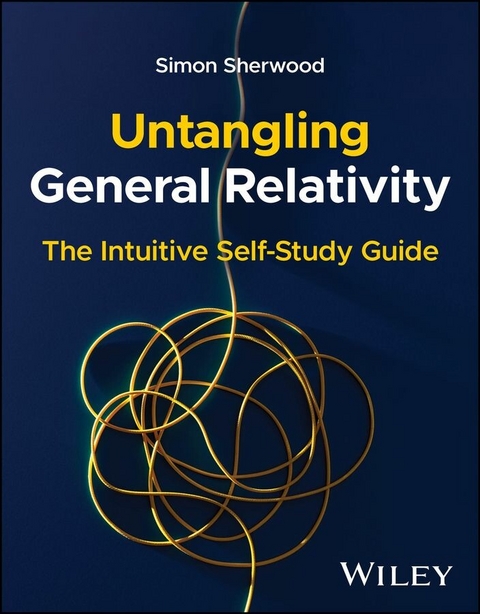
Untangling General Relativity (eBook)
790 Seiten
Wiley (Verlag)
978-1-394-35586-0 (ISBN)
An easy-to-read introduction to Einstein's theory of general relativity
In Untangling General Relativity, Simon Sherwood explains the details of general relativity with clarity, enthusiasm, and a sense of fun. Designed to be accessible to non-experts, the book combines intuitive explanations with the essential mathematics needed for a deep understanding of the subject. Sherwood introduces that maths gradually and clearly, in a step-by-step program designed to expand your appreciation and grasp of general relativity.
Untangling General Relativity serves as an effective springboard for more in-depth studies. It lays the groundwork for mastering the advanced topics covered in relativity textbooks and university physics courses.
Readers will find:
- A thorough introduction to general relativity, including the interpretation of gravity as curved spacetime and a full derivation of Einstein's field equations
- Comprehensive explanations of the spacetime metric, the equivalence principle, the geodesic equation, and the energy-momentum and curvature tensors
- Vacuum curvature: the Schwarzschild and Kerr metrics, black holes, white holes, event horizons, and gravitational waves
- Cosmology: the Friedmann equations, dark matter and energy, the Big Bang, inflation and an overview of current efforts to develop a quantum theory of gravity
Perfect for undergraduate students preparing to take a university-level physics course dealing with general relativity for the first time, Untangling General Relativity will also benefit students of the natural sciences and instructors and educators with a professional or academic interest in the subject.
Simon Sherwood is the author of Quantum Untangling (Wiley, 2023). Previously he was Chairman of Elegant Hotels PLC and the CEO of Orient-Express Hotels. He holds an MBA from Harvard Business School and is also a former strategy consultant with the Boston Consulting Group.
Chapter 1
Overview
Let me start with a warning. This overview is a brief summary of what is to come. If you follow even a fraction of it, well done. And, if you don’t, do not be concerned. You will have a much better grip on things when I step through them slowly. Think of this overview as a road map to check occasionally as you progress step by step towards a full understanding of the subject. Hopefully you will return and say: Ah yes... I get it now.
Einstein’s theory of general relativity is radically different to Newton’s (see Einstein’s apology in Box 1.1). It has often been summarised with a statement along the lines of matter tells space how to curve, space tells matter how to move. As we dig into the subject, you will learn that it is not just matter, but every source of energy and momentum (together called energy-momentum in this book) that creates the curvature, and it is not just space, but the combination of space and time (together called spacetime) that is curved. In spite of these inaccuracies, there is merit in using the simple description above as a starting point.
Box 1.1 Einstein’s apology to Newton
Newton, forgive me; you found the only way that, in your times, was just about possible for a man with the highest powers of thought and creativity. The concepts you created still guide us today in our thinking in physics, although we now know that they have to be replaced by others, more remote from the realm of immediate experience. Einstein in his autobiography
Einstein’s theory, which has copious evidence to back it, is that the presence of a source of energy-momentum distorts the surrounding spacetime, slowing clocks and altering lengths, relative to measurements made by an observer further from the source. For example, distant observers would see a clock near the source tick more slowly than their own. As a result, the straight-line paths, along which undisturbed objects might normally travel, are distorted and we observe the objects accelerate towards the source of energy-momentum. The energy-momentum distorts the spacetime (matter tells space how to curve) and the distorted spacetime changes the natural path of travel that objects follow (space tells matter how to move).
By the end of this book, I hope that readers will have a slightly more sophisticated view of the relationship between energy-momentum and the curvature of spacetime. Rather than thinking of energy-momentum causing a particular curvature of spacetime, I encourage you to think of energy-momentum and its related curvature of spacetime as being two sides of the same coin. Mess with the energy-momentum and the spacetime curvature changes. Mess with the spacetime curvature and the energy-momentum changes. Think less of the relationship as and more of it as . As you will see, this is what Einstein’s equations say.
1.1 Einstein Field Equations
Let’s jump straight to the punchline. Equation 1.1 shows the Einstein field equations.1 We will be discussing them a lot, so I will abbreviate them as the EFEs. If you understand what they mean and why they make sense, then you can stop reading and throw this book away. On the other hand, these equations will look weird and unfamiliar to any readers who are new to the subject.
The EFEs show the relationship between the way that spacetime is curved and the amount of energy and momentum in that spacetime . The two little symbols ( and ) in and indicate that they are components of tensors, which are sort of spiced-up vectors. The factor is just a constant, where is the speed of light and is the gravitational constant. It is the same that appears in Isaac Newton’s equation for the gravitational force of attraction between two objects of mass and at distance apart (as shown in Equation 1.2, which shows the inverse square relationship between the force and the separation ).
There is an important difference between tensors and vectors. I suspect (and hope) you know that a vector in space can be expressed in terms of three coordinates . For example, we might want to identify a particular point in space. We set an origin at and can express in terms of a vector that starts at the origin and ends at . If our point is a distance of 2 metres in the direction, 4 metres in the direction and 3 metres in the direction, we can label as . In flat space, the distance from the origin to is .
When you start dealing with curvature, you need a more complicated mathematical beast. You have to allow for the fact that the distance from the origin to may not always be . It may vary depending on where you are. Indeed, the directions may not even be orthogonal. By this, I mean that the , and axes may become bent and no longer be at right angles to each other. Suppose that the axis tilts slightly in the direction. A step away from the origin in the direction also involves moving away from the origin in the direction. This makes things more complicated. Simple vector notation of isn’t enough to fully describe the space or allow us to calculate how far is from the origin. We need a (3 × 3) matrix to determine distances. This has three components describing a step in the direction: to cover the basic movement along , plus two further components and to describe what the step in the direction means in terms of a change in and . Similarly, there are three components to describe a step in the direction and three for a step in the direction . This (3 × 3) matrix is an example of a tensor.
The in the EFEs is any component of the tensor , which is a (4 × 4) matrix. is the corresponding component from the tensor , which also is a (4 × 4) matrix (I will use square brackets when referring to the whole matrix to distinguish from its individual components). They are (4 × 4) matrices because they contain information about spacetime, so they include time as a fourth dimension. Another important tensor (with a small ) is called the metric that describes the actual curvature of spacetime itself, i.e. how a step along one axis (such as time ) relates to distance moved in each direction, potentially including movement in other directions (such as ). Equation 1.3 compares the structure of a spacetime vector with this sort of spacetime tensor. Each tensor contains 16 components compared with the 4 components of a spacetime vector.
We will be discussing tensors in detail later, so do not worry if they puzzle you. I just want you to understand that spacetime tensors have 16 components. This means that the EFEs as shown in Equation 1.1 are actually 16 equations, one for each component. For clarity, I have listed in Equation 1.4 three randomly chosen examples of these equations. Note that throughout this book I will use capitals for the indices of tensors simply because it is easier to read when written in the text. It turns out that 6 of the 16 equations are repeats because, in the case of the EFEs, components with reversed indices are equal e.g. , leaving only 10 independent equations.
Aarrgghh! This sounds awful. 16 related equations, 10 of which are independent. Do not panic, it is simpler than it sounds. For much of this book we will be studying the implications of the formula for spacetime, which is a vacuum (whether or not it is near to a source of energy-momentum). In this case , indicating that both sides of all 16 equations, including those in Equation 1.4, equal 0. An example might be the gravitational curvature of the spacetime in the vacuum surrounding a star or near a black hole.
I should add one technical point for clarity. The word tensor is also used for more complicated mathematical objects. For example, when discussing curvature, we will touch on the Riemann tensor, which for spacetime is a mammoth (4 × 4 × 4 × 4) monster. In this book, when I use the term tensor, I will always be referring to (4 × 4) tensors such as , and (see structure in Equation 1.3), unless I specify otherwise.
The major advantage of using tensors is that the resulting equations, such as the EFEs, work in all coordinate systems. For example, in addition to working with Cartesian coordinates , they work in spherical coordinates (don’t worry if you are unfamiliar with spherical coordinates, which will be explained in detail later). Some randomly chosen examples from the EFEs in spherical coordinates are shown in Equation 1.5.
1.2 Gravity as Curved Spacetime
For a moment, I want to step back from the abyss of complicated equations and talk about Einstein’s insight. In his theory of special relativity, he showed that time is different for an object when it is observed moving. The clock of a moving object ticks more slowly than that of a stationary object (time dilation). The spatial dimension also changes, contracting in the direction of motion (length contraction). The result is that time and space are no longer independent entities and combine into what is called Minkowski spacetime. We will look at the maths behind this in Chapter 2. For now, please just accept it as a proven truth.
The theory of special relativity doesn’t address the presence of mass or gravitational acceleration, but Einstein would have wondered about the time dilation for an object...
| Erscheint lt. Verlag | 10.10.2025 |
|---|---|
| Sprache | englisch |
| Themenwelt | Naturwissenschaften ► Physik / Astronomie ► Astronomie / Astrophysik |
| Schlagworte | Black Holes • easy general relativity book • general relativity basics • general relativity book • general relativity explainer • general relativity introduction • general relativity textbook • general relativity theory • simple general relativity book |
| ISBN-10 | 1-394-35586-6 / 1394355866 |
| ISBN-13 | 978-1-394-35586-0 / 9781394355860 |
| Informationen gemäß Produktsicherheitsverordnung (GPSR) | |
| Haben Sie eine Frage zum Produkt? |
 EPUB (Adobe DRM)
Kopierschutz: Adobe-DRM
Adobe-DRM ist ein Kopierschutz, der das eBook vor Mißbrauch schützen soll. Dabei wird das eBook bereits beim Download auf Ihre persönliche Adobe-ID autorisiert. Lesen können Sie das eBook dann nur auf den Geräten, welche ebenfalls auf Ihre Adobe-ID registriert sind.
Details zum Adobe-DRM
Dateiformat: EPUB (Electronic Publication)
EPUB ist ein offener Standard für eBooks und eignet sich besonders zur Darstellung von Belletristik und Sachbüchern. Der Fließtext wird dynamisch an die Display- und Schriftgröße angepasst. Auch für mobile Lesegeräte ist EPUB daher gut geeignet.
Systemvoraussetzungen:
PC/Mac: Mit einem PC oder Mac können Sie dieses eBook lesen. Sie benötigen eine
eReader: Dieses eBook kann mit (fast) allen eBook-Readern gelesen werden. Mit dem amazon-Kindle ist es aber nicht kompatibel.
Smartphone/Tablet: Egal ob Apple oder Android, dieses eBook können Sie lesen. Sie benötigen eine
Geräteliste und zusätzliche Hinweise
Buying eBooks from abroad
For tax law reasons we can sell eBooks just within Germany and Switzerland. Regrettably we cannot fulfill eBook-orders from other countries.
aus dem Bereich