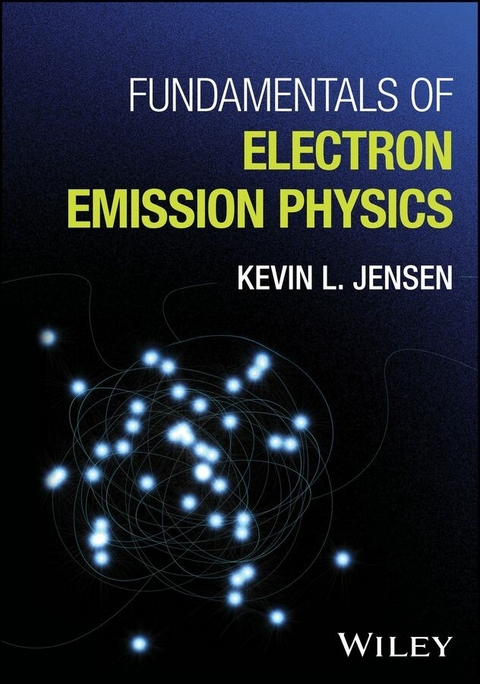
An authoritative and accurate guide to the physics of research- and technology-relevant phenomena of electron emission
In Fundamentals of Electron Emission Physics, distinguished research physicist, Dr. Kevin Jensen, delivers a practice-oriented introduction to the physics of electron emission. The book uses a physical intuition approach based on many years of research instead of heavy-handed mathematical formalism.
The author explores and explains the fundamentals of electron emission and the basis for successful performance and interpretation of experiments conducted at lab- and large-scale electron sources. He addresses the most common stumbling blocks that students and researchers who are new to the field often run into when confronted with the intricacies of the physics of electron emission.
- Thorough introductions to semiconductors, canonical emission models, and modern physics methods
- Comprehensive explorations of tunneling and transmission, the thermal-field-photoemission model, three-step models of photo- and secondary emission, and space charge
- Practical discussions of mathematical methods and specialized functions (e.g., Gamma function, Riemann Zeta function, orthogonal polynomials)
- A mathematical appendix, as well as sample problems and solutions to help explain the topics discussed in the book
Perfect for advanced undergraduate and doctoral students in solid state physics, materials science, electron transport, and beam physics, Fundamentals of Electron Emission Physics will also benefit users and developers of electron sources and practicing academics and researchers.
Kevin L. Jensen, PhD, was a research physicist in the Materials and Systems Branch, Materials Science and Technology Division at the Naval Research Laboratory in the United States until his retirement in 2023, and is now a Research Physicist at the Institute for Research in Electronics and Applied Physics at the University of Maryland. He is a Fellow of the American Physical Society, which recognized him for his contributions to the theory and modelling of electron emission sources or particle accelerators and microwave tubes, and a recipient of the Sigma Xi Applied Science Award for his work on electron emission.
An authoritative and accurate guide to the physics of research- and technology-relevant phenomena of electron emission In Fundamentals of Electron Emission Physics, distinguished research physicist, Dr. Kevin Jensen, delivers a practice-oriented introduction to the physics of electron emission. The book uses a physical intuition approach based on many years of research instead of heavy-handed mathematical formalism. The author explores and explains the fundamentals of electron emission and the basis for successful performance and interpretation of experiments conducted at lab- and large-scale electron sources. He addresses the most common stumbling blocks that students and researchers who are new to the field often run into when confronted with the intricacies of the physics of electron emission. Thorough introductions to semiconductors, canonical emission models, and modern physics methodsComprehensive explorations of tunneling and transmission, the thermal-field-photoemission model, three-step models of photo- and secondary emission, and space chargePractical discussions of mathematical methods and specialized functions (e.g., Gamma function, Riemann Zeta function, orthogonal polynomials)A mathematical appendix, as well as sample problems and solutions to help explain the topics discussed in the book Perfect for advanced undergraduate and doctoral students in solid state physics, materials science, electron transport, and beam physics, Fundamentals of Electron Emission Physics will also benefit users and developers of electron sources and practicing academics and researchers.
Chapter 1
Historical Background
For ‘tis your thoughts that now must deck our kings,
Carry them here and there, jumping o’er times,
Turning th’ accomplishment of many years
Into an hour-glass; for the which supply,
Admit me Chorus to this history ...
W. Shakespeare, Henry V I.Pro
As the Renaissance came to a close, previously heretical notions gained support in what came to be known as the Scientific Revolution. The organization of the heavens, in which Earth was no longer the center of the Universe (the Copernican model), championed by Galileo Galilei (Italian) is perhaps the better-known instance, but the atomic hypothesis beautifully articulated by the Roman poet Lucretius and strenuously advocated by Giordano Bruno (Italian) and supported by Galileo and others like Thomas Harriot (English) and Johannes Kepler (German), was comparable in importance but perhaps not as widely appreciated by modern audiences who lean towards big spectacle. Shortly before Shakespeare wrote Hamlet, Bruno was burnt at the stake in 1600 by the Inquisition, and a little more than 20 years after Shakespeare wrote The Tempest, Galileo was under house arrest in 1633, having been threatened with torture by the Inquisition if he did not recant.
The atomic hypothesis was too explanatory to suppress for long. Even the brilliant Descartes (French), who was not an atomist because he opposed the idea of vacuum and thought particles could be divided into smaller particles, incorporated ideas of atomism into his influential mechanistic philosophy. John Dalton (English) was able to explain chemical reactions by the union of molecules, and by 1890, Amedeo Avogadro (Italian) wrote about his intuition that two equal volumes of different gases kept at the same temperature and pressure would nevertheless contain the same number of molecules. By 1839, Michael Faraday (English) would write “On the Absolute Quantity of Electricity Associated with the Particles or Atoms of Matter” in Experimental Researches in Electricity, introducing the idea that charge, like particles of matter, came in units in equal proportion to the number of electrolytes. In his treatise on electricity and magnetism, James C. Maxwell (Scottish) remarked that the idea of a “molecule of electricity” was “gross... and out of harmony” with his treatise, and predicted that when an understanding of electrolysis materialized, it would not include the notion of “molecular charges.” Nevertheless, by 1874, George Johnstone Stoney (Irish) made a crude estimate of the basic unit of charge, which he termed “e” (but which herein shall be q) and christened it as “electron” in 1891.
In between the estimate of q and the naming of the electron, Edwin J. Houston (American) presented in October 1884 at the first American Institute of Electrical Engineers meeting in Philadelphia an inexplicable high vacuum phenomena observed by the inventor Thomas A. Edison (American). Edison had taken his incandescent lamp, in which a carbon fiber was enclosed in a glass vessel, the ends of which were connected to a battery, and inserted a strip of platinum connected to a galvanometer. Under ordinary operation, light was produced with no unusual effects, but as the current levels rose so that the luminosity of the lamp increased markedly (a factor of 3 to 12), the needle of the galvanometer was strongly deflected by current passing through its coils. For the physical theories of the time, and as Houston reported to the audience, the origin of the current was a mystery. Even more mysterious, when the leads were switched so that the galvanometer was connected to the negative terminal, then the current flowed in the opposite direction, but at about 1/40 of the level. Houston was baffled and told his audience
The question is, what is the origin of this current? How is it produced? Since we have within the globe a nearly perfect vacuum, we cannot conceive the current as flowing across vacuous space, as this is not in accordance with our pre-conceived ideas connected with higher vacua... I have no theory to propound as to the origin of these phenomena.
E. J. Houston [132]
The phenomena became known as the “Edison Effect” and the current as “Cathode Rays.” Up until 1890s, very different conceptions about their nature were debated. One explanation, identified with the German physicists, was that cathode rays were a process occurring in the aether because their motion in magnetic fields was in circular paths rather than straight lines. A competing explanation argued that the cathode rays were material and were the paths of particles of negative charge. In 1895, Jean Baptiste Perrin (French) demonstrated the particle nature of the cathode rays, and then in 1897, Joseph J. Thomson (English) settled the matter definitively by showing the deflection of the rays passing between a capacitor plate [340], proving that all of the particles had the same charge-to-mass ratio that was independent of the potential between the electrodes, and indifferent to either the residual gases within the tube or the chemical nature of the materials from which the rays were produced.
Physicists rapidly overcame their skepticism about the existence of elementary particles of negative charge [70]. The quantum theory pioneered by Erwin Schrödinger (Austrian), Werner Heisenberg (German), and brought to the United States by J. Robert Oppenheimer (American), was used by Niels H. D. Bohr (Danish) to explain the spectral lines of hydrogen and Arnold Sommerfeld (German) to put forth a model of metals. By the 1930s, through the efforts of Owen W. Richardson (English), Laue (German), and Dushman (Russian/American) the canonical equation for thermionic emission was developed bearing their names; Ralph H. Fowler (English) and Lothar W. Nordheim (German/American) did the same for field emission, and Fowler and DuBridge (American) for photoemission.
The development of vacuum electron tubes and radio communications was a watershed technology reliant on electron emission [98], but given that they were superseded by transistors in the 1960’s, and cathode ray tubes (CRT’s) by flat panel displays by 2007, focusing on a different technology here is more useful. The realization of how to manipulate electron beams inaugurated an era of relentless technological innovation, the most important of which may very well have been radar, a technology that has not ceded its empire to solid-state, especially for high-power devices. Given its importance in directing the outcome of the Second World War, radar deserves far more attention than what is often accorded to it.
There were many factors that allowed the Allies to defeat the Axis forces in World War II, but the introduction of radar was one of the most important. There is no way to know whether the Allies would have lost the war if they did not have radar, but it is quite clear that there would have been more losses and a longer time needed to win the war if there were no radar.
M. Skolnik [316] / IEEE
Atomic weapons, credited in the popular imagination as having outsized importance in WWII, were not a part of bringing the war in Europe to a close in 1944. Both Truman and his advisors understood that the ending of the war with Japan in 1945 had options other than the atomic bomb [351].
Other applications of electron sources rapidly materialized. Microwave ovens are perhaps the most obvious vacuum device, using a magnetron familiar from early radar devices. The most familiar devices to older generations are CRTs, which were the basis of all televisions, computer monitor displays, and oscilloscopes for decades. The heart of the CRT was a thermionic cathode that generated a beam of electrons that were accelerated towards a phosphor screen such that the beam scanned back and forth (“raster”). Before being overtaken by LCD and plasma displays, flat-panel field emission displays (FEDs) were developed in the 1990s by using small clusters of microfabricated field emitters to individually address pixel elements [330, 339].
Field emission microscopy [72], flash X-ray sources [247], and microwave devices using metallic wires [41] received intense investigation beginning in the late 1950s as a possible alternate to thermionic cathodes (the ability of field emission to be strongly modulated being the driver). Microwave amplifiers and high-power microwave (HPM) devices had strong military applications [110, 309]. Although solid-state electronics are justifiably venerated with solid-state devices dominating the lower-power, lower-frequency regimes, it is still the case that high average power and frequency need the “tubes” [29]. Vacuum electronics [99, 112, 274], and after the 1980s vacuum microelectronics [379] and vacuum nanoelectronics [77] led to much cathode development for microwave amplifiers and “tubes” [107] like klystrons, TWTs, magnetrons, crossed field amplifiers, gyrotrons, particle accelerators, rf injectors [229], free electron lasers (FELs) [30, 275], energy recovery linacsI (ERLs) [266, 287, 313], and X-ray FELs [344] use various cathode technologies.
Particular military and commercial interests in addition to radar include communications, electronic countermeasures, directed energy, long-range surveillance, long-range weather detection, airborne weather,...
| Erscheint lt. Verlag | 9.10.2025 |
|---|---|
| Sprache | englisch |
| Themenwelt | Naturwissenschaften ► Physik / Astronomie ► Atom- / Kern- / Molekularphysik |
| Schlagworte | electron emission applications • electron emission book • electron emission examples • electron emission mathematics • electron emission methods • electron emission physics • electron emission problems • electron emission solutions |
| ISBN-10 | 1-394-19961-9 / 1394199619 |
| ISBN-13 | 978-1-394-19961-7 / 9781394199617 |
| Informationen gemäß Produktsicherheitsverordnung (GPSR) | |
| Haben Sie eine Frage zum Produkt? |
 EPUB (Adobe DRM)
Kopierschutz: Adobe-DRM
Adobe-DRM ist ein Kopierschutz, der das eBook vor Mißbrauch schützen soll. Dabei wird das eBook bereits beim Download auf Ihre persönliche Adobe-ID autorisiert. Lesen können Sie das eBook dann nur auf den Geräten, welche ebenfalls auf Ihre Adobe-ID registriert sind.
Details zum Adobe-DRM
Dateiformat: EPUB (Electronic Publication)
EPUB ist ein offener Standard für eBooks und eignet sich besonders zur Darstellung von Belletristik und Sachbüchern. Der Fließtext wird dynamisch an die Display- und Schriftgröße angepasst. Auch für mobile Lesegeräte ist EPUB daher gut geeignet.
Systemvoraussetzungen:
PC/Mac: Mit einem PC oder Mac können Sie dieses eBook lesen. Sie benötigen eine
eReader: Dieses eBook kann mit (fast) allen eBook-Readern gelesen werden. Mit dem amazon-Kindle ist es aber nicht kompatibel.
Smartphone/Tablet: Egal ob Apple oder Android, dieses eBook können Sie lesen. Sie benötigen eine
Geräteliste und zusätzliche Hinweise
Buying eBooks from abroad
For tax law reasons we can sell eBooks just within Germany and Switzerland. Regrettably we cannot fulfill eBook-orders from other countries.
aus dem Bereich