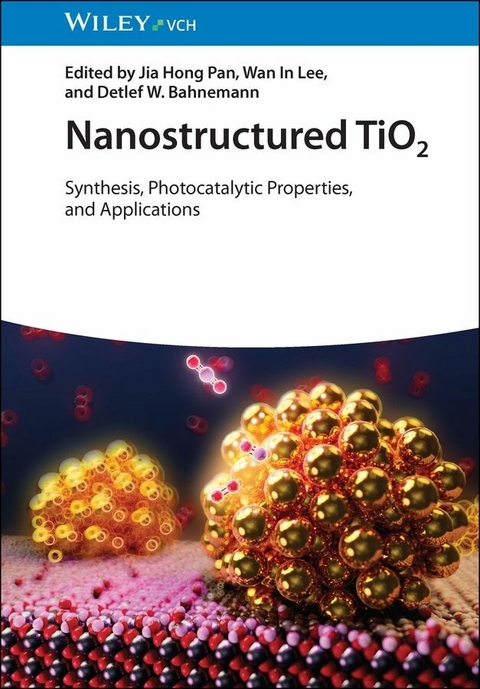
Nanostructured TiO2 (eBook)
544 Seiten
Wiley-VCH (Verlag)
978-3-527-84832-4 (ISBN)
Comprehensive reference on TiO2 materials, from fundamentals to widely used areas such as water purification and solar fuel generation
With in-depth analysis and coverage, Nanostructured TiO2 is an advanced reference on the subject, offering techniques, characterizations, and novel approaches to titanium dioxide (TiO2) nanostructures. The book incorporates cutting-edge research findings and innovations in the synthesis and utilization of TiO2 nanostructures.
From environmental remediation and renewable energy to biomedical applications and advanced materials science, this book provides insights into how these materials are transforming a wide range of industries. In addition to theory and research, the book provides practical insights including real-world case studies, experimental protocols, and problem-solving techniques.
Nanostructured TiO2 includes information on:
- Controllable synthesis of zero- to three-dimensional TiO2 nanostructures, immobilization of TiO2 on various substrates, and surface modification of TiO2
- Photocatalytic fixed-bed reactions for efficient photon utilization of TiO2 and carrier transport and recombination in sensitized nanostructured TiO2
- Type, characterization, and activity of TiO2-based heterojunction photocatalysts
- Application of TiO2 for the photocatalytic conversion of nitrogen oxides NO and NO2
- Recycling of heavy metal ions from wastewater by TiO2 photocatalysis
Nanostructured TiO2 is an essential up-to-date reference for inorganic chemists, catalytic chemists, materials scientists, photochemists, and professionals in the sensor industry seeking state-of-the-art knowledge on the subject.
Jia Hong Pan is a Full Professor in the School of Resources, Environment and Materials at Guangxi University, China.
Wan In Lee is an Emeritus Professor in the Department of Chemistry and Chemical Engineering at Inha University, Korea.
Detlef W. Bahnemann is Director of International Joint Center of Nature-Inspired Carbon Neutrality Solutions at Saint Petersburg State University, Russia; Distinguished Professor of Shaanxi University of Science and Technology, China; and Emeritus Professor of Leibniz University Hannover, Germany.
Introduction
Overview of Nanostructured TiO2: Synthesis, Properties, and Photocatalytic Applications
Jia Hong Pan,1,* Wan In Lee,2 Detlef W. Bahenmann,3,4
1State Key Laboratory of Featured Metal Materials and Life-Cycle Safety for Composite Structures, School of Resources, Environment and Materials, Guangxi University, Nanning, Guangxi, China
2Department of Chemistry and Chemical Engineering, Inha University, Incheon, Korea
3Institut für Technische Chemie, Gottfried Wilhelm Leibniz Universität Hannover, Hannover, Germany
4Laboratory “Photoactive Nanocomposite Materials”, Saint Petersburg State University, Peterhof, Saint Petersburg, Russia
* To whom all correspondence should be addressed.
E-mail: pan@ncepu.edu.cn (J. H. Pan)
1 TiO2 Photocatalysis
The Sun emits heat and radiant light to Earth, serving as the most abundant renewable energy resource. Natural photosynthesis is a well-known photochemical process that directly or indirectly powers living organisms in the biosphere by converting solar energy into storable chemical energy. Inspired by this process, heterogeneous photocatalysis mediated by semiconductors has gained significant attention for its potential in efficient solar-to-chemical energy conversion, attracting ongoing interest and research.
TiO2 is a highly stable inorganic material that is comparatively abundant in the Earth’s crust. Known as a versatile and eco-friendly material due to its inert and non-toxic properties, TiO2 is widely used in our daily lives or industries as an additive in pigments, paints, toothpastes, sun creams, abrasives, pharmaceutical products, and other applications. Since Honda and Fujishima reported photocatalytic water splitting using TiO2 electrodes in 1972 [1], TiO2 has been intensively and extensively investigated as a photocatalytic material in various oxidation and reduction reactions. Although various inorganic, organic, and organic–inorganic hybrid semiconductors have been reported, TiO2 remains the most extensively studied photocatalyst to date because of its exceptional physicochemical properties, including low cost, high quantum efficiency, chemical and photonic stability, favorable band positions, non-toxicity, biocompatibility, and versatility in (photo)catalysis, optoelectronics, sensors, photovoltaics, and biomedical applications.
Figure 1 illustrates the charge carrier generation, trapping, recombination, and interfacial charge transfer during the TiO2 photocatalysis [2–4]. The process starts with the absorption of photons that possess energy greater than its bandgap. TiO2 is thus photoexcited, inducing interband transitions and generating electrons (e−) at the conduction band (CB) and holes (h+) at the valence band (VB). A large portion of the photogenerated e−/h+ pairs is susceptible to recombination within the bulk or TiO2 surface, resulting in the energy release as light and heat. On the other hand, free charge carriers without recombination can migrate and be trapped at the TiO2 surface independently. Upon interfacial charge transfer, the trapped e− and h+ enable the reduction and oxidation processes, respectively. The underlying reaction can be written as follows [3].
Figure 1 Charge carrier transfer during TiO2 photocatalysis. Adapted from Ref. 2 with permission from Elsevier.
- Charge carrier generation: (1)
- Charge carrier trapping: (2a)(2b)(2c)
- Charge carrier recombination: (3a)(3b)(3c)(3d)(3e)
- Interfacial charge transfer with acceptor (A) or donor (D) molecules absorbed on the TiO2 surface: (4a)(4b)
Optimizing the textural properties of TiO2 is critical for enhancing its photochemical performance, prompting sustained research interest in the manipulation of TiO2 nanostructures. Advancements in nanotechnology, particularly in nanomaterial synthesis, have facilitated diverse strategies for tailoring the properties of nanostructured TiO2. Moreover, various photocatalytic applications of TiO2 have been developed through the manipulation of electrons (e−), holes (h+), and their associated radicals.
2 Crystal Phase of TiO2
TiO2 possesses four main crystal phases, i.e., anatase, rutile, brookite, and TiO2(B), as summarized in Table 1 [5]. Depending on the polymorph, size, and pH, the potential of holes generated from TiO2 is +1.0 to +3.5 V vs. NHE, while those of electrons are 0.5 to −1.5 V vs. NHE [3, 4]. Anatase and rutile have a tetragonal structure with band gaps of 3.2 and 3.0 eV, respectively, while brookite has an orthorhombic structure with a band gap of 2.96 eV. Rutile is the thermodynamically most stable phase, which is formed above 600 °C, while anatase is a kinetically favorable phase at lower temperatures, and brookite is a metastable phase that often forms at around 500 °C. Monoclinic TiO2(B) is generally obtained from the proton exchange of alkaline metal titanates to H2TiO3, following a heat treatment at 300–450 °C to induce a phase transformation to TiO2(B). Unlike the three other key natural polymorphic forms, artificial TiO2(B) exhibits perovskite-like layered structure.
Table 1 Crystal structures of four TiO2 polymorphs: anatase, rutile, brookite, and TiO2 (B). Red balls and grey balls are representatives of O and Ti atoms, respectively, and the bright-blue space-filling polyhedron units present octahedral unit constructs from a Ti4+ ion and six O2− ions. Adapted from Ref. 5 with permission from Elsevier.
| TiO2 phase | Anatase | Rutile | Brookite | TiO2(B) |
|---|
| Space group |
| Band gap | 3.2 eV | 3.0 eV | 3.0 eV | 3.4 eV |
| Crystal structure |
| Polyhedral structure |
In semiconductor photocatalysis, anatase is the most widely studied polymorph, showing superior photochemical performances owing to its high electron mobility, electron affinity, and transmittance for visible light. Rutile TiO2 exhibits relatively low photocatalytic activity. However, under visible light irradiation, rutile with a narrower bandgap might deliver better photocatalytic performances. When designing sunlight-active photocatalysts, the coexistence of anatase and rutile phases in nanostructured TiO2 can significantly enhance solar energy harvesting. This is the principle behind Aeroxide® P25 TiO2, which predominantly contains anatase with a smaller proportion of rutile. Brookite is the least studied as a photocatalyst, mainly due to challenges in controlling phase purity. TiO2(B) is only active in the UV region and exhibits photocatalytic activity comparable to that of anatase.
3 Synthesis of Nanostructured TiO2
A nanostructure refers to a material or object characterized by structural features at the nanoscale, typically with at least one dimension ranging from 1 to 100 nm. This nanoscale confinement imparts a high surface-to-volume ratio to the resulting nanomaterials, significantly enhancing their physicochemical properties and performance compared to bulk materials. Nanostructures can be categorized into four major types based on the degree of spatial confinement:
- Zero-dimensional (0D) nanostructures: All dimensions are on the nanometer scale (e.g., nanoparticles).
- One-dimensional (1D) nanostructures: One dimension is on the nanometer scale, while the other two are larger (e.g., nanorods, nanowires, and nanotubes).
- Two-dimensional (2D) nanostructures: Two dimensions are on the nanometer scale, with the third being larger (e.g., nanosheets and nanoplates).
- Three-dimensional (3D) nanostructures: Porous or hierarchical structures consisting of low-dimensional nanobuilding blocks (NBBs)
A variety of synthesis methods, including the sol-gel process, hydro/solvothermal techniques, and the combustion method, have been developed to enable the controllable fabrication of TiO2 nanomaterials in various forms of 0D nanoparticles (NPs), 1D nanorods, nanowires, and nanotubes, 2D nanosheets, and 3D superstructures, with variations in phases, dimensions, sizes, porosities, morphologies, and forms (e.g., powder, gel, film, and monolith). To the best of our knowledge, TiO2 has been the most frequently fabricated transition metal oxide over the past four decades, delivering an extremely rich gallery of TiO2 nanostructures.
Interestingly, in contrast to the abundance of TiO2 nanostructures, the precursors for synthesizing TiO2 nanostructures are quite limited, which include three key types:
- Metallic Ti
- Organic titanium alkoxide
- Inorganic precursors: TiCl4, TiF4, Ti(SO4)2, or commercial TiO2
Clearly, free Ti4+ ions seem to be absent in wet-chemical media where sol-gel process is frequently involved. Thus, deep understanding of the physicochemical properties of precursors and their chemical reactions is essential to the wet-chemical synthesis....
| Erscheint lt. Verlag | 9.10.2025 |
|---|---|
| Sprache | englisch |
| Themenwelt | Naturwissenschaften ► Chemie ► Anorganische Chemie |
| Schlagworte | immobilization TiO2 • photon utilization TiO2 • TiO2 approaches • tio2 carrier • TiO2 characterizations • TiO2 research • TiO2 substrates • TiO2 surface modification • TiO2 synthesis • TiO2 techniques • tio2 transport • TiO2 utilization |
| ISBN-10 | 3-527-84832-0 / 3527848320 |
| ISBN-13 | 978-3-527-84832-4 / 9783527848324 |
| Informationen gemäß Produktsicherheitsverordnung (GPSR) | |
| Haben Sie eine Frage zum Produkt? |
 EPUB (Adobe DRM)
Kopierschutz: Adobe-DRM
Adobe-DRM ist ein Kopierschutz, der das eBook vor Mißbrauch schützen soll. Dabei wird das eBook bereits beim Download auf Ihre persönliche Adobe-ID autorisiert. Lesen können Sie das eBook dann nur auf den Geräten, welche ebenfalls auf Ihre Adobe-ID registriert sind.
Details zum Adobe-DRM
Dateiformat: EPUB (Electronic Publication)
EPUB ist ein offener Standard für eBooks und eignet sich besonders zur Darstellung von Belletristik und Sachbüchern. Der Fließtext wird dynamisch an die Display- und Schriftgröße angepasst. Auch für mobile Lesegeräte ist EPUB daher gut geeignet.
Systemvoraussetzungen:
PC/Mac: Mit einem PC oder Mac können Sie dieses eBook lesen. Sie benötigen eine
eReader: Dieses eBook kann mit (fast) allen eBook-Readern gelesen werden. Mit dem amazon-Kindle ist es aber nicht kompatibel.
Smartphone/Tablet: Egal ob Apple oder Android, dieses eBook können Sie lesen. Sie benötigen eine
Geräteliste und zusätzliche Hinweise
Buying eBooks from abroad
For tax law reasons we can sell eBooks just within Germany and Switzerland. Regrettably we cannot fulfill eBook-orders from other countries.
aus dem Bereich