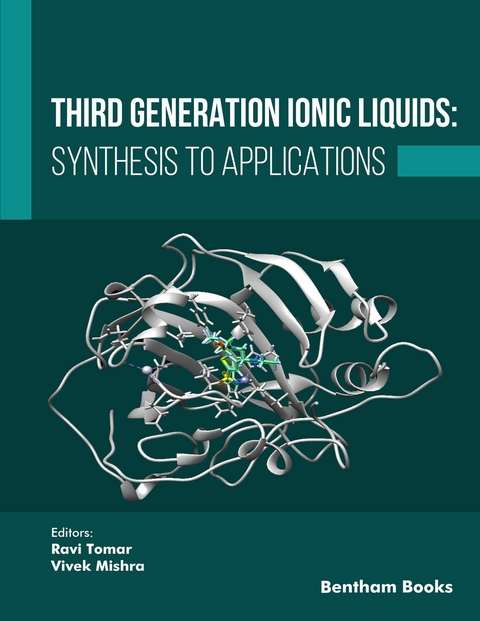
Third Generation Ionic Liquids: Synthesis to Applications (eBook)
245 Seiten
Bentham Science Publishers (Verlag)
979-8-89881-039-9 (ISBN)
Third Generation Ionic Liquids: Synthesis to Applications is an enquiry into the evolution, functional design, and multidisciplinary applications of next-generation ionic liquids. The book focuses on third generation ionic liquids, exploring themes such as novel synthesis routes, structure–property relationships, tunability, and integration into industrial and pharmaceutical systems. It spans major topic areas including supported ionic liquid phases (SILPs), catalysis, green solvents, electrochemical systems, and biomedical interfaces. By bridging fundamental chemistry with real-world applications, the volume supports innovation in green chemistry, energy systems, and advanced materials. Key features: Illustrates synthesis pathways and functionalization techniques Explains structure–property–performance correlations Demonstrates applications in catalysis, electrochemistry, and CO₂ capture Highlights environmental, toxicological, and regulatory aspects Includes expert contributions and interdisciplinary case studies
Ionic Liquids: History, Properties & Applications
Ahana Hazra1, Rideb Chakraborty1, Naureen Afrose1, Pratibha Bhowmick1, Mithun Bhowmick1, *
Abstract
Since the energy and chemical industries have been contributing to environmental pollution for a number of decades, society has come to expect scientists and engineers to try to create sustainable chemical processes that produce fewer harmful substances and more environmentally friendly energy sources. Ionic liquids are becoming more and more well-known in the research industry because of their unique properties and characteristics. Ionic liquids have been applied in both commercial and educational applications. Because of their special thermal, physical, chemical, and biological characteristics, they have the potential to be a clean, efficient, and environmentally friendly alternative source of volatile organic solvents, which could help solve some of the biggest problems society is currently facing. They also have many other important advantages. Furthermore, by changing the ratio of cations to anions, their qualities could change according to how they are used. Thus, a great deal of basic and applied study has focused on them due to their special qualities. Actually, compared to the standard way, ionic liquids are more exciting and effective. As a result, their uses in organic synthesis have expanded greatly because of their increased diversity and adaptability. We have concentrated on the background, properties, and uses of ionic liquids in this book chapter, particularly in the context of organic synthesis. The physicochemical qualities that are important for their usage in industrial applications are therefore measured in a number of ways and reviewed.
* Corresponding author Mithun Bhowmick: Bengal College of Pharmaceutical Sciences and Research, Basu Sarani, Bidhannagar, Durgapur 713212, West Bengal, India; Tel: +91-9754931377; E-mail: drmithunbhowmick@gmail.com
INTRODUCTION
Sustainable practices are essential now more than ever since environmental concerns from the chemical and traditional energy sectors are intensifying. An increasing number of scientists and engineers are looking for creative ways to reduce pollution and provide ecologically acceptable energy sources. Because of their remarkable qualities and wide range of uses, ionic liquids have been a focus
of study and development among these solutions. Ionic liquids have attracted a lot of interest from the academic and industrial communities because of their distinctive thermal, physical, chemical, and biological properties. Their ability to replace volatile organic solvents in a more effective, efficient, and ecologically responsible manner holds hope for resolving modern social issues. Ionic liquids' characteristics may be customized to meet the needs of various applications by varying the proportion of cations and anions, which has led to a great deal of research and use in a variety of disciplines [1]. Organic synthesis has been transformed by the development of ionic liquids, which provide a more dynamic and efficient way than traditional techniques. Their range of uses has expanded due to their increasing diversity and flexibility; this is especially true in organic synthesis, where their versatility is most evident. This chapter explores the background, inherent characteristics, and many uses of ionic liquids, with an emphasis on their use in organic synthesis. Ionic liquids play a key role in promoting sustainable chemical processes, as demonstrated by the careful examination and evaluation of their physicochemical properties that are essential for industrial use. This chapter attempts to clarify the revolutionary potential of ionic liquids in promoting sustainable chemical practices and innovation in the field of organic synthesis by utilizing a thorough examination of their history, characteristics, and uses [2]. A broad variety of features, such as variable solvation properties, great thermal stability, minimal vapor pressure, and large liquidus range, define ionic liquids. Their distinct molecular structure, which consists of inorganic or organic anions and organic cations, gives them these characteristics. They are perfect candidates for many applications because they lack a definite crystal structure, which allows them to stay in the liquid form at or close to ambient temperature.
Ionic liquids have been the subject of a recent study that has centered on examining their unique characteristics and identifying potential uses. The creation of task-specific ionic liquids for certain purposes is one subject of great interest. Through meticulous selection of component ions and structural modifications, scientists have developed ionic liquids with improved characteristics including conductivity, solubility, and catalytic activity. In addition, developments in computer modelling and simulation methods have yielded important new understandings of molecular interactions in ionic liquids. Ion transport and solvation dynamics have been clarified by molecular dynamics simulations, which have also provided insight into the behaviour of ions at the liquid interface [3]. The logical design of ionic liquids with enhanced performance in a variety of applications, such as energy storage, catalysis, and separation processes, has been made easier by these ideas.
Definition of Ionic Liquid
Liquids that are virtually entirely made up of ions are known as ionic liquids. Ionic conductivity is so displayed by them. With high melting points, these liquids are also included in the definition of molten salts or fused salts. For the last twenty years or so, the phrase “Ionic liquids” has mostly been used to refer to liquids that meet the preceding definition and have melting points or glass-transition temperatures below 100 °C. An ionic liquid is an organic molten salt consisting of a large cation and a charge-delocalized anion. Because the noncovalent interaction lies between the cation and the anion of an ionic liquid, an ionic liquid usually has a low melting point (below 100 °C) and is usually in a liquid state.
Ionic liquids are defined as those that contain essentially solely cations and anions and very few molecular species, such as ethyl ammonium nitrate.
Ionic liquids, like the halo aluminate systems, are binary mixes that are liquid and made completely of ions. “Room-temperature ionic liquids” is a term frequently used to describe tonic liquids that are liquid at or near room temperature.
Classification of Ionic Liquid
Ionic substances with a melting point below 100 °C are referred to as ionic liquids, or ILs. Their chemical and physical characteristics make them appealing for a range of uses. Even as early as the middle of the 19th Century, a number of organic substances that are today categorized as ionic liquids were described. Three generations of ILs have been gradually developed and applied as a result of the hunt for novel and distinctive ILs.
First-Generation Ionic Liquids
The first generation concentrated primarily on their distinct inherent chemical and physical characteristics, including strong chemical and thermal stability, dissolved state, conductivity, thickness, and stickiness. The first generation was water and air delicate, and it mostly consisted of dialkyl imidazolium and alkylpyridinium cations coupled with metal halide anions (Fig. 1). These ILs drew interest primarily because of their physical characteristics. These ILs have the potential to replace volatile organic solvents/agents that are harmful to the natural world. The majority of first-generation ILs, including [C4MIM][BF4] and [C4MIM][PF6] are poorly degradable and harmful to aquatic ecosystems. Their setup is extremely costly because of the inclusion of the indirect high E factor. Some typical anions, such as [BF4] and [PF6], are unstable because they are hydrolyzed when exposed to water from hazardous volatiles like HF and phosphate oxyfluoride [1]. Other poorly coordinated ions, such as TFA, TFSA, triflate, and methylsulfate, were additionally linked to first-generation ILs; for example- cations of the first generation of ILs are characterized by large volumes, such as 1,3-dialkyl- imidazolium or 1-alkylpyridinium, and anions based mostly on halogen aluminate (Al+3).
Fig. (1))The first generation of ionic liquids with physical, chemical, and biological properties.
Second-Generation Ionic Liquids
The second generation is stable in...
| Erscheint lt. Verlag | 23.9.2025 |
|---|---|
| Sprache | englisch |
| Themenwelt | Naturwissenschaften ► Chemie |
| ISBN-13 | 979-8-89881-039-9 / 9798898810399 |
| Informationen gemäß Produktsicherheitsverordnung (GPSR) | |
| Haben Sie eine Frage zum Produkt? |
 EPUB (Ohne DRM)
Digital Rights Management: ohne DRM
Dieses eBook enthält kein DRM oder Kopierschutz. Eine Weitergabe an Dritte ist jedoch rechtlich nicht zulässig, weil Sie beim Kauf nur die Rechte an der persönlichen Nutzung erwerben.
Dateiformat: EPUB (Electronic Publication)
EPUB ist ein offener Standard für eBooks und eignet sich besonders zur Darstellung von Belletristik und Sachbüchern. Der Fließtext wird dynamisch an die Display- und Schriftgröße angepasst. Auch für mobile Lesegeräte ist EPUB daher gut geeignet.
Systemvoraussetzungen:
PC/Mac: Mit einem PC oder Mac können Sie dieses eBook lesen. Sie benötigen dafür die kostenlose Software Adobe Digital Editions.
eReader: Dieses eBook kann mit (fast) allen eBook-Readern gelesen werden. Mit dem amazon-Kindle ist es aber nicht kompatibel.
Smartphone/Tablet: Egal ob Apple oder Android, dieses eBook können Sie lesen. Sie benötigen dafür eine kostenlose App.
Geräteliste und zusätzliche Hinweise
Buying eBooks from abroad
For tax law reasons we can sell eBooks just within Germany and Switzerland. Regrettably we cannot fulfill eBook-orders from other countries.
aus dem Bereich