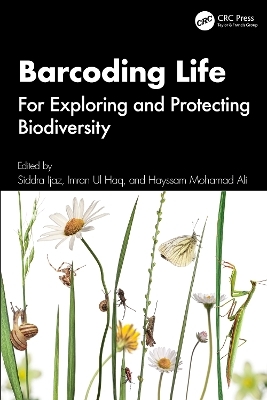
Barcoding Life
CRC Press (Verlag)
978-1-032-88744-9 (ISBN)
- Noch nicht erschienen (ca. April 2026)
- Versandkostenfrei
- Auch auf Rechnung
- Artikel merken
DNA barcoding is revolutionizing the way we identify, catalog, and analyze life on Earth. This method enhances our understanding of species diversity in ecosystems and genetic variation within species, accelerating discoveries and our knowledge of Earth’s complex web of life. By providing essential genetic insights, DNA barcoding serves as a key tool for species conservation and management.
Barcoding Life: For Exploring and Protecting Biodiversity gives a detailed exploration of DNA barcoding across all domains of life. Researchers will find that DNA barcoding facilitates rapid species identification, streamlining biodiversity studies and accelerating the discovery of new species. Taxonomists will gain valuable insights into species relationships, enabling more accurate classifications and targeted investigations. Policymakers will learn how DNA barcoding informs conservation priorities, guiding effective strategies and optimizing resource allocation.
With its unique focus on preserving biodiversity at sufficient resolution, this book provides insights and practical applications of DNA barcoding for stakeholders dedicated to safeguarding the natural world. Whether you are a scientist, conservationist, or decision-maker, this book is your essential guide to harnessing the power of DNA barcoding for a sustainable future.
Prof. Dr. Siddra Ijaz is currently serving as a professor at the Centre of Agricultural Biochemistry and Biotechnology (CABB), University of Agriculture, Faisalabad, Pakistan. She is the medalist in her postgraduate studies. She has made significant research contributions, publishing more than 80 papers with an impact factor above 110, 12 books, and over 55 book chapters on well-recognized and well-renowned publishing platforms, including Springer Nature and Taylor and Francis Group. She has served as the managing editor of the international impact factor journal Pakistan Journal of Agricultural Sciences. She has supervised and co-supervised 11 PhD students and over 100 MPhil students. She had been a member of the National Curriculum Revision Committee from 2013 to 2014. She is the head of the ‘Molecular Biology of Plant Disease Resistance Laboratory’ at CABB, UAF, and the curator of the Fungal Molecular Biology Laboratory Culture Collection (FMB-CC-UAF), an affiliated member of the World Federation for Culture Collections (WFCC). She has expertise in molecular biology, and her research focuses on unlocking the genetics involved in plant disease resistance through R gene identification and functional characterization for the exploration of resistance pathways and plant disease management. She has made colossal contributions to fungal taxonomy by reporting novel species of fungal pathogens in plants. She is working with a strong belief in the philosophy that disease resistance gene identification and the exploration of resistance pathways in plants are critical components of ensuring food security, as they play a significant role in mitigating crop losses caused by diseases. She has been awarded more than Rs. 50 million in research grants from different national and international funding agencies. Prof. Dr. Imran Ul Haq is a professor in the Department of Plant Pathology, University of Agriculture, Faisalabad, Pakistan. He has supervised more than 40 graduate students and established the Fungal Molecular Biology Laboratory Culture Collection (FMB-CC-UAF); he is an affiliated member of the World Federation for Culture Collections (WFCC). He has published more than 60 articles, 11 books, four laboratory manuals, and several book chapters. He has made significant contributions to fungal taxonomy by reporting novel species of fungal pathogens in plants. His research interests are fungal molecular taxonomy and nanotechnology integration with other control strategies for sustainable plant disease management. Dr. Hayssam Mohamed Ali is working at the Botany and Microbiology Department, College of Science, King Saud University. Dr. Hayssam M. Ali has a ‘WORLD RANKING OF TOP 2% SCIENTISTS’ according to the Stanford Scientists’ Ranking released by Stanford University in 2021, 2022, 2023, 2024, and 2025. He has more than 350 published papers, 20 published books, and he has reviewed more than 1,700 papers in highly impacted journals. He is interested in studying plant physiology, biotic and abiotic stresses, sustainability, environmental stresses, plant biotechnology, crop improvement, plant breeding, forestry, and plant biology.
About the Editors
List of Contributors
Chapter 1 Use of DNA Barcoding for Protecting and Exploring Plant
Biodiversity and Socioeconomic Impact
Siddra Ijaz, Muhammad Asif Saddique, Zakia Habib, and Hayssam Mohamed Ali
Chapter 2 Fungal DNA Barcoding for Species Identification
Barbaros Cetinel, Ceren Cer, Aqsa Saleem, Imran Ul Haq, and Siddra Ijaz
Chapter 3 DNA Barcoding in Insects: Taxonomy and Biodiversity
Muhammad Umair Sial, Rashad Rasool Khan, Jam Nazeer Ahmad, Zain ul Abdin, Muhammad Arshad, and Muhammad Naveed Anwar
Chapter 4 DNA Barcoding of Viruses
Tuaseef Tariq, Nabeeha Aslam Khan, Imran Ul Haq, Saira Azmat, Muhammad Waris, Ahmad Nisar, and Hayssam Mohamed Ali
Chapter 5 Mapping Bacterial Biodiversity Using DNA Barcoding
Amjad Abbas, Muhammad Usman, Muhammad Huzaifa Tanveer, Aysha Khalid, Muhammad Ehetisham-Ul-Haq, Amer Habib, Muhammad Zulkiffal, and Muhammad Amjad Ali
Chapter 6 DNA Barcoding and Marine Biodiversity
Muhammad Hassan Jahanzaib, Nazia Ehsan, and Hayssam Mohamed Ali
Chapter 7 DNA Barcoding in Animals for Integrative Taxonomy and Biodiversity
Humaira Muzaffar, Ghulam Hussain, Arslan Iftikhar, Misbah Ijaz, Muhammad Tahir Mohyud-din, Faiza Hassan, Misbah Batool, Shawana Iqbal, Ansha Ghaffar, Muhammad Mushahid, and Mahrukh Babar
Chapter 8 Prospects of DNA Barcoding in Protists for Exploring and Conserving Their Biodiversity
Imran Ul Haq, Siddra Ijaz, Muhammad Asif Saddique, Ayesha Ashfaq, and Abdullah
Chapter 9 DNA Barcoding of Plant Parasitic Nematodes: Status and Prospects
Muhammad Amjad Ali, Malaika Tariq, Usman Arshad, Abdelfattah A. Dababat, Cemal Kurt, Ikhlas Shafique, Muhammad Jabran, and Amjad Abbas
Index
| Erscheint lt. Verlag | 3.4.2026 |
|---|---|
| Zusatzinfo | 1 Tables, black and white; 3 Line drawings, black and white; 6 Halftones, black and white; 9 Illustrations, black and white |
| Verlagsort | London |
| Sprache | englisch |
| Maße | 156 x 234 mm |
| Themenwelt | Sachbuch/Ratgeber ► Natur / Technik ► Natur / Ökologie |
| Naturwissenschaften ► Biologie ► Botanik | |
| Naturwissenschaften ► Biologie ► Zoologie | |
| ISBN-10 | 1-032-88744-3 / 1032887443 |
| ISBN-13 | 978-1-032-88744-9 / 9781032887449 |
| Zustand | Neuware |
| Informationen gemäß Produktsicherheitsverordnung (GPSR) | |
| Haben Sie eine Frage zum Produkt? |
aus dem Bereich