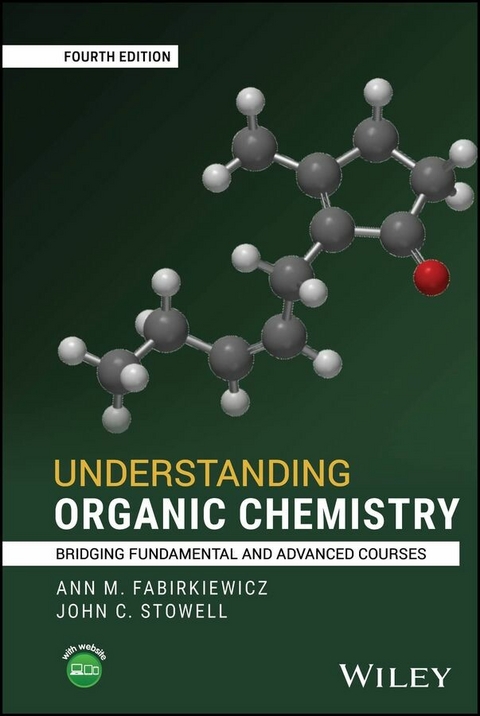
Understanding Organic Chemistry (eBook)
653 Seiten
Wiley (Verlag)
978-1-394-17985-5 (ISBN)
Provides a clear and cohesive path from fundamentals to advanced organic chemistry
Understanding Organic Chemistry: Bridging Fundamental and Advanced Courses equips students with the conceptual tools and technical knowledge needed to transition confidently from lower-division coursework to upper-level study and research in organic chemistry. By integrating synthetic and physical organic chemistry, this popular textbook helps students understand reaction mechanisms, stereochemical principles, and synthetic strategies in a way that is both rigorous and accessible.
The new fourth edition continues its dual focus on theoretical grounding and hands-on problem-solving, making it ideal for those who want to deepen their command of the subject and begin reading primary research literature with confidence. The text incorporates substantial updates throughout, including contemporary examples from synthetic chemistry, enhanced coverage of chiral catalysts and ene reactions, and newly developed in-text problem sets designed to promote self-guided learning. The chapters are structured around major themes-such as spectroscopy, reaction mechanisms, and functional group transformations-and include clear, concise explanations followed by extensive end-of-chapter exercises. Select problem answers are now available in the text, with full solutions and teaching materials accessible to instructors through a companion website.
A balanced treatment of synthetic and physical organic chemistry that promotes a deeper conceptual understanding of the subject, Understanding Organic Chemistry:
- Introduces modern synthetic topics and recent advances in bond-forming methodologies
- Provides up-to-date coverage of spectroscopy, functional group transformations, and synthesis design
- Explains stereochemistry and reaction mechanisms in a clear, structured manner ideal for advanced learners
- Enables students to critically engage with primary research literature in organic chemistry
With a student-friendly format that supports both coursework and self-directed study, Understanding Organic Chemistry: Bridging Fundamental and Advanced Courses, Fourth Edition, is ideal for junior- and senior-level undergraduates as well as first-year graduate students enrolled in intermediate or advanced organic chemistry courses. It is also a valuable reference for chemistry majors preparing for careers or further study in pharmaceuticals, materials science, or academic research.
Ann M. Fabirkiewicz, PhD, is Chair of the Chemistry Department at Randolph College, where she teaches organic and biochemistry and studies antioxidants in foods. She is the author of the third edition of Intermediate Organic Chemistry.
John C. Stowell, PhD, was Professor of Chemistry at the University of New Orleans, where he taught and conducted research in synthetic organic chemistry. He authored the first two editions of Intermediate Organic Chemistry and the monograph Carbanions in Organic Synthesis.
1
READING NOMENCLATURE
Organic chemistry is understood in terms of molecular structures as represented pictorially. Cataloging, writing, and speaking about these structures requires a nomenclature system, the basics of which you have studied in your introductory course. To go further with the subject, you must begin reading journals, and this requires an understanding of the nomenclature of complex molecules. This chapter presents a selection of compounds to illustrate the translation of names to structural representations. The more difficult task of naming complex structures is not covered here because each person's needs will be specialized and can be found in nomenclature guides [1–5]. Most of the nomenclature rules are used to eliminate alternative names and arrive at a unique (or nearly so) name for a particular structure; thus, when beginning with names, you will need to know only a small selection of the rules in order to simply read the names and provide a structure. Although the subject of nomenclature is vast, these selections will enable you to understand many names in current journals.
1.1 ACYCLIC POLYFUNCTIONAL MOLECULES
- (2E,6E)-2,6-Dimethylocta-2,6-diene-1,8-diol
The alcohol groups are the highest in priority, so the molecule is named as an alcohol. Two alcohol groups, located at the ends of the molecule, make it a diol. The molecule is numbered so as to give the remaining groups, the alkenes and the methyls, the lowest possible numbers. Both double bonds are in the E or trans configuration.
- 3-(S)-trans-1-Iodo-1-octen-3-ol methoxyisopropyl ether
This is an example of a derivative name, that is, the first word is the complete name of an alcohol, and the other two words describe a derivatization in which the alcohol is converted to an ether (ketal). Such a name would be useful in discussing a compound that has the ketal present as a temporary entity, for example, as a protecting group.
- Ethyl (E,3R*,6R*)-3,6,8-trimethyl-8-[(trimethylsilyl)oxy]-7-oxo-4-nonenoate
This is the ethyl ester of a nine-carbon unsaturated acid with substituents. The oxo indicates that there is a keto function on carbon 7. Be careful to distinguish this from the prefix oxa-, which has a different meaning; see Section 1.6. The asterisks indicate that the configuration designation is not absolute but rather represents the 3R,6R stereoisomer and/or its enantiomer. Thus, this name represents the R,R and/or the S,S isomers, but not R,S or S,R. This designation excludes diastereomers and is a common way to indicate a racemate.
1.2 MONOCYCLIC ALIPHATIC COMPOUNDS
- 2-(4-Acetylphenyl)cyclopentan-1-one
The benzene ring is named as a substituent with an acetyl group in the fourth position. This substituent is located on C-2 of the cyclopentanone ring, with C-1 bearing the carbonyl group.
- [2S-(1E,2α,3α,5α)]–[3-(Acetyloxy)-2-hydroxy-2-methyl-5-(methylethenyl) cyclohexylidene]acetic acid ethyl ester
The ylidene indicates that the cyclohexyl is attached to the acetic acid by a double bond, and the ethyl ester is indicated at the end for simplicity. The double-bonded ring atom is carbon 1, and the substituents on the ring are placed on the ring according to their locant numbers. The E indicates the geometry of the double bond. All the α substituents reside on one face of the ring, cis to each other. Any β substituents would reside on the opposite face of the ring, trans to the α substituents. Where two substituents are on the same ring atom, as on carbon 2 in this case, the Greek letter indicates the position of the higher-priority substituent. Here, the hydroxy, acetyloxy, and methylethenyl groups are all cis to each other on the ring.
1.3 BRIDGED POLYCYCLIC STRUCTURES
The nomenclature of bridged polycyclic systems requires additional specifications. A bicyclic system would require two bond breakings to open all the rings, a tricyclic system, three, and so on. Rather than viewing these compounds as rings, certain carbons are designated as bridgeheads from which the bridges branch and recombine. In the system below, the first bridgehead is designated as carbon 1, and the system is numbered around the largest bridge to the second bridgehead, carbon 5. Numbering continues around the medium bridge, then the smallest bridge, as shown. The compound is named bicyclo[3.2.1]octane.
All bicyclo compounds require three numbers in brackets, tricyclo require four, and so on, and these numbers indicate the number of carbons in the bridges and are used to locate substituents, heteroatoms, and unsaturation. The name of the parent alkane includes the total number of atoms in the bridges and bridgeheads (excluding substituents) and is given after the brackets. The use of prefixes exo, endo, syn, and anti to indicate stereochemical choices is demonstrated generally as shown below.
In tricyclic compounds, the relative stereochemistry among the four bridgeheads requires designation. Look at the largest possible ring in the molecule and consider the two faces of it. If there are no higher-priority substituents on the primary bridgehead atoms, the smallest bridge (but not a zero bridge) defines the α face. If the smallest non-zero bridge at the secondary bridgeheads is on the same face of the large ring as the α-defining one, it is also designated as α; that is, the two are cis to each other.
If they are trans, there will be two αs and two βs as illustrated. If there is a zero bridge, the position of the bridgehead hydrogens is indicated with Greek letters, as in the dione example below.
- (1α,2β,5β,6α)-Tricyclo[4.2.1.02,5]non-7-ene-3,4-dione
Starting with a pair of bridgeheads, draw the four-, two-, and one-carbon bridges. The zero bridge then connects carbons 2 and 5 as indicated by the superscripts, thus making them bridgeheads also. At bridgeheads 1 and 6, the smallest bridge is considered a substituent and given the α designation at both ends. At bridgeheads 2 and 5, the βs indicate that the hydrogens are trans to the α bridge.
- [1S-(2-exo,3-endo,7-exo)]-7-(1,1-Dimethylethyl)-3-nitro-2-phenylbicyclo[3.3.1]nonan-9-one
This bicyclo system has bridges with three, three, and one carbons each, indicated by the bracketed numbers separated by periods. Carbon 2 carries a phenyl ring that projects toward the smaller neighboring one-carbon bridge rather than the larger three-carbon bridge, as indicated by 2-exo. The 1,1-dimethylethyl group is also exo. This group is commonly called tert-butyl. Chemical Abstracts names substituents based on the linear group, thus naming ethyl as the longest chain, and the two methyl groups as substituents. The prefixes exo and endo indicate the stereochemistry.
Sometimes, a bridgehead substituent will have a higher priority than the smallest bridge thereon. The designation for that bridgehead will indicate the position, α or β, of that higher-priority substituent rather than the bridge, as illustrated in the next example.
- (1α,2β,4β,5β)-5-Hydroxytricyclo[3.3.2.02,4]deca-7,9-dien-6-one
At bridgehead 1, the smallest bridge, between carbons 9 and 10, is considered a substituent on the largest ring and is designated α. The hydrogens at carbons 2 and 4 are trans to it and are designated β. The OH group on carbon 5 is a higher-priority substituent than the C9–C10 bridge and is trans to the bridge; thus, it is labeled β.
1.4 FUSED POLYCYCLIC COMPOUNDS
Fused-ring compounds have a pair or pairs of adjacent carbon atoms common to two rings. Over 35 carbocyclic examples have trivial names, some of which need to be memorized as building blocks for names of more complex examples. The names end with -ene, indicating a maximum number of alternating double bonds. A selection is illustrated in Table 1.1, showing one resonance form for each. Others can be found online [6].
Fusing more rings onto one of these basic systems may give another one with a trivial name. If not, a name including the two rings or ring systems with bracketed locants is used, as in the following example.
TABLE 1.1 Trivial Names of Some Fused Polycyclic Hydrocarbons
| Naphthalene | Phenanthrenea | Anthracenea |
| Azulene | Indene | Fluorene |
| Pyrene | Triphenylene | Chrysene |
aExceptions to systematic numbering.
- Benz[a]anthracene-7,12-dione
A benzene ring is fused to one side of anthracene, so the sides of the anthracene are labeled a, b, c, and so on, where carbons numbered 1 and 2 constitute side a and 2 and 3 constitute side b, continuing in order for all sides. The earliest letter possible on the anthracene is used to...
| Erscheint lt. Verlag | 3.10.2025 |
|---|---|
| Sprache | englisch |
| Themenwelt | Naturwissenschaften ► Chemie ► Organische Chemie |
| ISBN-10 | 1-394-17985-5 / 1394179855 |
| ISBN-13 | 978-1-394-17985-5 / 9781394179855 |
| Informationen gemäß Produktsicherheitsverordnung (GPSR) | |
| Haben Sie eine Frage zum Produkt? |
 EPUB (Adobe DRM)
Kopierschutz: Adobe-DRM
Adobe-DRM ist ein Kopierschutz, der das eBook vor Mißbrauch schützen soll. Dabei wird das eBook bereits beim Download auf Ihre persönliche Adobe-ID autorisiert. Lesen können Sie das eBook dann nur auf den Geräten, welche ebenfalls auf Ihre Adobe-ID registriert sind.
Details zum Adobe-DRM
Dateiformat: EPUB (Electronic Publication)
EPUB ist ein offener Standard für eBooks und eignet sich besonders zur Darstellung von Belletristik und Sachbüchern. Der Fließtext wird dynamisch an die Display- und Schriftgröße angepasst. Auch für mobile Lesegeräte ist EPUB daher gut geeignet.
Systemvoraussetzungen:
PC/Mac: Mit einem PC oder Mac können Sie dieses eBook lesen. Sie benötigen eine
eReader: Dieses eBook kann mit (fast) allen eBook-Readern gelesen werden. Mit dem amazon-Kindle ist es aber nicht kompatibel.
Smartphone/Tablet: Egal ob Apple oder Android, dieses eBook können Sie lesen. Sie benötigen eine
Geräteliste und zusätzliche Hinweise
Buying eBooks from abroad
For tax law reasons we can sell eBooks just within Germany and Switzerland. Regrettably we cannot fulfill eBook-orders from other countries.
aus dem Bereich