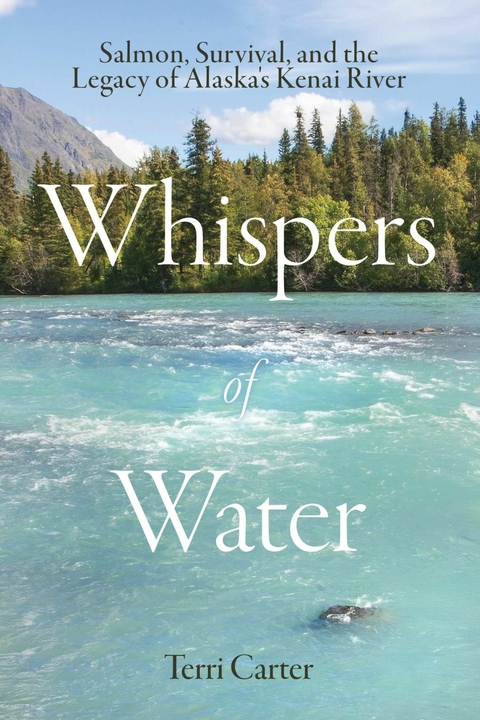
Whispers of Water (eBook)
204 Seiten
Bookbaby (Verlag)
979-8-3178-0271-4 (ISBN)
Terri Carter grew up where the river runs deep-on the banks of Alaska's legendary Kenai. Her roots reach back to homesteaders and dreamers who carved lives from the wilderness, and her voice carries the memory of a place that raised her with both grace and grit. For over three decades, she taught not just in classrooms, but in forests, along shorelines, and beside the river's shifting edge-guiding young people to know, respect, and belong to the land. A lifelong resident of Soldotna, Terri's story is one of listening closely-to water, to children, to the echoes of those who came before. Now retired, she lives a quieter rhythm with her husband John, surrounded by the deep joy of her children and grandchildren. Her faith in God, love of family, and commitment to community shape the path she walks each day. Whispers of Water is her first book-a tender weaving of memory, history, and environmental witness. It is at once a tribute and a warning, a song of home and a call to action. Through it, Terri invites us to lean in, to hear what the river is still trying to say-and to protect its voice before it fades.
Whispers of Water is more than a memoir-it is a luminous tribute to Alaska's Kenai River and the generations shaped by its current. With the heart of a conservationist and the voice of a poet, Terri Carter weaves lyrical storytelling with lived experience to create a powerful narrative of place, memory, and belonging. Raised along the banks of the Kenai River, Carter invites readers into a world of breathtaking beauty, legendary salmon runs, and enduring human connection. This is not just a personal story it's a meditation on the rhythms of a river that remembers, a land that teaches, and a culture shaped by both abundance and loss. For adventurers drawn to wild places, Whispers of Water offers the thrill of chasing king salmon and the deeper truths beneath the surface. For readers of history and culture, it honors the Dena'ina people, the original stewards of these waters, and traces the legacy of homesteaders who followed. For those who call Alaska home, it is a mirror of identity and inheritance. And for all who long to understand the North, it is an invitation to listen closely: to the river's past, its uncertain future, and the choices we must make to protect what remains. Steeped in reverence, yet alive with urgency, Whispers of Water is both elegy and call to action. It speaks to those who believe that rivers carry more than water they carry story, sustenance, and soul. This is Terri Carter's debut work, born of decades spent teaching and walking the banks of the river that raised her. With grace, insight, and fierce love, she calls on all who care for wild places to remember, reimagine, and respond before the last whispers are lost.
Chapter One
Etched in Stone,
Conveyed by Water
Long before my family claimed the Kenai River as part of our legacy, it became clear that we were only the latest in a long line of souls shaped by these waters—whispers of ancient lives lingered in its currents and the surrounding forests.
During the second summer in our new home, my sister was wandering down a narrow dirt road near our home by the Kenai River. Sunlight dappled through a tunnel of overhanging leaves and branches as she talked and sang to herself, occasionally kicking loose rocks along. A perfectly oval, dirty, orange-colored rock nestled in the dirt caught her eye. She stooped over and picked it up for a closer look and was stunned to see a face looking back at her! Slits of eyes etched deep into the chalkstone were positioned over a long straight nose, and beneath that, a small, expressionless mouth. It was only about two inches long and fit perfectly in the palm of her ten-year-old hand. She stared in amazement at the treasure from the depths of time, a relic from an ancient world that had been awaiting her discovery. In wonderment, she cradled the stone in her small, calloused hand and tucked it into the pocket of her well-worn jeans. She attempted to show it to our mom, who was distracted by dinner preparation and barely took notice. Later, Mom asked to see it and initially thought her clever daughter had made it. Gradually the realization dawned on her, as Laura once more told of her discovery, that this article of ancient craftsmanship must have been made by indigenous people. Mom talked to a neighbor, who passed the news along. Later that summer, an archaeological dig was conducted in the location of her discovery to gain additional insight into secrets buried beneath the surface of the land and to solve the mystery of what exactly the road construction had disturbed to unearth the fascinating find.
Eventually, this excavation, and others that followed in successive years and in varying locations, pieced together information that brought to life the story of an ancient group of people named by archaeologists: The Riverine Kachemak Tradition. The overall picture painted is one of salmon people reliant on the Kenai River and its watershed’s rich resources for all of life’s basic needs and who thrived as a result—in spite of an unforgiving landscape. A symphony of extremes, with seven months of winter from October to April and average temperatures ranging from 10 degrees above to 30 below zero Fahrenheit. Frequent winds drop the temperature even further. Available food, in the form of wildlife, diminishes as temperatures drop and people and animals hunker down to endure conditions. Dangers abound—not only in the form of weather but also in predators, challenging hunting terrain, and natural disasters. This was a hard country. These people navigated adversity with skill and knowledge passed generationally, a treasure trove of wisdom that enabled them to thrive.
In 1000 BC, King David began his reign in ancient Israel. The Iron Age was just starting in Europe, and Japan began cultivating rice. In Alaska, along the banks of the Kenai River, a group of people found a home. These salmon people lived in small villages along other major salmon streams too, including the Kasilof, Susitna, and Kustatan rivers. They anchored their existence to the life-giving waters of the rivers and their tributaries. We know them from what they left behind. Their tools, house sites, and even their garbage inform us about their lives. The tools and technology of the Riverine Kachemak Tradition were very similar to groups of people who lived on Kodiak Island and along Kachemak Bay. In fact, based on the dates of the sites, it is theorized that the Riverine people were the same people who had lived around Kachemak Bay, who relocated leaving Kachemak Bay for the inland salmon rivers. No one really knows why. It may have been due to changes in the climate; this was a warming time following the previous ice age. The environment and changing availability of food are likely to have been contributing factors. It might have been based on conflicts within themselves or with other people.
Imagine their first arrival—weary travelers, babies and toddlers strapped to the backs of women, gray heads atop stooped shoulders, leaning on sturdy walking sticks for support, men with heavy loads, weapons in hands and a constant protective gaze scanning the horizon. Children, young and energetic, did their share, hauling bundles of important possessions and filling the air with songs and constant chatter. These people were not following their seasonal ways of living, from winter hunting areas to summer fish camp. They were on a quest for a new home, a permanent place to begin again. They were willing to endure the hardship brought by this harsh country and it’s likely that their previous home had become more difficult to survive making the gamble a necessity.
The location of a new village site had to meet specific requirements. They needed a source of fresh water available year-round and trees in abundance and diversity for shelter, tools, and fuel for fires. They preferred a high ridge to provide views into the distance for game or trouble in the form of enemy raiders, a place to defend and protect their families as well as escape the threat of floods. More than anything else, they needed salmon. There was a culture that knew how to effectively harvest salmon in numbers that could keep their people alive through the long seasons until the fish returned once more. They must have known, or at least heard rumors of the plentiful salmon of exceptional size that this river produced. Maybe they found out from a trader or a traveler. Perhaps, they traveled north from Kachemak Bay and temporary summer camps to harvest salmon. Kachemak Bay is about 75 miles from the lower Kenai River and would have required extensive travel, most likely by water. If the need to relocate wasn’t urgent, it would stand to reason that they would have sent scouts ahead to identify the best locations for their new home.
What caused the Riverine Kachemak to leave their place of origin? Maybe it was family disputes, political division, or even war, like my dad’s experience. Was it a collapse of resources, or the belief that better opportunity was available in a distant and unsettled place, like my mom’s family? We may never know why they left their home, but there is no doubt that they found just what they were seeking on the Kenai River.
I learned about these people from two sources. My primary source is Dr. Doug Reger, now retired from a career as an archaeologist for the Alaska Department of Natural Resources. Doug conducted many archaeological investigations throughout South Central Alaska and the Cook Inlet. He conducted the dig resulting from my sister’s discovery for his doctorate thesis. He generously shared with me an article he has written: Early Use of the Kenai River, Volume 1, published in 2004. Another important source of information was a class at Kenai Peninsula College called Cook Inlet Anthropology, by Dr. Alan Boras. What these experts know and have taught was gained through decades of archaeological research, and through excavations and examinations of places where people have lived and careful analysis of what was left behind. Archaeologists carefully sift through the soil, layer by layer, and collect and analyze every item and artifact. They make detailed drawings of each site and combine their findings to tell a story. Stone endures almost all conditions, while some other materials decay, breaking down in the soil that surrounds them; bone, antler, and sometimes wood survive but become fragile. Wood can be used to estimate the age of a tree, and, thus the age of an ancient dwelling where preserved wood is found, through a process called carbon dating. Archaeologists can come close to knowing the site’s age if a tree used for structures shortly after it was harvested can be carbon-dated. This method was used to date the riverine people along the Kenai River to between 1000 BC and 900 AD, meaning that they lived in this area for roughly 2,000 years.
The Riverine Kachemak people left no written language to record information about who they were, how they lived, and what they believed. Like most cultures, they likely told stories that imparted their history and important events, taught lessons, issued warnings, and brought entertainment. No people from this culture live here now, so we don’t have that source of information. But what we do know provides a fascinating glimpse of an ancient culture and their reliance on the Kenai River.
Riverine Kachemak people built their homes right along the river’s edge, with the door always facing the water. Typically, they would excavate a rectangular hole about three feet deep, just the size of their new home. Most homes measured about 40 feet long and 20 feet wide. They didn’t have strong metal tools to make easy work of chipping away the hard clay, unsorted glacial till and packed river gravel and rock easier. They would have used stone, wood, antler, and bone plus a lot of muscle and effort. The effort was worth it because this hole provided support for the bottom section of a house and insulation from winter’s biting cold and numbing winds. Most historic village sites found so far have five to ten houses. The houses were quite close together, implying a need or desire to stick together. Scientists estimate that ten to fifteen people lived in the one-room structures. That is close quarters by our culture’s standards and wouldn’t provide the privacy we are used to having. Based on those numbers, a...
| Erscheint lt. Verlag | 1.7.2025 |
|---|---|
| Sprache | englisch |
| Themenwelt | Naturwissenschaften ► Geowissenschaften ► Geografie / Kartografie |
| ISBN-13 | 979-8-3178-0271-4 / 9798317802714 |
| Informationen gemäß Produktsicherheitsverordnung (GPSR) | |
| Haben Sie eine Frage zum Produkt? |
 EPUB (Ohne DRM)
Größe: 2,3 MB
Digital Rights Management: ohne DRM
Dieses eBook enthält kein DRM oder Kopierschutz. Eine Weitergabe an Dritte ist jedoch rechtlich nicht zulässig, weil Sie beim Kauf nur die Rechte an der persönlichen Nutzung erwerben.
Dateiformat: EPUB (Electronic Publication)
EPUB ist ein offener Standard für eBooks und eignet sich besonders zur Darstellung von Belletristik und Sachbüchern. Der Fließtext wird dynamisch an die Display- und Schriftgröße angepasst. Auch für mobile Lesegeräte ist EPUB daher gut geeignet.
Systemvoraussetzungen:
PC/Mac: Mit einem PC oder Mac können Sie dieses eBook lesen. Sie benötigen dafür die kostenlose Software Adobe Digital Editions.
eReader: Dieses eBook kann mit (fast) allen eBook-Readern gelesen werden. Mit dem amazon-Kindle ist es aber nicht kompatibel.
Smartphone/Tablet: Egal ob Apple oder Android, dieses eBook können Sie lesen. Sie benötigen dafür eine kostenlose App.
Geräteliste und zusätzliche Hinweise
Buying eBooks from abroad
For tax law reasons we can sell eBooks just within Germany and Switzerland. Regrettably we cannot fulfill eBook-orders from other countries.
aus dem Bereich