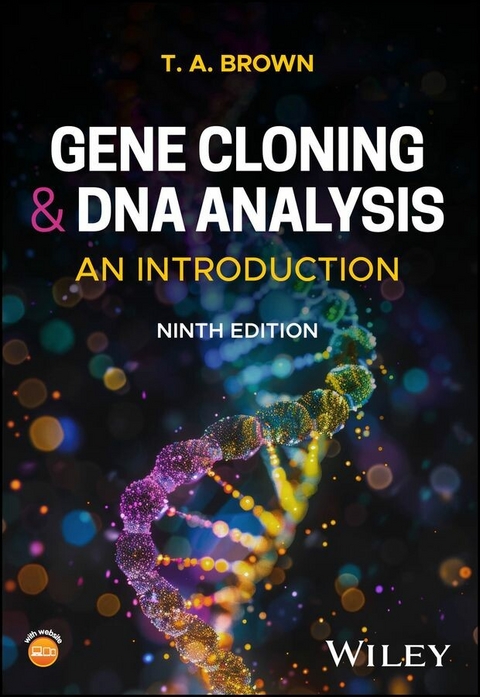
Gene Cloning and DNA Analysis (eBook)
838 Seiten
Wiley (Verlag)
978-1-394-29257-8 (ISBN)
New edition of a world-renowned introductory text to the rapidly-growing and dynamic field of Gene Cloning and DNA Analysis
Gene Cloning and DNA Analysis is a comprehensive introductory text that explores all of the topics vital for a complete understanding of gene cloning and DNA analysis. Presented in full color, the text's easy-to-follow layout and over 250 clear illustrations make the material simple and accessible for a diverse readership.
This newly revised and updated Ninth Edition highlights new developments in DNA sequencing technology and provides extended coverage on DNA editing including CRISPR methodology and its applications in gene therapy and plant genetic engineering.
This edition also contains updates on topics including optical mapping of DNA molecules, studying transcriptomes in situ, RNA interference methods for silencing genes in crop plants, studying kinship by DNA profiling, and using ancient DNA to study human prehistory and palaeogenomics.
Gene Cloning and DNA Analysis also discusses topics such as:
- The strategies used by researchers and industry practitioners to assemble telomere-to-telomere chromosome sequences
- The synthesis of recombinant vaccines for diseases such as COVID-19 and hepatitis B
- Interbreeding between Neanderthals and Homo sapiens
- The ethical issues raised by the use of gene cloning and DNA editing in pharming, gene therapy and plant genetic modification
The Ninth Edition of Gene Cloning and DNA Analysis continues to be an essential reference for undergraduate and graduate students within the fields of genetics and genomics, molecular biology, biochemistry, immunology, and applied biology, as well as professionals in all areas of biological science.
T. A. Brown is Emeritus Professor of Biomolecular Archaeology in the Department of Earth and Environmental Sciences at the University of Manchester in the United Kingdom. He has published several books on genetics, genomics, and biochemistry as well as over 150 research papers.
Chapter 1
Why Gene Cloning and DNA Analysis Are Important
Chapter contents
- 1.1 The early development of genetics
- 1.2 The advent of gene cloning and the polymerase chain reaction
- 1.3 What is gene cloning?
- 1.4 What is PCR?
- 1.5 Why gene cloning and PCR are so important
- 1.6 How to find your way through this book
In the middle of the 19th century, Gregor Mendel formulated a set of rules to explain the inheritance of biological characteristics. The basic assumption of these rules is that each heritable property of an organism is controlled by a factor, called a gene, that is a physical particle present somewhere in the cell. The rediscovery of Mendel's laws in 1900 marks the birth of genetics, the science aimed at understanding what these genes are and exactly how they work.
1.1 The early development of genetics
For the first 30 years of its life, this new science grew at an astonishing rate. The idea that genes reside on chromosomes was proposed by W. Sutton in 1903 and received experimental backing from T.H. Morgan in 1910. Morgan and his colleagues then developed the techniques for gene mapping, and by 1920 they had produced a comprehensive analysis of the relative positions of over 100 genes on the four chromosomes of the fruit fly, Drosophila melanogaster.
Despite the brilliance of these classical genetic studies, there was no real understanding of the molecular nature of the gene until the 1940s. Indeed, it was not until the experiments of Avery, MacLeod and McCarty in 1944 and of Hershey and Chase in 1952 that anyone believed that deoxyribonucleic acid (DNA) is the genetic material. Up until then, it was widely thought that genes were made of protein. The discovery of the role of DNA was a tremendous stimulus to genetic research, and many famous biologists (Delbrück, Chargaff, Crick and Monod were among the most influential) contributed to the second great age of genetics. In the 14 years between 1952 and 1966, the structure of DNA was elucidated, the genetic code cracked and the processes of transcription and translation described.
1.2 The advent of gene cloning and the polymerase chain reaction
These years of activity and discovery were followed by a lull, a period of anticlimax when it seemed to some molecular biologists (as the new generation of geneticists styled themselves) that there was little of fundamental importance that was not understood. In truth, there was frustration that the experimental techniques of the late 1960s were not sophisticated enough to allow genes to be studied in any greater detail.
Then, in the years 1971–1973, genetic research was thrown back into gear by what at the time was described as a revolution in experimental biology. A whole new methodology was developed, enabling previously impossible experiments to be planned and carried out, if not with ease, then at least with success. These methods, referred to as recombinant DNA technology or genetic engineering, and having at their core the process of gene cloning, sparked another great age of genetics. They led to rapid and efficient DNA sequencing techniques that enabled the structures of individual genes to be determined, reaching a culmination at the turn of the century with the massive genome sequencing projects, including the human project which was completed in 2000. They led to procedures for studying the regulation of individual genes, which have allowed molecular biologists to understand how aberrations in gene activity can result in human diseases such as cancer. The techniques spawned modern biotechnology, which puts genes to work in production of proteins and other compounds needed in medicine and industrial processes.
During the 1980s, when the excitement engendered by the gene cloning revolution was at its height, it hardly seemed possible that another equally novel and equally revolutionary process was just around the corner. According to DNA folklore, Kary Mullis invented the polymerase chain reaction (PCR) during a drive along California State Route 128 from Berkeley to Mendocino one Friday evening in 1983. His brainwave was an exquisitely simple technique that acts as a perfect complement to gene cloning. PCR has made easier many of the techniques that were possible but difficult to carry out when gene cloning was used on its own. It has extended the range of DNA analysis and enabled molecular biology to find new applications in areas of endeavour outside of its traditional range of medicine, agriculture and biotechnology. Archaeogenetics, molecular ecology and DNA forensics are just three of the new disciplines that have become possible as a direct consequence of the invention of PCR, enabling molecular biologists to ask questions about human evolution and the impact of environmental change on the biosphere and to bring their powerful tools to bear in the fight against crime. Fifty years have passed since the dawning of the age of gene cloning, but we are still riding the rollercoaster, and there is no end to the excitement in sight.
1.3 What is gene cloning?
What exactly is gene cloning? The easiest way to answer this question is to follow through the steps in a gene cloning experiment (Figure 1.1):
- A fragment of DNA, containing the gene to be cloned, is inserted into a circular DNA molecule called a vector to produce a recombinant DNA molecule.
- The vector transports the gene into a host cell, which is usually a bacterium, although other types of living cell can be used.
- Within the host cell, the vector multiplies, producing numerous identical copies, not only of itself but also of the gene that it carries.
- When the host cell divides, copies of the recombinant DNA molecule are passed to the progeny, and further vector replication takes place.
- After a large number of cell divisions, a colony, or clone, of identical host cells is produced. Each cell in the clone contains one or more copies of the recombinant DNA molecule. The gene carried by the recombinant molecule is now said to be cloned.
1.4 What is PCR?
The polymerase chain reaction is very different from gene cloning. Rather than a series of manipulations involving living cells, PCR is carried out in a single test tube simply by mixing DNA with a set of reagents and placing the tube in a thermal cycler, a piece of equipment that enables the mixture to be incubated at a series of temperatures that are varied in a preprogrammed manner. The basic steps in a PCR experiment are as follows (Figure 1.2):
Figure 1.1
The basic steps in gene cloning.
- The mixture is heated to 94°C, at which temperature the hydrogen bonds that hold together the two strands of the double‐stranded DNA molecule are broken, causing the molecule to denature.
- The mixture is cooled down to 50–60°C. The two strands of each molecule could join back together at this temperature, but most do not because the mixture contains a large excess of short DNA molecules, called oligonucleotides or primers, which anneal to the DNA molecules at specific positions.
- The temperature is raised to 74°C. This is a good working temperature for the Taq DNA polymerase that is present in the mixture. We will learn more about DNA polymerases in Section 4.1.3. All we need to understand at this stage is that the Taq DNA polymerase attaches to one end of each primer and synthesizes new strands of DNA, complementary to the template DNA molecules, during this step of the PCR. Now we have four stands of DNA instead of the two that there were to start with.
- The temperature is increased back to 94°C. The double‐stranded DNA molecules, each of which consists of one strand of the original molecule and one new strand of DNA, denature into single strands. This begins a second cycle of denaturation–annealing–synthesis, at the end of which there are eight DNA strands. By repeating the cycle 30 times, the double‐stranded molecule that we began with is converted into over 130 million new double‐stranded molecules, each one a copy of the region of the starting molecule delineated by the annealing sites of the two primers.
Figure 1.2
The basic steps in the polymerase chain reaction.
1.5 Why gene cloning and PCR are so important
As you can see from Figures 1.1 and 1.2, gene cloning and PCR are relatively straightforward procedures. Why then have they assumed such importance in biology? The answer is largely because both techniques can provide a pure sample of an individual...
| Erscheint lt. Verlag | 7.10.2025 |
|---|---|
| Sprache | englisch |
| Themenwelt | Naturwissenschaften ► Biologie ► Genetik / Molekularbiologie |
| Schlagworte | Ancient DNA • Bioethics • cloning vector • DNA cloning • DNA editing • DNA profiling • DNA purification • DNA sequencing • gene therapy • genetically modified plant • genome annotation • Polymerase chain reaction • Proteome • recombinant protein • recombinant vaccine • restriction endonucleases • transcriptome • Transformation |
| ISBN-10 | 1-394-29257-0 / 1394292570 |
| ISBN-13 | 978-1-394-29257-8 / 9781394292578 |
| Informationen gemäß Produktsicherheitsverordnung (GPSR) | |
| Haben Sie eine Frage zum Produkt? |
 EPUB (Adobe DRM)
Kopierschutz: Adobe-DRM
Adobe-DRM ist ein Kopierschutz, der das eBook vor Mißbrauch schützen soll. Dabei wird das eBook bereits beim Download auf Ihre persönliche Adobe-ID autorisiert. Lesen können Sie das eBook dann nur auf den Geräten, welche ebenfalls auf Ihre Adobe-ID registriert sind.
Details zum Adobe-DRM
Dateiformat: EPUB (Electronic Publication)
EPUB ist ein offener Standard für eBooks und eignet sich besonders zur Darstellung von Belletristik und Sachbüchern. Der Fließtext wird dynamisch an die Display- und Schriftgröße angepasst. Auch für mobile Lesegeräte ist EPUB daher gut geeignet.
Systemvoraussetzungen:
PC/Mac: Mit einem PC oder Mac können Sie dieses eBook lesen. Sie benötigen eine
eReader: Dieses eBook kann mit (fast) allen eBook-Readern gelesen werden. Mit dem amazon-Kindle ist es aber nicht kompatibel.
Smartphone/Tablet: Egal ob Apple oder Android, dieses eBook können Sie lesen. Sie benötigen eine
Geräteliste und zusätzliche Hinweise
Buying eBooks from abroad
For tax law reasons we can sell eBooks just within Germany and Switzerland. Regrettably we cannot fulfill eBook-orders from other countries.
aus dem Bereich