


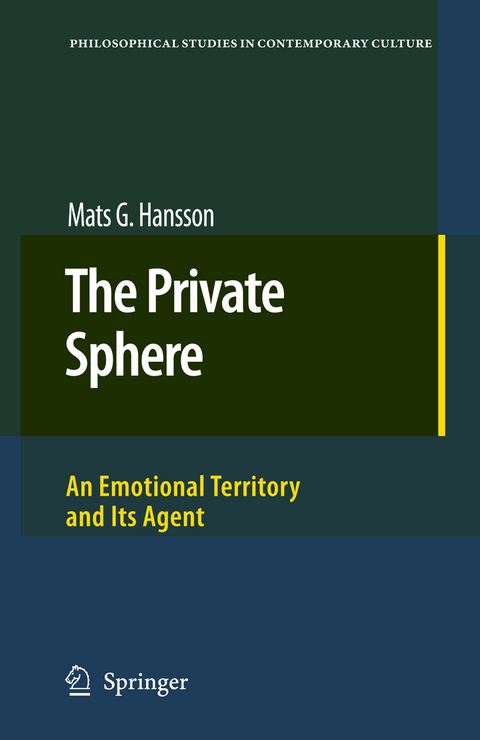
The Private Sphere
An Emotional Territory and Its Agent
Seiten
2007
|
2008 ed.
Springer-Verlag New York Inc.
978-1-4020-6651-1 (ISBN)
Springer-Verlag New York Inc.
978-1-4020-6651-1 (ISBN)

This book describes an emotional territory, which forms the individual's own sphere of action and experience. This develops in the course of evolution in pace with the individual's conditions of life, brought about by challenges in the natural and social environment.
The present work has emerged as the result of several years' involvementin various multidisciplinary research projects which have been carried out within the - search Programme in Biomedical Ethics at Uppsala University, now the Centre for Bioethics at Karolinska Institutet and Uppsala University. I am grateful to various colleagues who have taken part, whether brie?y or at length, in discussions of the concepts of privacy and integrity. Hearty thanks must go to Gert Helgesson, Ulrik von Essen, Par Segerdahland Richard Wessman who have read the initial version of the book and provideduseful comments. I am particularlyindebted to Par for taking the trouble to read the whole manuscript a second time. Arne Ohman and his - searchgroupatthe PsychologySectionin theDepartmentofClinical Neurosciences at Karolinska Institutet read an earlier version of Chapters 3 and 4. This provided a constructive and rewarding discussion which was of particular value to me since psychologydid not form part of my own professionaltraining. Sven Danielsson and the members of his research seminar in practical philosophy at Uppsala University read Chapters 5 and 6 and offered constructivecriticism.
Their critical views helped me to try to express more clearly the aim of these chapters within the framework of the book as a whole. All the readers of the book or parts of it can certainly have reason to wish for further revisions or indeed for a different presentation of the problem of understanding the role of the agent in the private sphere.
The present work has emerged as the result of several years' involvementin various multidisciplinary research projects which have been carried out within the - search Programme in Biomedical Ethics at Uppsala University, now the Centre for Bioethics at Karolinska Institutet and Uppsala University. I am grateful to various colleagues who have taken part, whether brie?y or at length, in discussions of the concepts of privacy and integrity. Hearty thanks must go to Gert Helgesson, Ulrik von Essen, Par Segerdahland Richard Wessman who have read the initial version of the book and provideduseful comments. I am particularlyindebted to Par for taking the trouble to read the whole manuscript a second time. Arne Ohman and his - searchgroupatthe PsychologySectionin theDepartmentofClinical Neurosciences at Karolinska Institutet read an earlier version of Chapters 3 and 4. This provided a constructive and rewarding discussion which was of particular value to me since psychologydid not form part of my own professionaltraining. Sven Danielsson and the members of his research seminar in practical philosophy at Uppsala University read Chapters 5 and 6 and offered constructivecriticism.
Their critical views helped me to try to express more clearly the aim of these chapters within the framework of the book as a whole. All the readers of the book or parts of it can certainly have reason to wish for further revisions or indeed for a different presentation of the problem of understanding the role of the agent in the private sphere.
The Private Sphere from a Historical and Cultural Perspective.- The Private Sphere as an Emotional Territory – A Psychological and Evolutionary Perspective.- Integrity as Something Worthy of Moral Protection.- Respect for the Individual as a Person with Moral and Political Authority – Integrity from a Philosophical Perspective.- Balancing Seclusion and Participation – Integrity from the Perspective of Moral Philosophy.- Legal Protection – Privacy and Integrity from the Perspective of Jurisprudence and the Law.- Integrity as a Quality Worthy of Esteem and Respect.- Conclusions and Applications.
| Erscheint lt. Verlag | 28.12.2007 |
|---|---|
| Reihe/Serie | Philosophical Studies in Contemporary Culture ; 15 |
| Zusatzinfo | IX, 179 p. |
| Verlagsort | New York, NY |
| Sprache | englisch |
| Maße | 156 x 235 mm |
| Themenwelt | Geisteswissenschaften ► Philosophie ► Allgemeines / Lexika |
| Geisteswissenschaften ► Philosophie ► Ethik | |
| Geisteswissenschaften ► Psychologie ► Allgemeine Psychologie | |
| Geisteswissenschaften ► Psychologie ► Verhaltenstherapie | |
| Naturwissenschaften ► Biologie | |
| Recht / Steuern ► Allgemeines / Lexika | |
| Recht / Steuern ► EU / Internationales Recht | |
| ISBN-10 | 1-4020-6651-1 / 1402066511 |
| ISBN-13 | 978-1-4020-6651-1 / 9781402066511 |
| Zustand | Neuware |
| Informationen gemäß Produktsicherheitsverordnung (GPSR) | |
| Haben Sie eine Frage zum Produkt? |
Mehr entdecken
aus dem Bereich


aus dem Bereich
die letzten Jahre der Philosophie und der Beginn einer neuen …
Buch | Hardcover (2024)
Klett-Cotta (Verlag)
CHF 39,20


