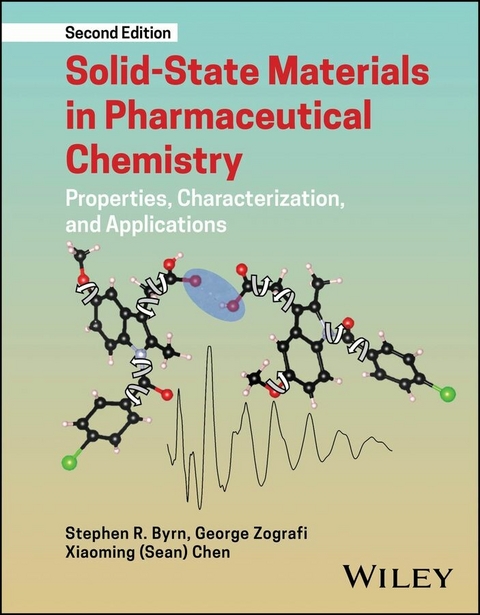
Solid-State Materials in Pharmaceutical Chemistry (eBook)
1585 Seiten
Wiley (Verlag)
978-1-394-25446-0 (ISBN)
Updated and expanded information on the properties of pharmaceutical solids and their impact on drug product performance, quality, and stability
Solid-State Materials in Pharmaceutical Chemistry provides readers with a comprehensive and up-to-date resource for understanding and controlling the solid-state properties of pharmaceutical materials, enabling the development of safe and effective medicines including small molecule compounds, peptides, proteins, and nucleotides. This new edition covers the significant transformations in the landscape of pharmaceutical research, development, and manufacturing since the previous edition was published, presenting both novel challenges and unprecedented opportunities.
New chapters in this edition cover physical and chemical properties of RNA therapeutics, a frontier to many life-saving medicines and vaccines including Covid vaccines, and final stage drug substance manufacturing and control, addressing challenges in API process development including impurity purging, chiral separation, final form preparation, particle size reduction, and nitrosamine control. Readers will also find other updated topics including bulk and surface properties of solids, lipid nanoparticles, applications of pharmaceutical solvates in impurity purging and final form preparation, pharmaceutical cocrystal engineering to enable chiral separation, the emerging technique of microcrystal electron diffraction in solid form characterization, poor wettability of APIs, oral delivery of peptides such as semaglutide, injectable drug-device combination products, and N-nitrosamine control in drug product.
This updated and revised Second Edition still features:
- Physical and chemical properties of solid-state pharmaceuticals such as amorphous forms, mesophases, polymorphs, hydrates/solvates, salts, co-crystals, nano-particles, and solid dispersions
- Characterization techniques for solid form identification and physical attribute analysis such as X-Ray powder diffraction, thermal analysis, microscopy, spectroscopy, solid state NMR, particle analysis, water sorption, mechanical property testing, solubility, and dissolution
- Applications of pharmaceutical chemistry and physical characterization techniques in developing and testing drug substances and drug products for small molecules and biopharmaceuticals
This book is an essential resource on the subject for formulation scientists, process chemists, medicinal chemists, and analytical chemists. The book will also appeal to quality control, quality assurance, and regulatory affair specialists and advanced undergraduate and graduate students in pharmaceutical chemistry, drug delivery, material science, crystal engineering, pharmaceutics, and biopharmaceutics.
Stephen R. Byrn, PhD, Charles B. Jordan Professor of Medicinal Chemistry in the Department of Industrial and Molecular Pharmaceutics, Purdue University.
George Zografi, PhD, Edward Kremers Professor Emeritus of Pharmaceutical Sciences, School of Pharmacy, University of Wisconsin-Madison.
Xiaoming (Sean) Chen, PhD, works in the field of pharmaceutical product development and held various positions at Schering-Plough, OSI Pharmaceuticals, Astellas Pharma, Shionogi Inc, Antares Pharma, Arvinas, and Improved Pharma.
Updated and expanded information on the properties of pharmaceutical solids and their impact on drug product performance, quality, and stability Solid-State Materials in Pharmaceutical Chemistry provides readers with a comprehensive and up-to-date resource for understanding and controlling the solid-state properties of pharmaceutical materials, enabling the development of safe and effective medicines including small molecule compounds, peptides, proteins, and nucleotides. This new edition covers the significant transformations in the landscape of pharmaceutical research, development, and manufacturing since the previous edition was published, presenting both novel challenges and unprecedented opportunities. New chapters in this edition cover physical and chemical properties of RNA therapeutics, a frontier to many life-saving medicines and vaccines including Covid vaccines, and final stage drug substance manufacturing and control, addressing challenges in API process development including impurity purging, chiral separation, final form preparation, particle size reduction, and nitrosamine control. Readers will also find other updated topics including bulk and surface properties of solids, lipid nanoparticles, applications of pharmaceutical solvates in impurity purging and final form preparation, pharmaceutical cocrystal engineering to enable chiral separation, the emerging technique of microcrystal electron diffraction in solid form characterization, poor wettability of APIs, oral delivery of peptides such as semaglutide, injectable drug-device combination products, and N-nitrosamine control in drug product. This updated and revised Second Edition still features: Physical and chemical properties of solid-state pharmaceuticals such as amorphous forms, mesophases, polymorphs, hydrates/solvates, salts, co-crystals, nano-particles, and solid dispersionsCharacterization techniques for solid form identification and physical attribute analysis such as X-Ray powder diffraction, thermal analysis, microscopy, spectroscopy, solid state NMR, particle analysis, water sorption, mechanical property testing, solubility, and dissolutionApplications of pharmaceutical chemistry and physical characterization techniques in developing and testing drug substances and drug products for small molecules and biopharmaceuticals This book is an essential resource on the subject for formulation scientists, process chemists, medicinal chemists, and analytical chemists. The book will also appeal to quality control, quality assurance, and regulatory affair specialists and advanced undergraduate and graduate students in pharmaceutical chemistry, drug delivery, material science, crystal engineering, pharmaceutics, and biopharmaceutics.
Chapter 1
Solid-State Properties and Pharmaceutical Development
1.1 Introduction
Solid-state chemistry and the solid-state properties of pharmaceutical materials play an ever-increasing and important role in pharmaceutical development. There is much more emphasis on physical characterization since the ICH Q6A guidance on specifications was released. This guidance directs the scientist to determine what solid form is present in the drug substance (API) and drug product. It directs the manufacturer to “know what they have.” Additionally, the ICH Q8 guidance on development and the ICH Q9 guidance on risk require a firm understanding of how the medicine was developed and any risks involved.
There are many more poorly soluble drugs under development. In many cases, the solid form of the API and the solid form and formulation in the drug product determine apparent solubility, which in turn determines blood levels. That is, the formulation determines bioavailability and therapeutic response. In these cases, it is even more important to physically characterize the API form and the formulations. Furthermore, most medicines (drug products) are solids, and those drug products that are not solids often start with solid APIs. In addition to solubility and bioavailability, the solid form may affect stability, flow, compression, hygroscopicity, and several other properties.
This book focuses on solid-state properties of pharmaceutical materials and methods of determining these properties. The authors have made every effort to include examples and case studies to illustrate the importance of knowing what you have. This book will focus on solid-state properties and general strategies for physical characterization. Case studies and practical examples will be emphasized. This book will illustrate that a medicine is more than a molecule in many aspects. Additional goals include providing a full physical/analytical/operational definition of the different solid forms, as well as other terms frequently used in pharmaceutical materials science, including polymorph, solvate, amorphous form, habit, nucleation, transformation, dissolution, solubility, and stability.
1.2 Solid-state Forms
Pharmaceutical materials can exist in a crystalline or amorphous state. Figure 1.1 illustrates the crystalline state as a perfectly ordered solid with molecules (circles) packed in an orderly array. Figure 1.1 also illustrates an amorphous material as a disordered material with only short-range order. Crystalline materials give an X-ray diffraction pattern because Bragg planes exist in the material (see Figure 1.2). Amorphous materials do not give a diffraction pattern (see Figure 1.2). Of course, there are many interesting cases where a pharmaceutical material shows an intermediate degree of order falling somewhere between the highly ordered crystalline state and the completely disordered amorphous state. From a thermodynamic point of view, crystalline materials are more stable, but the rate of transformation of amorphous materials to crystalline materials can be highly variable [1].
Figure 1.1 Idealized view of crystalline (left panel) and amorphous (right panel) material. In this two-dimensional figure, the molecules are viewed as circles.
Figure 1.2 X-ray diffraction pattern of three samples: crystalline, low crystallinity, and amorphous.
Crystals of a pharmaceutical material from different sources can vary greatly in their size and shape. Typical particles in different samples may resemble, for example, needles, rods, plates, prisms. Such differences in shape are collectively referred to as differences in morphology. This term merely acknowledges the fact of different shapes. It does not distinguish among the many possible reasons for the different shapes. Naturally, when different compounds are involved, different crystal shapes would be expected as a matter of course. However, when batches of the same substance display crystals with different morphology, further work is needed to determine whether the different shapes are indicative of polymorphs, solvates, or just habits. Because these distinctions can have a profound impact on drug performance, their careful definition is very important to our discourse. At this time, only brief definitions are presented:
- Polymorphs – When two crystals have the same chemical composition but different internal structure (molecular packing), they are polymorphic modifications or polymorphs (think of the three forms of carbon: diamond, graphite, and fullerenes). Polymorphs can result from different molecular packing, different molecular conformation, tautomeric structure, or combinations of these.
- Solvates – In addition to containing molecules of the same given substance, these crystal forms contain molecules of solvent regularly incorporated into a unique structure (think of wet, setting plaster: CaSO4 + 2H2O → CaSO4 · 2H2O).
- Habits – Crystals are said to have different habits when samples have the same chemical composition and the same crystal structure (i.e. the same polymorph and unit cell) but display different shapes (think of snowflakes).
Together, these solid-state physical modifications of a compound are referred to as crystalline forms. When differences between early batches of a substance are found by microscopic examination, for example, a reference to “form” is particularly useful in the absence of information that allows the more accurate description of a given variant batch (i.e. polymorph, solvate, habit, or amorphous material). The term “pseudopolymorphism” is applied frequently to designate solvates. These solid-state modifications have different physical properties.
To put these important definitions into a practical context, we consider two cases (aspirin and flufenamic acid) in which a drug was crystallized from several different solvents, and different-shaped crystals resulted in each experiment. Although dramatically different shapes were sometimes obtained on changing solvents for the various crystallizations, the final interpretations in the two cases are different. For aspirin, X-ray powder diffraction showed that all crystals regardless of shape had the same diffraction pattern. Thus, the different-shaped crystals are termed crystal habits. For flufenamic acid, the different-shaped crystals had different X-ray powder diffraction patterns. Subsequent analysis showed that the crystals did not contain solvent. Thus, these different crystals are polymorphs.
Further analysis of the crystals from this case provides the single crystal structure. The single crystal structure gives the locations of the atoms relative to a hypothetical unit cell. The unit cell is the smallest building block of a crystal. Figure 1.3 shows the unit cell of Form I of flufenamic acid. This unit cell contains four flufenamic acid molecules. Figure 1.4 shows a space-filling model of the contents of the flufenamic acid Form I unit cell. This figure illustrates Kitaigorodski’s close packing theory, which requires that the molecules pack to minimize free volume [2].
Figure 1.3 Single crystal structure of the Form I polymorph of flufenamic acid (structure shown on right panel).
Figure 1.4 Space-filling drawing of the unit cell of flufenamic acid form I.
Amorphous materials will be discussed in Chapter 6. In this introductory chapter, as previously mentioned briefly, amorphous materials have no long-range order and are thermodynamically metastable. An amorphous solid is characterized by a unique glass transition temperature , the temperature at which it changes from a glass to a super-cooled liquid or rubbery state. When rises above , the rigid solid can flow, and the corresponding increase in molecular mobility can result in crystallization or increased chemical reactivity of the solid. Several historic papers describe some additional details of amorphous materials. Pikal and coworkers [3] at Eli Lilly showed that amorphous materials can have lower chemical stability, and Fukoka et al. [4] showed that amorphous materials had a tendency to crystallize. Nevertheless, in some cases, amorphous forms have been historically used as products. An excellent example is novobiocin [5], which exists in a crystalline and an amorphous form. The crystalline form, when administered orally, is poorly absorbed and does not provide therapeutic blood levels; in contrast, the amorphous form is readily absorbed and is therapeutically active. Further studies show that the solubility rate of the amorphous form is 70 times greater than the crystalline form in 0.1 N HCl at 25 °C when particles <10 microns are used.
Making a “top 10” list of the differences between crystalline and amorphous materials is possible. Crystalline materials have the following characteristics:
- higher purity,
- more physically and chemically stable, crystalline hydrate > anhydrous crystal > amorphous,
- lower solubility,
- narrow and (usually) higher melting point range,
- harder,
- brittle – slip and cleavage,
- directionally dependent properties – anisotropy,
- less compressible,
- better flow and handling characteristics, and
- less hygroscopic.
From this list, crystalline materials are generally more desirable unless they are so insoluble that they cannot be used as medicines.
Not only do...
| Erscheint lt. Verlag | 30.9.2025 |
|---|---|
| Sprache | englisch |
| Themenwelt | Naturwissenschaften ► Chemie |
| Schlagworte | amorphous solid dispersions • chemical stability • co-crystals • Control polymorph • Crystal engineering • hydrates • hygroscopicity • N-nitrosamine control • Phase transformation • poor drug solubility • salt selection • solid-state characterization • solvates |
| ISBN-10 | 1-394-25446-6 / 1394254466 |
| ISBN-13 | 978-1-394-25446-0 / 9781394254460 |
| Informationen gemäß Produktsicherheitsverordnung (GPSR) | |
| Haben Sie eine Frage zum Produkt? |
 EPUB (Adobe DRM)
Kopierschutz: Adobe-DRM
Adobe-DRM ist ein Kopierschutz, der das eBook vor Mißbrauch schützen soll. Dabei wird das eBook bereits beim Download auf Ihre persönliche Adobe-ID autorisiert. Lesen können Sie das eBook dann nur auf den Geräten, welche ebenfalls auf Ihre Adobe-ID registriert sind.
Details zum Adobe-DRM
Dateiformat: EPUB (Electronic Publication)
EPUB ist ein offener Standard für eBooks und eignet sich besonders zur Darstellung von Belletristik und Sachbüchern. Der Fließtext wird dynamisch an die Display- und Schriftgröße angepasst. Auch für mobile Lesegeräte ist EPUB daher gut geeignet.
Systemvoraussetzungen:
PC/Mac: Mit einem PC oder Mac können Sie dieses eBook lesen. Sie benötigen eine
eReader: Dieses eBook kann mit (fast) allen eBook-Readern gelesen werden. Mit dem amazon-Kindle ist es aber nicht kompatibel.
Smartphone/Tablet: Egal ob Apple oder Android, dieses eBook können Sie lesen. Sie benötigen eine
Geräteliste und zusätzliche Hinweise
Buying eBooks from abroad
For tax law reasons we can sell eBooks just within Germany and Switzerland. Regrettably we cannot fulfill eBook-orders from other countries.
aus dem Bereich