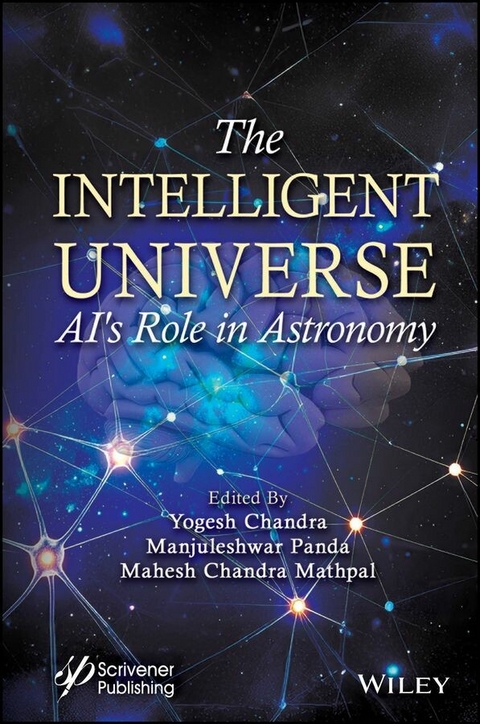
The Intelligent Universe (eBook)
718 Seiten
Wiley-Scrivener (Verlag)
978-1-394-35549-5 (ISBN)
Uncover the universe's secrets with this essential guide that provides a comprehensive exploration of how artificial intelligence is revolutionizing modern astronomical research.
Artificial intelligence (AI) is revolutionizing astronomy, enabling researchers to process vast datasets, uncover hidden patterns, and enhance observational precision like never before. This book explores this transformative synergy, bringing together insights from experts across the globe. Covering a wide spectrum of topics, including AI-driven data mining, exoplanet discovery, gravitational wave detection, and autonomous observatories, this book highlights the impact of machine learning, computer vision, and big data analytics on modern astrophysical research.
From detecting transient celestial events to refining cosmic evolution models, this volume delves into the ways AI is reshaping our understanding of the cosmos. As we enter a new era of discovery, this guide serves as both a foundational reference and a forward-looking exploration of AI's expanding role in space science. Whether you are a student, researcher in astronomy or space science, or an AI practitioner, this book offers an invaluable resource on the frontiers of AI-driven astronomical research.
Readers will find this volume:
- Provides a balanced mix of fundamental concepts, practical applications, and future perspectives;
- Designed to be informative and approachable, combining scientific insights, high-quality images, and detailed analyses to enhance understanding;
- Explores how AI is transforming space exploration, telescope automation, and cosmic data processing, providing readers a future-focused perspective.
Audience
Academics, researchers, astronomers, astrophysicists, and industry professionals interested in the transformative power of AI for astrological applications.
Yogesh Chandra, PhD is an assistant professor of physics at the Government Post Graduate College, Bazpur, Kumaun University, India. He has published several journal articles, mentored many students, and attended a number of conferences and workshops. He specializes in astronomy, astrophysics, and atmospheric science, with a focus on AI applications in these fields.
Manjuleshwar Panda is an independent astronomy researcher in New Delhi, India, with an M.Sc. in Physics from Kumaun University, Nainital, India. He has contributed to national and international research programs and has completed two specialized courses with the Indian Space Research Organization. He has a keen interest in observational and extragalactic astronomy, high-energy astrophysics, and the role of AI in astronomy.
Mahesh Chandra Mathpal, PhD is a lecturer in physics at Govt. IC Lohali, Uttarakhand, India. He has published over ten research papers in international journals and is actively engaged in advancing AI-driven astrophysical studies. His research focuses on astrophysics and solar physics, with a specialization in applying artificial neural networks (ANN) to these fields.
Uncover the universe s secrets with this essential guide that provides a comprehensive exploration of how artificial intelligence is revolutionizing modern astronomical research. Artificial intelligence (AI) is revolutionizing astronomy, enabling researchers to process vast datasets, uncover hidden patterns, and enhance observational precision like never before. This book explores this transformative synergy, bringing together insights from experts across the globe. Covering a wide spectrum of topics, including AI-driven data mining, exoplanet discovery, gravitational wave detection, and autonomous observatories, this book highlights the impact of machine learning, computer vision, and big data analytics on modern astrophysical research. From detecting transient celestial events to refining cosmic evolution models, this volume delves into the ways AI is reshaping our understanding of the cosmos. As we enter a new era of discovery, this guide serves as both a foundational reference and a forward-looking exploration of AI s expanding role in space science. Whether you are a student, researcher in astronomy or space science, or an AI practitioner, this book offers an invaluable resource on the frontiers of AI-driven astronomical research. Readers will find this volume: Provides a balanced mix of fundamental concepts, practical applications, and future perspectives; Designed to be informative and approachable, combining scientific insights, high-quality images, and detailed analyses to enhance understanding; Explores how AI is transforming space exploration, telescope automation, and cosmic data processing, providing readers a future-focused perspective. Audience Academics, researchers, astronomers, astrophysicists, and industry professionals interested in the transformative power of AI for astrological applications.
1
Introduction to AI in Astronomy
Rahul Barnwal1*, Aman Kumar2, Kala S.1 and Sree Ranjani Rajendran3
1Department of Electronics and Communication Engineering, Indian Institute of Information Technology Kottayam, Kerala, India
2Department of Physics, Savitribai Phule Pune University, Pune, India
3Department of Electrical Engineering and Computer Science, Florida Atlantic University, Boca Raton, Florida
Abstract
Astronomy is undergoing a transformative phase driven by the explosion of data from modern telescopes, satellites, and space missions. Due to the vast amount and complexity of these data, conventional analytical methods are no longer adequate, and artificial intelligence (AI) has emerged as a revolutionary tool. AI, through machine learning (ML) and deep learning (DL), allows astronomers to process vast amounts of data, detect intricate patterns, and make predictions that would be impossible through manual methods alone. AI is driving substantial advancements in several crucial domains, including galaxy classification, where machine learning algorithms can analyze millions of galaxies, identifying their shapes, structures, and characteristics far more efficiently than human classification. Similarly, AI is advancing the discovery of transient astronomical events like gamma-ray bursts and fast radio bursts, providing astronomers with the ability to detect and observe these short-lived phenomena in real time. In exoplanet research, AI techniques have revolutionized the way scientists sift through light curve data from missions like Kepler, leading to the discovery of many new exoplanets that would have otherwise gone unnoticed. A specialized type of deep learning, known as convolutional neural networks (CNNs), is also proving indispensable in the enhancement of astronomical images, enabling researchers to reduce noise, improve resolution, and extract meaningful features from the images of galaxies and other celestial objects. Beyond observational data, AI is playing a critical role in simulating large-scale cosmic phenomena, such as galaxy formation, dark matter distribution, and the behavior of black holes, which helps astronomers refine their models of the universe. Reinforcement learning is another innovative application, allowing AI systems to autonomously control and optimize telescope operations, improving the efficiency of astronomical observations. This integration of AI with autonomous telescopes enables real-time decision-making, ensuring that critical observations are not missed, particularly when dealing with transient or rapidly evolving events. Historically, AI’s journey in astronomy began with simple automation tasks, but it has evolved into an indispensable part of cutting-edge research, driving discoveries at an unprecedented rate. As next-generation observatories, such as the James Webb Space Telescope, become operational, AI’s role will become even more critical in processing the exponentially increasing volumes of data. The synergy between AI and human expertise promises to push the boundaries of what we know about the universe, leading to deeper insights and helping astronomers address some of the most profound questions about the cosmos. As AI continues to gain significance, it is clear that it is not merely a tool but a fundamental collaborator in unraveling the mysteries of the universe. This chapter explores the diverse applications of AI in astronomy and highlights the ways in which it will shape the future of cosmic discovery.
Keywords: Artificial intelligence, astronomy, machine learning, deep learning, data analysis, galaxy classification, cosmic phenomena, telescope optimization, celestial discovery
1.1 Introduction
Imagine standing beneath a vast star-studded sky on a clear night, gazing at the twinkling dots scattered across the heavens. For millennia, these celestial wonders have captivated poets, dreamers, and scientists alike. What secrets do they hold? How did they form? How do they evolve, and what can they tell us about the origins of our universe? These profound questions have fueled human curiosity since the dawn of civilization. Astronomy [1], at its core, is a journey of exploration—a quest to unravel the mysteries of existence, from the birth of stars to the enigmatic nature of black holes and the exploration of planets outside our solar system. The tools of astronomy have evolved dramatically over the centuries. Early civilizations charted the heavens with the naked eye, creating elaborate maps of the night sky. The invention of the telescope in the 17th century revolutionized our understanding of space, allowing astronomers to peer deeper into the cosmos. In the modern era, spacecraft, space telescopes, and radio observatories have expanded our vision beyond what was once unimaginable. Today, we can detect gravitational waves rippling through space-time, witness distant galaxies colliding, and analyze the chemical signatures of exoplanet atmospheres—all from millions or even billions of light-years away. However, with these advances comes an overwhelming flood of data. The universe is vast, and the amount of information collected by modern telescopes is staggering. Every second, space observatories capture terabytes of data, imaging galaxies at unimaginable distances, detecting faint signals from pulsars, and even searching for potential signs of extraterrestrial life. The sheer scale of this information presents an enormous challenge: how do we analyze it efficiently? Traditional methods, relying on manual examination and conventional algorithms, simply cannot keep up. If sifting through astronomical data was once like piecing together a thousand-piece puzzle, today’s challenge is akin to assembling a trillion-piece mosaic within a day. Enter artificial intelligence (AI), the modern-day navigator in our cosmic voyage [2]. AI has revolutionized nearly every scientific field, and astronomy is no exception. Utilizing ML and DL approaches, scientists can identify patterns, forecast outcomes, and tackle challenges that were previously considered unsolvable. Consider the case of exoplanets—planets beyond our solar system. In the past, astronomers had to painstakingly sift through telescope data to identify tiny dips in a star’s luminosity, indicating a planet passing in front of it. This process could take years. Today, AI accomplishes this in mere hours, identifying thousands of new exoplanets with remarkable accuracy. Similarly, AI-driven algorithms help classify galaxies, detect transient cosmic events like supernovae, and even interpret gravitational wave signals from black hole mergers. What once required months of human effort is now completed in fractions of the time. The true beauty of AI in astronomy lies not just in its speed but in its ability to learn and adapt. Neural networks, inspired by the human brain, recognize patterns with astonishing precision. Just as we can instantly distinguish a constellation from a cluster of stars, AI can differentiate between different types of galaxies, identify celestial anomalies, and generate highly accurate simulations of the early universe. These advancements are more than just conveniences; they are fundamental to pushing the boundaries of our knowledge. Beyond exoplanet discovery and galaxy classification, AI is making its mark in other critical areas of astrophysics. For instance, AI-powered algorithms are helping scientists map dark matter distributions by analyzing the gravitational lensing effects visible in astronomical images. Dark matter, an unseen and enigmatic substance, is thought to constitute a substantial part of the universe, yet it cannot be directly observed. AI’s ability to detect subtle distortions in light has provided deeper insights into this elusive component of the cosmos. Additionally, AI is revolutionizing the study of black holes by sifting through radio telescope data to construct detailed images, such as the now-iconic first-ever photograph of a black hole’s event horizon, captured by the Event Horizon Telescope. Another groundbreaking use of AI in astronomy is the automated capturing of fast radio bursts (FRBs) [3], enigmatic and powerful bursts of radio waves originating from deep space. Their transient nature makes them difficult to capture using conventional methods, but AI has enabled real-time identification of these signals, resulting in new discoveries and a deeper insight into their potential origins. Looking ahead, AI’s role in astronomy will only continue to grow. With the upcoming launch of next-generation telescopes like the Nancy Grace Roman Space Telescope, the volume of data will expand exponentially. AI-driven methodologies will be indispensable in handling this deluge, allowing researchers to automate discovery processes, identify new cosmic phenomena, and even refine our understanding of fundamental physics. But how does this magic work? What exactly is AI, and what tools does it offer? How do concepts like neural networks, CNNs, and DL algorithms connect to the world of astronomy? In the chapters ahead, we will delve into the fascinating realm of artificial intelligence, beginning with its core principles and exploring its deep impact on astronomical research. We will break down complex ideas, provide real-world examples, and showcase how AI is revolutionizing our understanding of the cosmos. The universe has always been a frontier of discovery, and now, with AI as our guide, we stand at the brink of an unprecedented era of exploration. The mysteries of the stars are waiting— let us embark on this extraordinary journey together.
1.2...
| Erscheint lt. Verlag | 30.9.2025 |
|---|---|
| Sprache | englisch |
| Themenwelt | Naturwissenschaften ► Physik / Astronomie ► Astronomie / Astrophysik |
| ISBN-10 | 1-394-35549-1 / 1394355491 |
| ISBN-13 | 978-1-394-35549-5 / 9781394355495 |
| Informationen gemäß Produktsicherheitsverordnung (GPSR) | |
| Haben Sie eine Frage zum Produkt? |
 EPUB (Adobe DRM)
Kopierschutz: Adobe-DRM
Adobe-DRM ist ein Kopierschutz, der das eBook vor Mißbrauch schützen soll. Dabei wird das eBook bereits beim Download auf Ihre persönliche Adobe-ID autorisiert. Lesen können Sie das eBook dann nur auf den Geräten, welche ebenfalls auf Ihre Adobe-ID registriert sind.
Details zum Adobe-DRM
Dateiformat: EPUB (Electronic Publication)
EPUB ist ein offener Standard für eBooks und eignet sich besonders zur Darstellung von Belletristik und Sachbüchern. Der Fließtext wird dynamisch an die Display- und Schriftgröße angepasst. Auch für mobile Lesegeräte ist EPUB daher gut geeignet.
Systemvoraussetzungen:
PC/Mac: Mit einem PC oder Mac können Sie dieses eBook lesen. Sie benötigen eine
eReader: Dieses eBook kann mit (fast) allen eBook-Readern gelesen werden. Mit dem amazon-Kindle ist es aber nicht kompatibel.
Smartphone/Tablet: Egal ob Apple oder Android, dieses eBook können Sie lesen. Sie benötigen eine
Geräteliste und zusätzliche Hinweise
Buying eBooks from abroad
For tax law reasons we can sell eBooks just within Germany and Switzerland. Regrettably we cannot fulfill eBook-orders from other countries.
aus dem Bereich