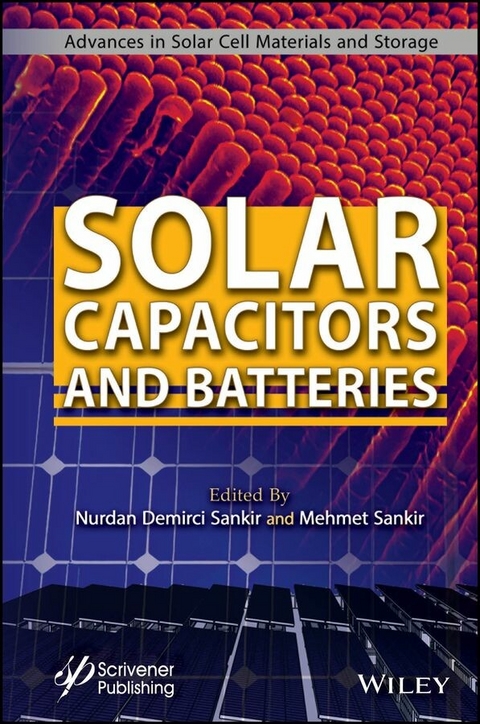
Solar Capacitors and Batteries (eBook)
673 Seiten
Wiley-Scrivener (Verlag)
978-1-394-23377-9 (ISBN)
Dive into the future of clean energy with this essential guide, offering a comprehensive look at the innovative power of batteries and supercapacitors for the efficient storage and utilization of solar power.
The storage of solar energy is as important as its harvesting. So far, solar energy has been primarily stored using electrochemistry-based batteries. Generally, batteries that can be charged with solar energy serve domestic and portable systems, especially in devices with low energy use. In addition to classic devices, innovative devices have been developed in recent years that provide both the conversion and storage of solar energy. In the last few years, supercapacitors have gained significant recognition due to their low cost, safe operation, fast charge-discharge cycles, high power density, and cyclic stability. This book comprehensively covers both batteries that can be charged with solar energy and photo-supercapacitors. Through expert insights and real-world case studies, this book offers an in-depth look at these innovative technologies and how they are shaping a more sustainable future.
Readers will find this volume:
- Introduces different systems that enable the conversion and storage of solar energy;
- Covers the systems for designing photovoltaic cells, storage units such as batteries and capacitors, and the structures and operating principles of integrated devices with conversion and storage functions;
- Explains device structures, working principles, and performance tests, and the highly efficient and innovative materials used in these systems;
- Explores cutting-edge technologies for the future of solar energy conversion and storage systems.
Audience
Chemists, physicists, engineers, students, educators, and policymakers working with solar-assisted capacitors and batteries.
Nurdan Demirci Sankir, PhD is a professor in the Materials Science and Nanotechnology Engineering Department at the TOBB University of Economics and Technology, Ankara, Turkey. She has edited eight books and is actively involved in research and consulting activities. Her expertise focuses on photovoltaic devices, solution-based thin-film manufacturing, solar-driven water splitting, photocatalytic degradation, and nanostructured semiconductors.
Mehmet Sankir, PhD is a professor in the Department of Materials Science and Nanotechnology Engineering at TOBB University of Economics and Technology and group leader of the Advanced Membrane Technologies Laboratory, Ankara, Turkey. He is actively involved in research and consulting activities and has edited eight books. His research focuses on membranes for fuel cells, flow batteries, hydrogen generation, and desalination.
1
Photosupercapacitor
Mohamad Mohsen Momeni* and Hossein Mohammadzadeh Aydisheh
Department of Chemistry, Isfahan University of Technology, Isfahan, Iran
Abstract
Energy is a fundamental pillar of human society, playing a pivotal role across various sectors, including industry, agriculture, and transportation. Over the past decades, the energy demand has steadily risen. However, our global energy supply still heavily relies on nonrenewable fossil fuels—coal, oil, and natural gas—which pose risks such as energy crises and the accumulation of greenhouse and toxic gases in the atmosphere, contributing to global environmental challenges. We must turn to cleaner and more sustainable energy sources to address these issues. Wind, hydro, tidal, geothermal, and solar energy are excellent examples of such alternatives. These renewable resources offer inexhaustible supplies and are increasingly competitive in today’s energy landscape. Among the available energy sources, solar energy stands out as a renewable and abundant clean alternative to conventional fossil fuels. Leveraging the abundance of solar energy, storage devices like batteries and supercapacitors can serve as uninterrupted energy reservoirs when integrated with solar cells. However, the highly fluctuating nature of solar energy often leads to misalignment with actual energy demand. To address this challenge, direct conversion and electrochemical storage of solar energy are practical strategies. In this chapter, we delve into the principles governing integrated devices. We explore major types of essential integrated devices, emphasizing the development of high-performance systems based on solar energy conversion components, including photosupercapacitors. Additionally, we combine recent advancements and modern technologies in solar energy storage, with a keen focus on novel materials. Lastly, we address the challenges and opportunities for future development.
Keywords: Environmental challenges, renewable energy, solar energy, photosupercapacitor
1.1 Introduction
The indiscriminate use of fossil fuels has led to the significant production of toxic and greenhouse gases (e.g., CO, CO2, SOx, NOx), resulting in global warming and critical environmental and health issues. Factors such as population growth, fossil fuel depletion, and limitations in conventional energy sources have prompted a shift toward renewable energy alternatives, including wind, tidal, hydro, and solar energy (see Figure 1.1). Among these options, harnessing abundant solar energy for green electricity stands out due to its global availability, lack of pollution, and cost-effectiveness. This approach represents a promising pathway toward achieving a sustainable global civilization. Therefore, the development of solar energy conversion technologies and solar cells is of utmost importance. One of the major limitations the present solar electricity production technologies hold is that they are not capable of storing the solar energy directly within them. Unlike fossil fuels, which can be stored for later use, solar energy is typically converted into electricity for immediate consumption. Thus, in practical terms for application, an energy storage system like a battery or supercapacitor is needed to store the energy for later use. Among these storage devices, supercapacitors show high power and energy densities against traditional batteries and capacitors. Supercapacitors have been considered in the past for storing solar energy using an external wire connection. This approach results in two systems with no integration: the solar cell system and the supercapacitor system. Unfortunately, this architecture had very complicated development steps, so the cell and supercapacitor designs were extremely large and space-consuming. Moreover, high external resistance was created, which induced high power losses because of the external interconnection among the cells and energy storage devices. To overcome these limitations, integrated energy harvesting and storage devices have emerged. These integrated systems, while efficient, pose challenges related to device packaging efficiency and ohmic transport losses. Additionally, the output voltage of photovoltaic cells often falls short of fully charging batteries or capacitors. Consequently, supplementary electronics are required, adding to the overall cost of these energy storage solutions [1–7]. In the realm of energy harvesting and storage, a critical imperative arises: the development of novel strategies that meet the demands of current and future wearable devices. Addressing this challenge has led to an empirical solution—integrating solar cells and energy storage components within a single module. This remarkable hybrid technology, known as the photosupercapacitor, seamlessly combines energy harvesting and storage functionalities in a single device. Its potential impact extends to various domains, including public transport, hybrid electric vehicles, military applications, and space exploration. As we look ahead, this integrated approach promises to be a significant boon for efficient energy utilization [2, 3]. In this chapter, we include the basic concepts and the latest developments on advanced integrated energy devices. We first give some basic concepts about these advanced devices, considering their integration modes and complex processes of solar energy conversion and storage. We then categorize two kinds of integrated devices into photovoltaic and photoelectrochemical rechargeable supercapacitors according to their two different device configurations, summarized in detail. Finally, we outline the most important challenges and opportunities for future research in developing new, state-of-the-art integrated devices for the conversion and storage of solar energy. We think that by entering this frontier, we will see transformational breakthroughs that will set a new trajectory in using sustainable energy in the future [4, 5].
Figure 1.1 Various clean and renewable energy sources [1–7].
1.2 Photosupercapacitors
Photosupercapacitors represent an innovative class of energy storage devices that combine the principles of supercapacitors with the characteristics of photovoltaic cells. These devices are designed by integrating elements from dye-sensitized perovskite or organic/silicon solar cells with various supercapacitor technologies into a unified module. The resulting bifunctional systems are capable of efficiently converting solar energy into electrical charge, thereby enhancing energy storage capabilities [6, 7]. When light interacts with the photoactive material in photosupercapacitors, it generates an electrical charge that is subsequently stored within the supercapacitor. This stored energy can be readily released as needed to power electronic devices. One of the classes of energy storage devices that has promise is photosupercapacitors, which elegantly merge concepts from supercapacitors and photovoltaic cells. The photoactive material, under illumination of light, generates electrons that migrate toward the transparent electrode. These electrons finally get stored as electrostatic charge in the supercapacitor until it is needed. Photosupercapacitors offer a number of advantages compared to traditional batteries. They are also highly efficient and long lasting in that they can charge and discharge fast and as many times as one desires without loss of performance. Another added advantage of their eco-friendliness is their reliance upon renewable energy sources and their cycle life, which permits them to undergo many charge– discharge cycles without degradation. Potential applications for photosupercapacitors include wearable electronics, sensors, and energy-harvesting devices. Moreover, they have huge potential for smart windows; they will store the solar energy and emit heat at night, which can help save energy in heating and cooling. Though photosupercapacitors offer such benefits, the process is still in an infant stage. Researchers constantly search for new materials and design innovations that will increase their efficiency, durability, and scalability since there are several problems within the development of this exciting field [8].
1.3 Designs and Principles of Photosupercapacitor
The generic functionality of a photosupercapacitor involves two main processes: light absorption and charge storage. In short, the mechanism entails that the incident light interfacing with the photovoltaic material within the device generates electron–hole pairs. These photogenerated electrons and holes are separated thereafter and moved toward the electrodes, generating accumulation of charge on the electrode surfaces. This stored charge is released, on demand, for the delivery of electrical power. Basically, photosupercapacitors can be divided into two main groups: two-electrode and three-electrode systems. Their design for each type and the operational mechanism have been explained in this paper below [9].
1.3.1 Three-Electrode Systems
In laboratory, researchers employ three-electrode systems for researching and developing new materials for photosupercapacitor applications. These systems consist of the following components:
Photoelectrode: This electrode, made from conducting and optically transparent substrates, serves as the working electrode. Commonly used substrates include Sn-doped In2O3 (ITO), F-doped SnO2 (FTO), Sb-doped SnO2 (ATO), and Al-doped ZnO (AZO).
Reference electrode:...
| Erscheint lt. Verlag | 30.9.2025 |
|---|---|
| Reihe/Serie | Advances in Solar Cell Materials and Storage |
| Sprache | englisch |
| Themenwelt | Naturwissenschaften ► Physik / Astronomie |
| Technik ► Elektrotechnik / Energietechnik | |
| ISBN-10 | 1-394-23377-9 / 1394233779 |
| ISBN-13 | 978-1-394-23377-9 / 9781394233779 |
| Informationen gemäß Produktsicherheitsverordnung (GPSR) | |
| Haben Sie eine Frage zum Produkt? |
 EPUB (Adobe DRM)
Kopierschutz: Adobe-DRM
Adobe-DRM ist ein Kopierschutz, der das eBook vor Mißbrauch schützen soll. Dabei wird das eBook bereits beim Download auf Ihre persönliche Adobe-ID autorisiert. Lesen können Sie das eBook dann nur auf den Geräten, welche ebenfalls auf Ihre Adobe-ID registriert sind.
Details zum Adobe-DRM
Dateiformat: EPUB (Electronic Publication)
EPUB ist ein offener Standard für eBooks und eignet sich besonders zur Darstellung von Belletristik und Sachbüchern. Der Fließtext wird dynamisch an die Display- und Schriftgröße angepasst. Auch für mobile Lesegeräte ist EPUB daher gut geeignet.
Systemvoraussetzungen:
PC/Mac: Mit einem PC oder Mac können Sie dieses eBook lesen. Sie benötigen eine
eReader: Dieses eBook kann mit (fast) allen eBook-Readern gelesen werden. Mit dem amazon-Kindle ist es aber nicht kompatibel.
Smartphone/Tablet: Egal ob Apple oder Android, dieses eBook können Sie lesen. Sie benötigen eine
Geräteliste und zusätzliche Hinweise
Buying eBooks from abroad
For tax law reasons we can sell eBooks just within Germany and Switzerland. Regrettably we cannot fulfill eBook-orders from other countries.
aus dem Bereich