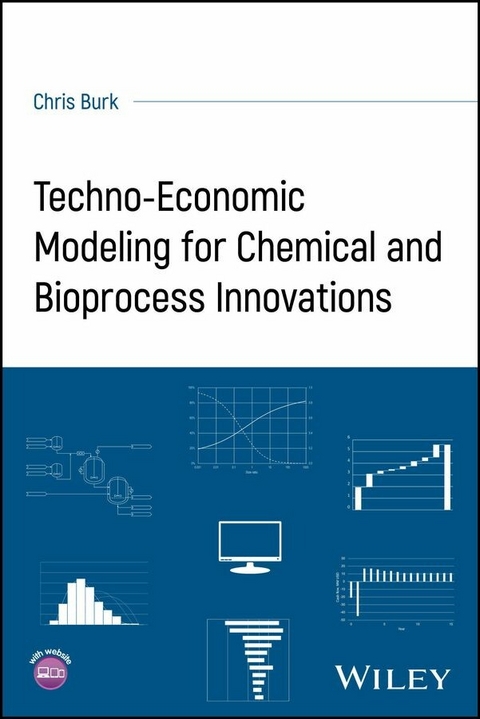
Techno-Economic Modeling for Chemical and Bioprocess Innovations (eBook)
497 Seiten
Wiley (Verlag)
978-1-394-24642-7 (ISBN)
Build spreadsheet-based techno-economic models to understand factors driving economic value
Techno-economic modeling examines how technical and financial parameters influence the economic value of a technology at the commercial scale. Techno-Economic Modeling for Chemical and Bioprocess Innovations is a practical guide to building spreadsheet-based techno-economic models and using them to make better decisions on the road to market.
Inside, this book:
- Explains the role of techno-economic modeling in advancing new technologies toward commercialization.
- Presents spreadsheet best practices that form the foundation for effective and efficient techno-economic modeling.
- Teaches how to combine process modeling, equipment sizing, and cost estimation in a cohesive and usable spreadsheet model.
- Introduces techniques for analyzing model results to assess economic viability, quantify uncertainty, inform R&D priorities, and improve stakeholder communication.
- Provides practical Excel and VBA examples, with two complete sample models available online.
This book equips readers with the tools to combine science, engineering, and cost estimation. It is an essential resource for chemical and bioprocess engineers, including academics, startup teams, and advanced students working to bring innovations into the world.
Chris Burk is a chemical engineer and consultant. He is a leader in the field of techno-economic modeling for tough-tech innovations. Chris has developed models for over 100 technologies, built a library of software tools, and has written and spoken extensively on the subject. He regularly works with startups from the top tough-tech focused organizations in the United States, such as Activate and MIT's The Engine, as well as many others.
Introduction
I.1 Why Chemical and Bioprocess Technologies Are Important
Chemical and bioprocess technologies – or just process technologies for short – typically involve the reaction, separation, or transformation of bulk liquids, solids, and gases. They fall squarely in the domain of chemical and bioprocess engineers.1
Process technologies are central to a wide range of industries, from energy and carbon capture to mineral extraction, foods, cosmetics, biofuels, plastics, and electrochemistry. They’re crucial in maintaining our quality of life and tackling the many critical challenges we face, such as reducing our environmental impact, combating global warming, decreasing dependence on fossil fuels, and feeding a growing population.
I.2 Why We Need to Care About Economics
For a technology to be useful at scale in the real world, it needs to do more than just work – it needs to be economically viable. Typically, this means generating more money than it consumes or being less costly than alternative solutions.
There is more to this statement than rote capitalism. In an efficient economy, price serves as a measure of value to society – value in the sense of importance or utility. In this light, money is a tool to equitably measure and compare the value of a product versus that of the materials, energy, labor, and time used to produce it.
While impact‐driven investors may have lower thresholds for return on investment and environmentally‐conscious customers might be willing to pay extra for certain goods, their altruism remains constrained by economic realities, and technologies still need to compete on price. As a result, any scientist, engineer, investor, or policymaker aiming to bring new technologies to the world, whatever their motivation may be, needs to also be concerned with economic viability.
In some sectors, like software, economic viability largely depends on consumer sentiment and marketing, which often have little to do with production costs. However, the economic viability of process technologies is explicitly constrained by laws of physics, chemistry, and biology. Many ideas are impractical simply because scientific or engineering constraints make them uneconomical – in other words, their benefits don’t outweigh their costs. Consider a precious metal recovery technology. If its operational costs exceed the value of the metals extracted, it won’t find any practical application. After all, who would use a process that loses money?
I.3 Development of Process Technologies
Innovation in the process industries, driven by societal goals and economic pressures, typically stems from scientific or engineering discoveries – a new catalyst, an advanced membrane, an innovative piece of equipment, etc. These discoveries are usually first demonstrated at small scale by researchers in a laboratory. However, to achieve industrial relevance, they must undergo a process of scaling up.
On the one hand, scaling is necessary to produce useful amounts of the product or service, but scaling is also usually needed for economic viability. Larger scale processes cost less to build and operate per unit of production. This concept is known as economy of scale.
The degree to which a technology needs to be scaled depends on the application, but scaling usually happens in discrete stages. The classic progression in the process industry starts with bench scale and is followed by pilot scale, demonstration scale, and finally commercial scale. Each of these stages typically involves a 10–100× increase in capacity.
Scaling in stages helps manage risk. At each intermediate step, engineers collect data to assess technical feasibility and inform engineering design at the next stage. They also collect data to assess economic viability.
Crucially, it is the economic viability at commercial scale that really matters. Pilot and demonstration plants are essentially large‐scale experiments. Their costs are important for fundraising and business cash flow planning, and interim milestones are critical to progress and securing continued funding, but a technology’s economic viability ultimately rests on its commercial implementation, and so this should serve as the primary basis for decisions on whether to proceed.
I.4 Risk in Process Technology Development
It can take a long time to scale a technology from the lab to commercialization, and each stage in the progression involves a larger capital investment. The exact timeline and amount of money required depends on the application, but developing a process technology to the point of commercialization can take 10 or more years and tens of millions of dollars. Implementing the commercial process can then cost tens or hundreds of millions more.
From a stakeholder’s perspective, there is a lot of intrinsic risk. Risk is the product of the likelihood and the consequences of a negative outcome:
The negative outcome in this instance would be a failure to commercialize the technology.
Assuming a sound market analysis, the likelihood of failure includes (1) the likelihood of encountering an insurmountable scientific or engineering challenge or a technical failure and (2) the likelihood of discovering that the technology is not economically viable. These two aspects are interdependent because a process must meet certain technical targets to achieve economic viability. However, economic viability also depends on market conditions and even politics, which can influence the available incentives. The uncertainty in these factors is amplified by the long timeline from lab to commercialization.
Turning to the other half of the equation, the obvious consequence of failure for the stakeholder is the loss of their financial investment. But if you expand the definition of stakeholder to include not just founders and investors but the nation or even the global community, then the consequences include the loss of all the resources consumed – person‐hours, funding, taxpayer dollars, natural resources, land, etc. – resources that could have been used elsewhere, such as in the development of a successful technology.
There are undoubtedly collateral benefits resulting from failed development efforts: The developers may make discoveries that prove useful in other areas or their experiences may inspire the development of some different successful technology. However, given that our resources are limited, if our goal is to develop and commercialize high‐impact technologies, we should strive to direct those resources toward the most promising ones.
I.5 What Is Techno‐Economic Modeling?
When evaluating a technology for commercialization, developers and investors consider its anticipated benefits and costs along with the associated uncertainty. The earlier and more accurately they can estimate these variables, the better they can direct their efforts and resources away from dead ends and toward potentially successful, high‐impact objectives. This is where techno‐economic modeling (TEM) becomes useful.
TEM uses software modeling to examine how technical and financial parameters influence the economic value of a process or technology:
- Technical parameters. R&D results and engineering assumptions.
- Financial parameters. Prices for raw materials, utilities, waste treatment, labor, etc., and factors for overhead, maintenance, etc. Cost correlations for equipment.
- Economic value. Levelized product cost, net present value, profit margin, payback, etc.
TEM is valuable for assessing economic viability, but a good model is more than a one‐off cost estimate; it is a tool for understanding design trade‐offs and development risks and for effectively guiding development. For example, sensitivity analyses, like the tornado diagram shown in Figure I.1, can help developers identify technical opportunities, risks, and areas of uncertainty. This information can then be used to direct development efforts toward the most promising targets (see Part III for more on building and interpreting tornado diagrams.)
Figure I.1 Tornado diagrams can be used to identify technical opportunities, risks, and areas of uncertainty.
The practice of TEM combines three skills: process engineering, cost estimation, and model building. The first two skills are well‐known to chemical and bioprocess engineers and have been covered extensively in the literature [1–4]. It is the third skill – model building – that enables effective TEM and is the main focus of this book.
I.6 When Is the Right Time for Techno‐Economic Modeling?
If a technology is selected for development toward commercialization, it generally means that the developers believe it has the potential to be economically viable. At some level, they are drawing certain assumptions from their understanding of the technology and market, and concluding that further development is warranted. TEM works the same way, except it makes the logic and assumptions explicit.
A techno‐economic model ideally represents your best current understanding of the technology. This includes your best approximation of the process design and informed estimates of the values and ranges for the governing parameters. Granted, early‐stage...
| Erscheint lt. Verlag | 30.9.2025 |
|---|---|
| Sprache | englisch |
| Themenwelt | Naturwissenschaften ► Chemie |
| Schlagworte | Techno-economic analysis • techno-economic benefit • techno-economic finance • techno-economic models • techno-economic processes techno-economic projects • techno-economic risk • techno-economic risks • techno-economic sustainability |
| ISBN-10 | 1-394-24642-0 / 1394246420 |
| ISBN-13 | 978-1-394-24642-7 / 9781394246427 |
| Informationen gemäß Produktsicherheitsverordnung (GPSR) | |
| Haben Sie eine Frage zum Produkt? |
 EPUB (Adobe DRM)
Kopierschutz: Adobe-DRM
Adobe-DRM ist ein Kopierschutz, der das eBook vor Mißbrauch schützen soll. Dabei wird das eBook bereits beim Download auf Ihre persönliche Adobe-ID autorisiert. Lesen können Sie das eBook dann nur auf den Geräten, welche ebenfalls auf Ihre Adobe-ID registriert sind.
Details zum Adobe-DRM
Dateiformat: EPUB (Electronic Publication)
EPUB ist ein offener Standard für eBooks und eignet sich besonders zur Darstellung von Belletristik und Sachbüchern. Der Fließtext wird dynamisch an die Display- und Schriftgröße angepasst. Auch für mobile Lesegeräte ist EPUB daher gut geeignet.
Systemvoraussetzungen:
PC/Mac: Mit einem PC oder Mac können Sie dieses eBook lesen. Sie benötigen eine
eReader: Dieses eBook kann mit (fast) allen eBook-Readern gelesen werden. Mit dem amazon-Kindle ist es aber nicht kompatibel.
Smartphone/Tablet: Egal ob Apple oder Android, dieses eBook können Sie lesen. Sie benötigen eine
Geräteliste und zusätzliche Hinweise
Buying eBooks from abroad
For tax law reasons we can sell eBooks just within Germany and Switzerland. Regrettably we cannot fulfill eBook-orders from other countries.
aus dem Bereich