


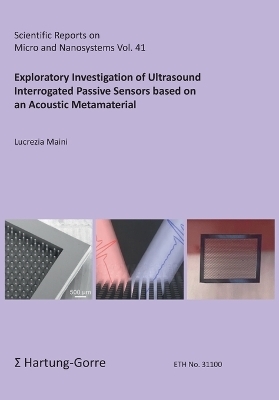
Exploratory Investigation of Ultrasound Interrogated Passive Sensors based on an Acoustic Metamaterial
Seiten
2025
|
2025
Hartung-Gorre (Verlag)
9783866288454 (ISBN)
Hartung-Gorre (Verlag)
9783866288454 (ISBN)

Wireless technologies have significantly influenced the development of new
sensing concepts for continuous health monitoring and disease detection.
Compared to wired solutions, wireless sensors overcome limitations such as
risk of infection and discomfort caused by tethered connections. Wireless
systems are classified as passive (powerless) and active (powered). Active
solutions face significant challenges both in terms of power management
and fabrication, requiring the integration of complex electronic components
and circuits. Furthermore, active devices may require power source
replacement, which can lead to health risks and complications for the
patient. In contrast, passive devices present reduced complications thanks
to their powerless nature and simpler architecture. Wireless devices
typically rely on electromagnetic coupling interrogation for powering or
data transmission. Electromagnetic waves, while being a common approach
for sensing interrogation, are limited by overheating risks associated with
high energy absorption and scattering in tissue. Moreover, the development
of customized receivers for these sensing applications requires significant
design investment.
Due to their mechanical nature, acoustic waves achieve comparable
penetration depths to electromagnetic waves at lower power levels.
Furthermore, standardized clinical equipment such as echographs can be
utilized for interrogation in the MHz regime (ultrasound). Acoustic sensors
based on ultrasound interrogation have already been explored, but they are
mostly limited by the spatial resolution of commercially-available
transducers, often insufficient to measure variations of biomedical
parameters of interest (e.g. pressure, temperature). This thesis presents a
new approach to perform intracorporeal sensing, investigating the
advantages of frequency resolution and ultrasound interrogation. In
particular, this is achieved exploiting the high resonant states generated by
an acoustic metamaterial. Metamaterials (from Greek: μϵτα, "beyond"
conventional matter), engineered structures by design, exhibit properties
beyond those of conventional materials. While fundamental research on
metamaterials spans more than three decades, their application to
ultrasound for the development of new and innovative medical devices is
still in the early stages.
The acoustic metamaterial presented in this thesis consists of
three-dimensional silicon micropillars (radius: 35 μm), arranged in a
honeycomb lattice, and embedded in a polymeric matrix (PDMS,
polyimethylsiloxane), which also acts as an encapsulation material. This
design combines the high amplitude of the resonance mode of the
metamaterial with the temperature and pressure sensitivity introduced by
the presence of the PDMS matrix. The objectives of this thesis are focused
on the demonstration of (1) temperature and (2) pressure sensing
capabilities, within ranges of interest for medical applications. Specifically,
temperature sensitivity is evaluated in the 36◦ ÷ 41◦C range and pressure
sensitivity in the 0 ÷ 200 mbar range. Temperature applications are
relevant for the detection of infections in failing implants. Pressure sensing
requirements were selected in collaboration with our clinical partners from
the Deutsches Herzzentrum der Charité, DHZC, Charité Hospital. In
particular, pressure specifications were defined for bi-atrial pressure
monitoring, as a key indicator of relevant cardiovascular conditions, such as
heart failure.
The metamaterial (henceforth, PDMS-Meta) was initially characterized in
water. Its response was compared to a bilayer of silicon and PDMS
(henceforth, Bilayer), and to the metamaterial without the PDMS matrix
(henceforth, Si-Meta). These two structures were utilized to elucidate the
physical mechanism behind the temperature sensitivity. The temperature
resolution achieved by the PDMS-Meta is below 0.1 K (0.03 K), with a
temperature sensitivity of −2.9 · 10−3 K-1. The physical origin of
temperature sensitivity was investigated by experiments and Finite
Element Method (FEM) simulations and explained as a
temperature-dependency of the bulk modulus of the PDMS.
Temperature characterization was repeated in presence of tissue mimicking
materials, TMMs—imaging samples with acoustic properties comparable to
those of human muscle—and with animal tissue (pork loin) to assess the
effect of scattering and attenuation on the temperature performance.
Temperature sensitivity was comparable in the three media
(−3.4 · 10−3 K-1, −3 · 10−3 K-1, −3.5 · 10−3 K-1, in water and in presence
of the TMM and tissue, respectively), although the temperature resolution
degraded (0.02 K, 0.12 K, 0.18 K, in water, TMM and tissue). The
achieved temperature resolution in presence of tissue is comparable to the
resolution of infrared cameras utilized in medical thermometry (0.1 K).
The measurement location was observed to strongly influence the
temperature results in presence of highly inhomogeneous media as an effect
of the multiple interferences introduced by the tissue.
Finally, pressure characterization of the Bilayer, PDMS-Meta and Si-Meta
was performed in water with a bulge-test setup. Pressure sensitivity was
significantly higher in the PDMS-Meta and the Bilayer, although opposite
in sign (−4.3 · 10−6 mbar-1 and 11 · 10−6 mbar-1, respectively) in
comparison to the Si-Meta (−0.5 · 10−6 mbar-1). Pressure resolution was
comparable in the PDMS-Meta and Bilayer (11.6 mbar vs 18.3 mbar,
respectively), but significantly lower in the Si-Meta (224.8 mbar). The
origin of pressure sensitivity was investigated by FEM simulations. In the
Bilayer, the primary mechanism was identified as a geometrical effect in
the PDMS layer. For the PDMS-metamaterial, the pressure sensitivity is
potentially attributed to a strain-dependent variation in the speed of sound
within the PDMS. The achieved pressure resolution enables the detection
of pressure changes equivalent to systolic and diastolic pressure values
(13 mbar vs 187 mbar) in ideal conditions (water).
As a next step, alternative metamaterial designs could be investigated to
exploit anisotropy with respect to the direction of interrogation of the
ultrasound source. This approach could be particularly useful in
multi-modal sensing to decouple each contribution. Furthermore, the
current spatial dependency of the results should be addressed, for instance
with a multichannel setup with enhanced time averaging modality, to
enable the interrogation of the sensor at multiple locations with improved
signal resolution.
The presented sensor opens the way to a new class of zero-power devices
based on acoustic metamaterials and ultrasound interrogation to perform
remote sensing with limited integration and, potentially, exposure
complications for the patient.
sensing concepts for continuous health monitoring and disease detection.
Compared to wired solutions, wireless sensors overcome limitations such as
risk of infection and discomfort caused by tethered connections. Wireless
systems are classified as passive (powerless) and active (powered). Active
solutions face significant challenges both in terms of power management
and fabrication, requiring the integration of complex electronic components
and circuits. Furthermore, active devices may require power source
replacement, which can lead to health risks and complications for the
patient. In contrast, passive devices present reduced complications thanks
to their powerless nature and simpler architecture. Wireless devices
typically rely on electromagnetic coupling interrogation for powering or
data transmission. Electromagnetic waves, while being a common approach
for sensing interrogation, are limited by overheating risks associated with
high energy absorption and scattering in tissue. Moreover, the development
of customized receivers for these sensing applications requires significant
design investment.
Due to their mechanical nature, acoustic waves achieve comparable
penetration depths to electromagnetic waves at lower power levels.
Furthermore, standardized clinical equipment such as echographs can be
utilized for interrogation in the MHz regime (ultrasound). Acoustic sensors
based on ultrasound interrogation have already been explored, but they are
mostly limited by the spatial resolution of commercially-available
transducers, often insufficient to measure variations of biomedical
parameters of interest (e.g. pressure, temperature). This thesis presents a
new approach to perform intracorporeal sensing, investigating the
advantages of frequency resolution and ultrasound interrogation. In
particular, this is achieved exploiting the high resonant states generated by
an acoustic metamaterial. Metamaterials (from Greek: μϵτα, "beyond"
conventional matter), engineered structures by design, exhibit properties
beyond those of conventional materials. While fundamental research on
metamaterials spans more than three decades, their application to
ultrasound for the development of new and innovative medical devices is
still in the early stages.
The acoustic metamaterial presented in this thesis consists of
three-dimensional silicon micropillars (radius: 35 μm), arranged in a
honeycomb lattice, and embedded in a polymeric matrix (PDMS,
polyimethylsiloxane), which also acts as an encapsulation material. This
design combines the high amplitude of the resonance mode of the
metamaterial with the temperature and pressure sensitivity introduced by
the presence of the PDMS matrix. The objectives of this thesis are focused
on the demonstration of (1) temperature and (2) pressure sensing
capabilities, within ranges of interest for medical applications. Specifically,
temperature sensitivity is evaluated in the 36◦ ÷ 41◦C range and pressure
sensitivity in the 0 ÷ 200 mbar range. Temperature applications are
relevant for the detection of infections in failing implants. Pressure sensing
requirements were selected in collaboration with our clinical partners from
the Deutsches Herzzentrum der Charité, DHZC, Charité Hospital. In
particular, pressure specifications were defined for bi-atrial pressure
monitoring, as a key indicator of relevant cardiovascular conditions, such as
heart failure.
The metamaterial (henceforth, PDMS-Meta) was initially characterized in
water. Its response was compared to a bilayer of silicon and PDMS
(henceforth, Bilayer), and to the metamaterial without the PDMS matrix
(henceforth, Si-Meta). These two structures were utilized to elucidate the
physical mechanism behind the temperature sensitivity. The temperature
resolution achieved by the PDMS-Meta is below 0.1 K (0.03 K), with a
temperature sensitivity of −2.9 · 10−3 K-1. The physical origin of
temperature sensitivity was investigated by experiments and Finite
Element Method (FEM) simulations and explained as a
temperature-dependency of the bulk modulus of the PDMS.
Temperature characterization was repeated in presence of tissue mimicking
materials, TMMs—imaging samples with acoustic properties comparable to
those of human muscle—and with animal tissue (pork loin) to assess the
effect of scattering and attenuation on the temperature performance.
Temperature sensitivity was comparable in the three media
(−3.4 · 10−3 K-1, −3 · 10−3 K-1, −3.5 · 10−3 K-1, in water and in presence
of the TMM and tissue, respectively), although the temperature resolution
degraded (0.02 K, 0.12 K, 0.18 K, in water, TMM and tissue). The
achieved temperature resolution in presence of tissue is comparable to the
resolution of infrared cameras utilized in medical thermometry (0.1 K).
The measurement location was observed to strongly influence the
temperature results in presence of highly inhomogeneous media as an effect
of the multiple interferences introduced by the tissue.
Finally, pressure characterization of the Bilayer, PDMS-Meta and Si-Meta
was performed in water with a bulge-test setup. Pressure sensitivity was
significantly higher in the PDMS-Meta and the Bilayer, although opposite
in sign (−4.3 · 10−6 mbar-1 and 11 · 10−6 mbar-1, respectively) in
comparison to the Si-Meta (−0.5 · 10−6 mbar-1). Pressure resolution was
comparable in the PDMS-Meta and Bilayer (11.6 mbar vs 18.3 mbar,
respectively), but significantly lower in the Si-Meta (224.8 mbar). The
origin of pressure sensitivity was investigated by FEM simulations. In the
Bilayer, the primary mechanism was identified as a geometrical effect in
the PDMS layer. For the PDMS-metamaterial, the pressure sensitivity is
potentially attributed to a strain-dependent variation in the speed of sound
within the PDMS. The achieved pressure resolution enables the detection
of pressure changes equivalent to systolic and diastolic pressure values
(13 mbar vs 187 mbar) in ideal conditions (water).
As a next step, alternative metamaterial designs could be investigated to
exploit anisotropy with respect to the direction of interrogation of the
ultrasound source. This approach could be particularly useful in
multi-modal sensing to decouple each contribution. Furthermore, the
current spatial dependency of the results should be addressed, for instance
with a multichannel setup with enhanced time averaging modality, to
enable the interrogation of the sensor at multiple locations with improved
signal resolution.
The presented sensor opens the way to a new class of zero-power devices
based on acoustic metamaterials and ultrasound interrogation to perform
remote sensing with limited integration and, potentially, exposure
complications for the patient.
| Erscheinungsdatum | 03.10.2025 |
|---|---|
| Reihe/Serie | Scientific Reports on Micro and Nanosystems ; 41 |
| Verlagsort | Konstanz |
| Sprache | englisch |
| Maße | 170 x 240 mm |
| Gewicht | 610 g |
| Themenwelt | Naturwissenschaften ► Physik / Astronomie ► Atom- / Kern- / Molekularphysik |
| Schlagworte | Acoustic Metamaterial • penetration depths • Ultrasound Interrogated Passive Sensor • zero power devices |
| ISBN-13 | 9783866288454 / 9783866288454 |
| Zustand | Neuware |
| Informationen gemäß Produktsicherheitsverordnung (GPSR) | |
| Haben Sie eine Frage zum Produkt? |
Mehr entdecken
aus dem Bereich



aus dem Bereich
Buch | Softcover (2024)
Wiley-VCH (Verlag)
CHF 83,85
Introduction to Quantum Electrodynamics
Buch | Softcover (2024)
Wiley-VCH GmbH (Verlag)
CHF 156,75


