


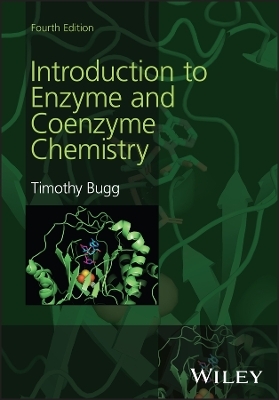
Introduction to Enzyme and Coenzyme Chemistry
Seiten
2026
|
4th edition
John Wiley & Sons Inc (Verlag)
978-1-394-36559-3 (ISBN)
John Wiley & Sons Inc (Verlag)
978-1-394-36559-3 (ISBN)
- Noch nicht erschienen (ca. April 2026)
- Versandkostenfrei
- Auch auf Rechnung
- Artikel merken
A comprehensive, up-to-date discussion of what enzymes are, how they work, and how they catalyse enzymatic reactions
Enzymes are giant macromolecules which catalyse all the biochemical reactions in living cells. Their three-dimensional structures are highly complex, yet they are formed by spontaneous folding of a linear polypeptide chain. Their catalytic properties are even more impressive than synthetic catalysts which operate under more extreme conditions. Enzyme-catalysed reactions proceed very high enantioselectivity and enantiospecificity at rates which approach ”catalytic perfection.” Living cells carry out a huge repertoire of enzyme-catalysed chemical reactions, some of which have little or no precedent in organic chemistry.
New case studies
A new section on oxygen activation by enzymes
Expanded sections on membrane proteins, enzyme purification, enzymatic phosphoryl transfer reactions, fatty acid biosynthesis and polyketide biosynthesis
Additional examples from recent literature used to illustrate key points
Additional problems and solutions outlined and updated Further Reading sections at the end of each chapter
Over 40 full-colour figures of the active sites of enzymes that illustrate the interplay between enzyme structure and function
Introduction to Enzyme and Coenzyme Chemistry provides a concise but comprehensive account from the perspective of organic chemistry that explains what enzymes are, how they work, and how they catalyse many of the major classes of enzymatic reactions. It will prove invaluable to undergraduate and postgraduate students of organic, bio-organic and medicinal chemistry, chemical biology, biochemistry and biotechnology.
Enzymes are giant macromolecules which catalyse all the biochemical reactions in living cells. Their three-dimensional structures are highly complex, yet they are formed by spontaneous folding of a linear polypeptide chain. Their catalytic properties are even more impressive than synthetic catalysts which operate under more extreme conditions. Enzyme-catalysed reactions proceed very high enantioselectivity and enantiospecificity at rates which approach ”catalytic perfection.” Living cells carry out a huge repertoire of enzyme-catalysed chemical reactions, some of which have little or no precedent in organic chemistry.
New case studies
A new section on oxygen activation by enzymes
Expanded sections on membrane proteins, enzyme purification, enzymatic phosphoryl transfer reactions, fatty acid biosynthesis and polyketide biosynthesis
Additional examples from recent literature used to illustrate key points
Additional problems and solutions outlined and updated Further Reading sections at the end of each chapter
Over 40 full-colour figures of the active sites of enzymes that illustrate the interplay between enzyme structure and function
Introduction to Enzyme and Coenzyme Chemistry provides a concise but comprehensive account from the perspective of organic chemistry that explains what enzymes are, how they work, and how they catalyse many of the major classes of enzymatic reactions. It will prove invaluable to undergraduate and postgraduate students of organic, bio-organic and medicinal chemistry, chemical biology, biochemistry and biotechnology.
Tim Bugg is Professor of Biological Chemistry at the University of Warwick. His academic career started at the University of Southampton in 1991, where his group studied enzymes involved in the bacterial degradation of aromatic compounds and enzymes involved in bacterial peptidoglycan assembly. Since moving to Warwick in 1999, his group has more recently studied enzymes involved in bacterial degradation of lignin, and the application of biocatalysis to convert lignin into renewable aromatic chemicals.
| Erscheint lt. Verlag | 23.4.2026 |
|---|---|
| Verlagsort | New York |
| Sprache | englisch |
| Themenwelt | Naturwissenschaften ► Chemie |
| ISBN-10 | 1-394-36559-4 / 1394365594 |
| ISBN-13 | 978-1-394-36559-3 / 9781394365593 |
| Zustand | Neuware |
| Informationen gemäß Produktsicherheitsverordnung (GPSR) | |
| Haben Sie eine Frage zum Produkt? |
Mehr entdecken
aus dem Bereich

aus dem Bereich
Gefüge von Metallen, Keramiken und Verbunden
Buch | Hardcover (2025)
Wiley-VCH (Verlag)
CHF 149,95


