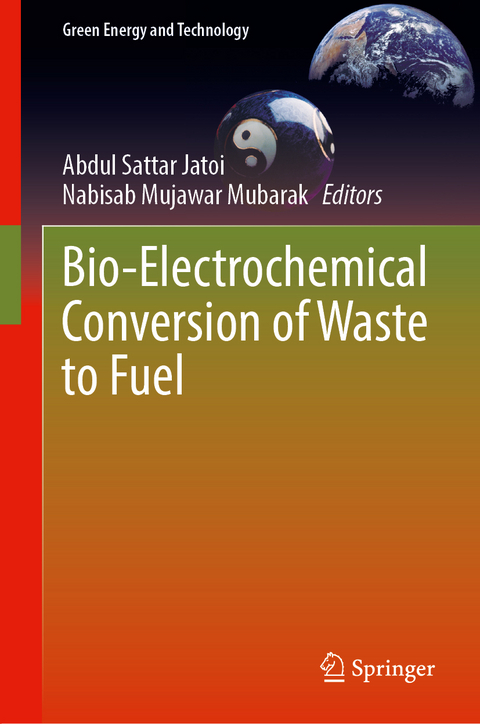
Bio-Electrochemical Conversion of Waste to Fuel
Springer Verlag, Singapore
978-981-95-4309-0 (ISBN)
- Titel nicht im Sortiment
- Artikel merken
This method not only tackles waste management challenges by decreasing landfill usage and lowering greenhouse gas emissions but also enhances energy sustainability. The bio-electrochemical conversion process is regarded as a renewable energy solution, as it can operate on renewable energy sources and supports the circular economy by transforming waste into resources. Current research and advancements in this area are focused on optimizing microbial communities, enhancing energy recovery efficiencies, and scaling up the technology for industrial applications. In summary, bio-electrochemical conversion holds significant potential for influencing waste treatment and energy production, making it a promising field for future exploration and development.
Dr. Abdul Sattar Jatoi is an assistant professor in the Chemical Engineering department at Dawood University of Engineering and Technology, Karachi, Pakistan. He has over 13 years of experience in Academics and Research. His research interests are in food bioprocessing and their application in various food industries and microbial electrochemical systems for environmental and energy applications. Dr. Nabisab Mujawar Mubarak is an associate professor in the Faculty of Engineering at Universiti Teknologi Brunei, Brunei Darussalam. His interest areas are in carbon nanomaterials synthesis via microwave technology, MXene synthesis and its application in wastewater treatment and energy storage, graphene/CNT buckypaper for strain sensor application, biofuels, magnetic buckypaper, immobilization of enzymes, protein purification, magnetic biochar production using a microwave, and wastewater treatment using advanced materials.
Introduction to bioelectrochemical conversion.- Types of Organic Waste for Bio-Electrochemical Systems.- Principle of bioelectrochemical systems.- Design and Operation of Bioelectrochemical System.- Conversion Processes and Pathways in Bio-Electrochemical Systems.- Microbial Communities and Their Role in Bioelectrochemical Systems.- Electron Transfer Mechanisms in Bio-Electrochemical Systems.- Innovative Energy Solutions: Merging Bio-Electrochemical Systems with Renewables.- Microbial fuel cell for wastewater treatment and bioenergy generation.- Conversion of CO2 into Methanol using BES.- Biohydrogen production using bioelectrochemical system.- Bioelectricity Generation from Different Organic Waste Using BES.- Algae-Derived Electrodes in Bio-Electrochemical Systems.- New trends and advancements in the field of BES.- Energy-Efficient Bio-Electrochemical System for Treatment of Agricultural Wastes.
| Erscheinungsdatum | 29.11.2025 |
|---|---|
| Reihe/Serie | Green Energy and Technology |
| Zusatzinfo | 49 Illustrations, color; 3 Illustrations, black and white |
| Verlagsort | Singapore |
| Sprache | englisch |
| Maße | 155 x 235 mm |
| Themenwelt | Naturwissenschaften ► Biologie ► Ökologie / Naturschutz |
| Technik ► Elektrotechnik / Energietechnik | |
| Technik ► Umwelttechnik / Biotechnologie | |
| Schlagworte | agricultural wastes • Algae-Derived Electrodes • bioelectricity generation • Bioenergy Generation • Electron Transfer Mechanisms • microbial communities • microbial fuel cells • Organic Waste • Renewable energy systems • Waste water treatment |
| ISBN-10 | 981-95-4309-6 / 9819543096 |
| ISBN-13 | 978-981-95-4309-0 / 9789819543090 |
| Zustand | Neuware |
| Informationen gemäß Produktsicherheitsverordnung (GPSR) | |
| Haben Sie eine Frage zum Produkt? |
aus dem Bereich