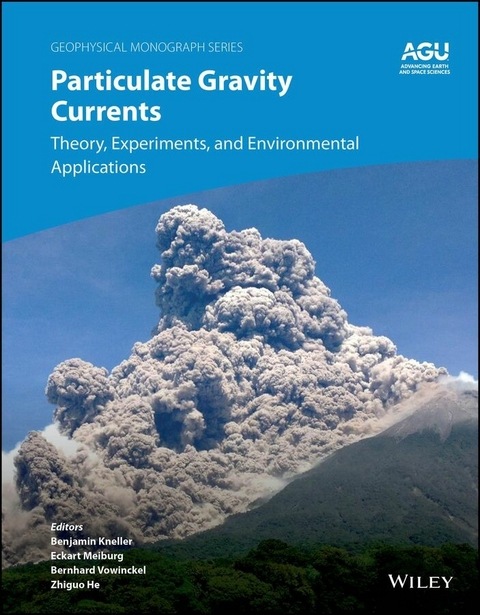
Particulate Gravity Currents (eBook)
757 Seiten
Wiley (Verlag)
978-1-394-21671-0 (ISBN)
Exploring the properties, behavior, and dynamics of particulate gravity currents
Theory, Experiments, and Environmental Applications
Particulate gravity currents involve the movement of mixtures of particles and fluid under the influence of gravity. Examples in the natural environment include snow avalanches, pyroclastic flows, and seafloor turbidity currents. Understanding how particles move, mix, stratify, and settle has applications such as hazard mitigation and pollution management.
Particulate Gravity Currents: Theory, Experiments, and Environmental Applications presents experimental, numerical, and field studies of particulate gravity currents, offering new insights into their properties, behavior, and dynamics.
Volume highlights include:
- Explorations of cohesive and non-cohesive sediment and transport
- Applications of theoretical understanding to real-world subaerial and subaqueous processes
- Studies using the latest techniques, including 3D numerical simulation
- Broader relevance beyond the natural environment to other types of particulate and non-particulate gravity currents
Benjamin Kneller, University of Aberdeen, United Kingdom
Eckart Meiburg, University of California at Santa Barbara, United States of America
Bernhard Vowinckel, TUD Dresden University of Technology, Germany
Zhiguo He, Zhejiang University, China
LIST OF CONTRIBUTORS
- Tanmay Agrawal
- Department of Applied Mechanics
- Indian Institute of Technology
- New Delhi, India
- Pascale Aussillous
- Aix-Marseille Université, CNRS
- Institut Universitaire des Systèmes Thermiques Industriels
- Marseille, France
- Jaco H. Baas
- School of Ocean Sciences
- Bangor University
- Menai Bridge, United Kingdom
- Bofeng Bai
- State Key Laboratory of Multiphase Flow in Power Engineering
- Xi'an Jiaotong University
- Xi'an, China
- Megan L. Baker
- Department of Geography
- Durham University
- Durham, United Kingdom
- Sivaramkrishnan Balachandar
- Department of Mechanical & Aerospace Engineering
- University of Florida
- Gainesville, Florida, USA
- Cyrille Bonamy
- Université Grenoble Alpes, CNRS
- Grenoble INP, LEGI
- Grenoble, France
- Eric C. P. Breard
- School of GeoSciences
- University of Edinburgh
- Edinburgh, United Kingdom
- and
- Department of Earth Science
- University of Oregon
- Eugene, Oregon, USA
- Ermanno Brosch
- School of Agriculture and Environment
- Massey University
- Palmerston North, New Zealand
- Henri Busch
- Leichtweiß‐Institute for Hydraulic Engineering and Water Resources
- Technical University of Braunschweig
- Braunschweig, Germany
- Mariano I. Cantero
- Balseiro Institute
- San Carlos de Bariloche, Argentina
- Matteo Cerminara
- National Institute of Geophysics and Volcanology
- Pisa, Italy
- Vamsi Chalamalla
- Department of Applied Mechanics
- Indian Institute of Technology
- New Delhi, India
- Kyoungsik Chang
- School of Mechanical Engineering
- University of Ulsan
- Ulsan, South Korea
- Julien Chauchat
- Université Grenoble Alpes, INRAE, CNRS, IRD
- Grenoble INP, IGE
- Grenoble, France
- George Constantinescu
- IIHR—Hydroscience and Engineering and Department of Civil and Environmental Engineering
- University of Iowa
- Iowa City, Iowa, USA
- Lucas Corna
- School of Agriculture and Environment
- Massey University
- Palmerston North, New Zealand
- Giovanni De Cesare
- Hydraulic Constructions Platform
- Swiss Federal Technology Institute of Lausanne
- Lausanne, Switzerland
- Yvan Dossmann
- Laboratoire d'Energétique et de Mécanique Théorique et Appliquée
- Université de Lorraine, CNRS
- Nancy, France
- Natasha Dowey
- Geography, Environment and Planning
- Sheffield Hallam University
- Sheffield, United Kingdom
- Josef Dufek
- Department of Earth Science
- University of Oregon
- Eugene, Oregon, USA
- Atsuki Fukuoka
- Faculty of Information Science and Technology
- Osaka Institute of Technology
- Hirakata, Japan
- Cyril Gadal
- Institut de Mécanique des Fluides de Toulouse
- Université de Toulouse, CNRS
- Toulouse, France
- Élisabeth Guazzelli
- Université Paris Cité, CNRS
- Matière et Systèmes Complexes, UMR 7057
- Paris, France
- Yakun Guo
- Faculty of Engineering and Informatics
- University of Bradford
- Bradford, United Kingdom
- Dongrui Han
- Institute of Port, Coastal and Offshore Engineering
- Zhejiang University
- Zhoushan, China
- and
- State Key Laboratory of Ocean Sensing
- Zhejiang University
- Zhoushan, China
- Zhiguo He
- State Key Laboratory of Ocean Sensing
- Zhejiang University
- Zhoushan, China
- and
- Suzhou Industrial Technological Research Institute
- Zhejiang University
- Suzhou, China
- Tian‐Jian Hsu
- Center for Applied Coastal Research
- University of Delaware
- Newark, Delaware, USA
- Han Huang
- State Key Laboratory of Multiphase Flow in Power Engineering
- Xi'an Jiaotong University
- Xi'an, China
- Matthew Johnson
- School of Environmental Sciences
- University of Hull
- Hull, United Kingdom
- Thomas Johnston
- School of Environmental Sciences
- University of Hull
- Hull, United Kingdom
- Jim Jones
- School of Engineering and Advanced Technology
- Massey University
- Palmerston North, New Zealand
- Sebastien Kiesgen de Richter
- Laboratoire d'Energétique et de Mécanique Théorique et Appliquée
- Université de Lorraine, CNRS
- Nancy, France
- Laurent Lacaze
- Institut de Mécanique des Fluides de Toulouse
- Université de Toulouse, CNRS
- Toulouse, France
- Ying‐Tien Lin
- Institute of Port, Coastal and Offshore Engineering
- Zhejiang University
- Zhoushan, China
- and
- State Key Laboratory of Ocean Sensing
- Zhejiang University
- Zhoushan, China
- Gert Lube
- School of Agriculture and Environment
- Massey University
- Palmerston North, New Zealand
- Jonathan Malarkey
- School of Ocean Sciences
- Bangor University
- Menai Bridge, United Kingdom
- Kazuma Matsunami
- Faculty of Information Science and Technology
- Osaka Institute of Technology
- Hirakata, Japan
- Eckart Meiburg
- Department of Mechanical Engineering
- University of California at Santa Barbara
- Santa Barbara, California, USA
- Matthieu J. Mercier
- Institut de Mécanique des Fluides de Toulouse
- Université de Toulouse, CNRS
- Toulouse, France
- Alexander Metelkin
- Leichtweiß‐Institute for Hydraulic Engineering and Water Resources
- Technical University of Braunschweig
- Braunschweig, Germany
- Florence Naaim‐Bouvet
- Université Grenoble Alpes, INRAE, CNRS, IRD
- Grenoble INP, IGE
- Grenoble, France
- Ren Nagano
- Faculty of Information Science and Technology
- Osaka Institute of Technology
- Hirakata, Japan
- Sean O'Donnell
- Jackson School of Geosciences
- University of Texas
- Austin, Texas, USA
- Samuel Ukpong Okon
- State Key Laboratory of Ocean Sensing
- Zhejiang University
- Zhoushan, China
- and
- Suzhou Industrial Technological Research Institute
- Zhejiang University
- Suzhou, China
- Daniel Parsons
- School of Environmental Sciences
- University of Hull
- Hull, United Kingdom
- Jorge A. Penaloza‐Giraldo
- Center for Applied Coastal Research
- University of Delaware
- Newark, Delaware, USA
- Alison Provost
- Department of Earth Science and Engineering
- Imperial College
- London, United Kingdom
- Marie Rastello
- Université Grenoble Alpes, CNRS
- Grenoble INP, LEGI
- Grenoble, France
- Olivier Roche
- Laboratoire Magmas et Volcans
- Université Clermont‐Auvergne, CNRS, IRD, OPGC
- Clermont‐Ferrand, France
- Pete Rowley
- School of Earth Sciences
- University of Bristol
- Bristol, United Kingdom
- Jorge Salinas
- Department of Mechanical & Aerospace Engineering
- University of Florida
- Gainesville, Florida, USA
- Currently
- Sandia National Laboratories
- Livermore, California, USA
- Jean Schneider
- Laboratoire d'Energétique et de Mécanique Théorique et Appliquée
- Université de Lorraine, CNRS
- Nancy, France
- Ricardo Silva Jacinto
- Geo‐Ocean Unit
- Ifremer
- Plouzané, France
- Gregory Smith
- School of Environmental Sciences
- University of Hull
- Hull, United Kingdom
- Franco Tapia
- Aix‐Marseille Université, CNRS
- Institut Universitaire des Systèmes Thermiques Industriels
- Marseille, France
- Daniel Uhle
- School of Agriculture and Environment
- Massey University
- Palmerston North, New...
| Erscheint lt. Verlag | 22.9.2025 |
|---|---|
| Reihe/Serie | Geophysical Monograph Series |
| Sprache | englisch |
| Themenwelt | Naturwissenschaften ► Geowissenschaften ► Geologie |
| Schlagworte | gravity current behavior • gravity current dynamics • gravity current properties • gravity current studies • gravity particle mix • gravity particle movement • gravity particle settle • gravity particle strategy • Hazard Mitigation • Pollution management |
| ISBN-10 | 1-394-21671-8 / 1394216718 |
| ISBN-13 | 978-1-394-21671-0 / 9781394216710 |
| Informationen gemäß Produktsicherheitsverordnung (GPSR) | |
| Haben Sie eine Frage zum Produkt? |
 EPUB (Adobe DRM)
Kopierschutz: Adobe-DRM
Adobe-DRM ist ein Kopierschutz, der das eBook vor Mißbrauch schützen soll. Dabei wird das eBook bereits beim Download auf Ihre persönliche Adobe-ID autorisiert. Lesen können Sie das eBook dann nur auf den Geräten, welche ebenfalls auf Ihre Adobe-ID registriert sind.
Details zum Adobe-DRM
Dateiformat: EPUB (Electronic Publication)
EPUB ist ein offener Standard für eBooks und eignet sich besonders zur Darstellung von Belletristik und Sachbüchern. Der Fließtext wird dynamisch an die Display- und Schriftgröße angepasst. Auch für mobile Lesegeräte ist EPUB daher gut geeignet.
Systemvoraussetzungen:
PC/Mac: Mit einem PC oder Mac können Sie dieses eBook lesen. Sie benötigen eine
eReader: Dieses eBook kann mit (fast) allen eBook-Readern gelesen werden. Mit dem amazon-Kindle ist es aber nicht kompatibel.
Smartphone/Tablet: Egal ob Apple oder Android, dieses eBook können Sie lesen. Sie benötigen eine
Geräteliste und zusätzliche Hinweise
Buying eBooks from abroad
For tax law reasons we can sell eBooks just within Germany and Switzerland. Regrettably we cannot fulfill eBook-orders from other countries.
aus dem Bereich