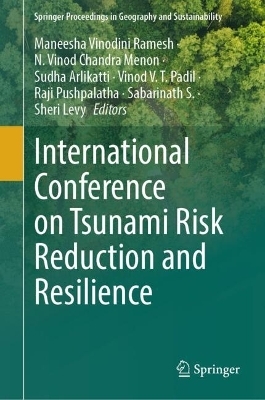
International Conference on Tsunami Risk Reduction and Resilience
Springer International Publishing (Verlag)
978-3-032-09620-3 (ISBN)
- Noch nicht erschienen - erscheint am 21.02.2026
- Versandkostenfrei
- Auch auf Rechnung
- Artikel merken
Dr. Maneesha Vinodini Ramesh, Provost of Amrita Vishwa Vidyapeetham, holds key roles in Strategic Initiatives, Research & Innovation, AI+X, and leads the School for Sustainable Futures and Amrita Center for Wireless Networks and Applications (AWNA). She earned her Ph.D. in Computer Science and Engineering, pioneering the world s first AI-integrated IoT-based landslide early warning system, which secured a U.S. patent and placed her among the top 2% of scientists globally, as recognized by Stanford University. Dr. Ramesh has secured substantial research grants in areas like landslide detection, water sustainability, and heritage preservation. As Dean of International Programs, she has facilitated over 150 international collaborations. Her commitment to societal development is evident in her leadership of Live-in-Labs®, providing sustainable solutions to over 2000 communities, and the Jivamritam project, which delivers clean drinking water to millions across India. Prof. N. Vinod Chandra Menon has over 37 years of working experience in the fields of disaster risk reduction, climate change adaptation, and public policy analysis. Currently he is Adjunct Professor at Amrita Vishwa Vidyapeetham and Advisor Amrita School of Sustainable Development; Chair of the Advisory Council of the Africa International Policy Research Center (AIPRC) aiprcafrica.com based in Nairobi, Kenya ; Member of the Peer Committee on Technological Preparedness for Dealing with National Disruptions established by the Indian National Academy of Engineering (INAE); President of RedR India (redr.org.in); Senior Advisor and Mentor of the International Institute of Information Technology ISquareIT, Pune (isquareit.edu.in); Chairman and Managing Trustee of the Governing Board of Swayam Shikshan Prayog (swayamshikshanprayog.org); Chief Advisor and Mentor of AJSA India, Bhubaneshwar (ajsaindia.org); Chief Strategic Advisor (Climate Resilience and Global Policy) of Terrablu Climate Technologies Pvt. Ltd. Pune (terrablu.life) Member of the Advisory Board of the Centre of Excellence in Disaster Management (CoEDM) at the Development Management Institute (DMI), Patna; Senior Advisor and Data Evangelist of India Excellence Foundation; and Mentor of engineering students participating in the eYantra Innovation Challenge (eYIC) of IIT Bombay, Chairperson of the Board of Oceanic Circles Foundation, Pune among others. Professor Sudha Arlikatti has degrees in Architecture (Pune University), City Planning (I.I.T. Kharagpur), and Urban and Regional Science (Texas A& M University) with an emphasis in Environmental Planning and Hazards Management. She has over 12 years of practitioner experience and 19 years of teaching and research experience in the USA, India, and the UAE. Her research interests include risk communication and protective action decision making in multi-ethnic communities responding to tsunamis, floods, earthquakes, hurricanes, and biological threats; disaster sheltering and housing recovery; and individual and organizational resiliency for sustainable development. She has received funding for her research endeavors from the U.S. National Science Foundation, Texas Department of State Health Services, Dallas Area Habitat for Humanity, and the University of North Texas. Her works have been published in notable disasters, environmental planning and public policy journals including Disasters, Disaster Prevention and Management, Environmental Management, Homeland Security and Emergency Management, International Journal of Disaster Risk Reduction, International Journal of Mass Emergencies and Disasters, Natural Hazards, Natural Hazards Review, Public Administration Review, Risk Analysis and Sustainability. Here at Amrita University, she is motivated to empower students through meaningful research to find transformat
Chapter 1: Coastal Communities' Tsunami Preparedness: Examining The Utility of Social Network Analysis And Social Capital.- Chapter 2: Youth-Led Tsunami Preparedness:Bridging Early Warning System And Indigenous Knowledge In The South Coast of India.- Chapter 3: Empowering Women And Children In Coastal Communities: Enhancing Tsunami Preparedness And Resilience Through Gender-Responsive Disaster Management.- Chapter 4: Mapping Climate Change Awareness Among Students In Kerala: Educational Strategies For Resilience.- Chapter 5: Advancing Tsunami Risk Management: Global Lessons And Strategic Frameworks For Resilience.- Chapter 6: Comparative Analysis of Tsunami Recovery Strategies: Evidence From Asian Region.- Chapter 7: Examining Tsunami Preparedness In Nine Schools of Alappad Community: The Process, Challenges And Way Forward.- Chapter 8: Disaster Risk Reduction And Preparedness: A Probabilistic Tsunami Risk Management Assessment For Eastern Cape Coastal South Africa.- Chapter 9: Integrating Bio-Inspired Technologies Into Tsunami Early Warning Systems: A Sustainable Approach.- Chapter 10: Modelling And Simulation of Tsunami Waves Using Neural Networks.- Chapter 11: A Continuous Wave X Band Radar For Early Tsunami Detection.- Chapter 12: Harnessing Fiber Bragg Grating Sensors For Enhanced Tsunami Monitoring And Early Warning.- Chapter 13: Hybrid Machine Learning Models For Enhanced Tsunami Prediction: Advancing Ai-Driven Disaster Management.- Chapter 14: Development of Habitat Vulnerability Index (Hvi) For Southern Indian Coastal Stretch: A Machine Learning-Based Spatial Modelling Approach.- Chapter 15: Impact of Tsunami On The Chennai Coast: Sea Level Rise, Shoreline Shift, And Effects On Turtles.- Chapter 16: Role of Nature-Based Solutions (Nbs) And Local & Indigenous Knowledge Systems For Protection of Coastal Areas From Hazards: A Case of Tsunami Affected Fishing Villages of Kerala.- Chapter 17: Forgotten Groves: Why Kerala s Mangroves Lack Sacred Status And Why They Need One.- Chapter
18: Improving Water Quality In Disaster-Prone Coastal Communities: Sustainable Solutions For Solai Nagar Community.- Chapter 19: Localized Resilience Hubs For Disaster Risk Reduction And Preparedness.- Chapter 20: Sustainability Reporting of Agricultural Risk Management Strategies For Resilience In Disaster-Prone Coastal Communities of Kerala, India.- Chapter 21: Carbon Footprint Analysis For Sustainable Tourism: The Munroe Island Case Study.- Chapter 22: Two Decades of Lessons: Systematic Review of Mangroves Role In Tsunami Disaster Mitigation (2004 2024).- Chapter 23: Community Resilience And Social Support: A Qualitative Study of Coping Strategies Among Tsunami Survivors In Kerala, India.- Chapter 24: Safeguarding Livelihoods And Pet Companionship: The Role of Livestock And Pet Sheltering In Coastal Disaster Resilience In Kuttanad, Kerala, India.- Chapter 25: Impact of Self-Help Groups On Psychosocial Well-Being And Disaster Preparedness.
| Erscheinungsdatum | 29.11.2025 |
|---|---|
| Reihe/Serie | Springer Proceedings in Geography and Sustainability |
| Zusatzinfo | XVI, 297 p. 98 illus., 94 illus. in color. |
| Verlagsort | Cham |
| Sprache | englisch |
| Maße | 155 x 235 mm |
| Themenwelt | Naturwissenschaften ► Biologie ► Ökologie / Naturschutz |
| Naturwissenschaften ► Geowissenschaften | |
| Schlagworte | Coastal resilience • disaster risk reduction • early warning systems • Forecasting • Tsunami |
| ISBN-10 | 3-032-09620-0 / 3032096200 |
| ISBN-13 | 978-3-032-09620-3 / 9783032096203 |
| Zustand | Neuware |
| Informationen gemäß Produktsicherheitsverordnung (GPSR) | |
| Haben Sie eine Frage zum Produkt? |
aus dem Bereich