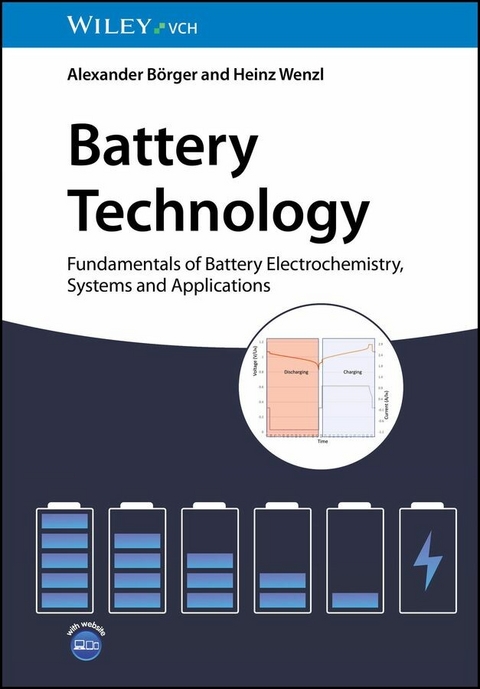
Battery Technology (eBook)
968 Seiten
Wiley-VCH (Verlag)
978-3-527-84804-1 (ISBN)
Understand the technology that will power our future with this comprehensive guide
Energy supply is perhaps the most challenging engineering problem and social and economic issue of the modern age. Energy storage technologies and in particular batteries are an important option to optimize energy supply systems both technically and economically. They help to drive down costs, make new products and services possible and can reduce emissions. Batteries are now key components for vehicles, portable products and the electricity supply system. Understanding batteries, in particular the two dominant battery technologies, lead-acid and lithium-ion, has therefore never been more essential to technological developments for these applications.
Battery Technology: Fundamentals of Battery Electrochemistry, Systems and Applications offers a comprehensive overview of how batteries work, why they are designed the way they are, the technically and economically most important systems and their applications. The book begins with background information on the electrochemistry, the structure of the materials and components and the properties of batteries. The book then moves to practical examples often using field data of battery usage. It can serve both as an introduction for engineering and science students and as a guide for those developing batteries and integrating batteries into energy systems.
Battery Technology readers will also find:
- A focused introduction to electrochemical and materials science aspects of battery research
- An author team with decades of combined experience in battery research and industry
- Clear structure enabling easy use
Battery Technology is ideal for materials scientists, software engineers developing battery management systems, design engineers for batteries, battery systems and the many auxiliary components required for safe and reliable operation of batteries.
Alexander Börger, PhD, has been working in industry since 2008, focusing on the development of batteries and their use in vehicles, and also lectured in the field of electrochemical energy storage at the Technical University of Brunswick in Germany. After studying chemistry at the Technical University Dresden and the Universidad de Salamanca, Alexander Börger received his PhD in physical chemistry from the Technical University Brunswickg in 2006, followed by two years of postdoctoral research there.
Heinz Wenzl, PhD, has lectured in the field of battery technology at the Institute of Electrical Power Engineering and Energy Systems at Clausthal University of Technology in Germany where he headed the battery technology group and, since 2010, is an honorary professor of battery systems. The physicist and industrial engineer earned his doctorate at the Technical University Munich and, after working in various positions in industry, including at a manufacturer of many different battery systems, lead-acid, nickel-cadmium, silver-zinc, lithium-metal and battery-supported power supplies, set up his own engineering consultancy in 1993 to provide consulting services for batteries and energy technology.
1
Introduction
Batteries and other energy storage systems are options for the technical and economic optimization of an energy supply system and, in many cases, indispensable for ensuring the required functions. Very often, however, batteries are in competition with other technologies, which impact the development and market opportunities of batteries.
A comparison of batteries with other energy storage technologies is of little value without precise knowledge of the application and limitations of competing technologies.
All batteries are based on the same physical and chemical principles. Different electrochemically active materials and designs lead to major differences in properties, including the necessity of additional components required for safe and long‐lasting operation.
Batteries are usually categorized according to their bridging time and application areas: portable, mobile, and stationary.
1.1 Energy Supply in General
Energy storage systems are an option for the technical and economic optimization of an energy supply system because they allow energy generation1 to be quickly and efficiently adapted to energy consumption. Without energy storage systems that can both store and release energy, generation and consumption units would always have to adapt to each other with very high dynamics. Fast response times are often not possible or only possible at great expense. Energy storage systems also serve as an energy source for technical systems that do not have their own energy supply from primary energy sources, as well as for starting up systems that in most cases cannot be started without the provision of electrical energy from an energy storage system or the electrical grid.
The use of batteries is indispensable in many cases to ensure the required functions. The following examples of electromobility and the electricity supply system will show that the overall technical and economic context must always be carefully considered when estimating and forecasting the future importance of batteries.
Figure 1.1 shows the integration of energy storage systems into the overall electrical energy supply system and illustrates in particular that energy storage2 competes with many technical alternatives to ensure the required functions. In addition to highly dynamic generation units, which, unlike conventional thermal power plants, can adapt their power output very quickly to demand, alternatives for quickly balancing power generation and consumption are primarily load management systems and switchable loads, in particular heat generators (power‐to‐heat).
Figure 1.1 Electrochemical energy storage as part of the power supply system.
Electricity from a photovoltaic system that is not consumed immediately at the site of installation can be used locally or, for example, it is to be
- stored in a battery,
- used as thermal energy for space heating or hot water supply via an electrically operated heating cartridge,
- used by switching on household loads such as washing machines or refrigerators depending on the supply, or
- made available to the electrical grid for loads elsewhere.
From a system perspective, these alternatives are equivalent and therefore are often referred to as storage‐equivalent systems or functional storage systems.
Electrochemical energy storage systems are also in technical and economic competition with other energy storage technologies, see Ref. [1].
1.2 Electrochemical and Non‐electrochemical Energy Technologies
In principle, energy can be stored in very different ways, that is, in different forms of energy, namely
- mechanically, for example, in the form of potential energy in pumped storage power plants or in the form of rotational energy in flywheels,
- magnetically, for example, in the magnetic field of a superconducting coil,
- electrically, for example, in the electric field of double‐layer capacitors,
- chemically, for example, by conversion to hydrogen,
- thermally, for example, in the form of hot water storage tanks or in steam boilers, and
- electrochemically, that is, by converting electrical energy into chemical energy.
Table 1.1 provides a short summary of these technologies and the basic physical formulas.
Table 1.1 Comparison of different energy storage technologies.
| Energy type | Principle | Examples |
|---|
| Potential energy | E = mgΔh | Pumped storage power plants |
| Gas pressure | E = pΔV | Compressed air storage |
| Rotational energy | E = 0.5Jω2 | Flywheels |
| Magnetic energy | E = 0.5LI2 | Loss‐free direct current flowing in a superconducting coil (so‐called SMES) |
| Electrical energy | E = 0.5CU2 | Double‐layer capacitors (ultracapacitors, electrolytic capacitors, etc.) |
| Chemical energy | E = nΔrG | Hydrogen storage |
| Thermal energy | E = CiΔT | Hot water tank |
| Electrochemical energy | E = ∫ UIdt | Batteries |
Explanation of symbols: m: mass, g: gravity constant, h: height, p: pressure, V: volume, J: moment of inertia, ω: rotational speed, L: inductance, I: current, C: capacitance (in Farad), U: voltage, n: amount of substance, ΔrG: free enthalpy of reaction, Ci: heat capacity of substance i, ΔT: temperature difference, t: discharge time.
With some energy storage technologies, particularly thermal storage, the stored energy cannot be made available to the overall system as electrical energy or only at great cost. Despite various limitations, different energy storage systems compete with each other in certain applications. Before discussing electrochemical energy storage systems in detail in the following chapters, here are some comments on non‐electrochemical energy storage systems.
1.2.1 Capacitors and Ultracapacitors
The energy content of capacitors is very low, even for the group of so‐called ultracapacitors or supercapacitors3 (ultracaps) with very high capacitances (unit Farad: 1 F = 1 As/V). At a nominal voltage of 2.5 V and a capacity of 3000 F, for example, the energy content is only approx. 2.6 Wh, of which normally only 75% can be technically extracted, compared to approx. 9 Wh for a small 2.5 Ah lithium‐ion cell, which is significantly more compact, lighter, and cheaper. In terms of specific power (W/kg), however, ultracapacitors can deliver significantly higher electrical power and are therefore used in special applications.
Ultracapacitors have a high self‐discharge rate (they are often completely discharged within 24 hours) and therefore a high energy loss in standby mode. They require a similarly complex charge control as lithium‐ion batteries.
Other types of capacitors, such as classic electrolytic capacitors, only have a capacitance in the micro‐ or millifarad range and less and are therefore not able to store large amounts of energy, even if their rated voltage is very high.
1.2.2 Superconducting Coils
The magnetic field present in a current‐carrying coil stores usable amounts of energy at high currents. The losses are only sufficiently low if the resistance of the coil is minimized by superconductivity. However, energy storage systems based on superconductivity require complex cooling and therefore have high standby losses. In the 1990s, superconducting magnetic energy storage (SMES) systems with an output of 1 MW for 10 seconds and an energy content of several kilowatt‐hours were built to stabilize the power grid.
1.2.3 Flywheels
The energy content stored in flywheels depends on the square of the rotational speed and is proportional to the moment of inertia. Slowly rotating flywheels (with up to approx. 4000 rpm) are commercial products for uninterruptible power supply (UPS) systems with an output of 1.6 MW for 15 seconds (Powerbridge, Piller GmbH), corresponding to 6.7 kWh energy content, of which only 75% can be technically extracted. These flywheels are a technical and economical alternative to batteries for bridging times of a few seconds until the starting of diesel power generation units.
Very fast rotating flywheels (up to 100,000 rpm) are light and very powerful, whereby the power is a function of the generator coupled to it. Such flywheels have been used in motorsport.
All...
| Erscheint lt. Verlag | 16.9.2025 |
|---|---|
| Sprache | englisch |
| Themenwelt | Naturwissenschaften ► Chemie ► Physikalische Chemie |
| Schlagworte | Battery Technology • charging batteries • charging cells • discharging batteries • discharging cells • electrochemical basics • electrode • electromobility • energy storage technology • Energy Supply • Lead-acid battery • Lithium-Ion Battery • Vehicle Battery |
| ISBN-10 | 3-527-84804-5 / 3527848045 |
| ISBN-13 | 978-3-527-84804-1 / 9783527848041 |
| Informationen gemäß Produktsicherheitsverordnung (GPSR) | |
| Haben Sie eine Frage zum Produkt? |
 EPUB (Adobe DRM)
Kopierschutz: Adobe-DRM
Adobe-DRM ist ein Kopierschutz, der das eBook vor Mißbrauch schützen soll. Dabei wird das eBook bereits beim Download auf Ihre persönliche Adobe-ID autorisiert. Lesen können Sie das eBook dann nur auf den Geräten, welche ebenfalls auf Ihre Adobe-ID registriert sind.
Details zum Adobe-DRM
Dateiformat: EPUB (Electronic Publication)
EPUB ist ein offener Standard für eBooks und eignet sich besonders zur Darstellung von Belletristik und Sachbüchern. Der Fließtext wird dynamisch an die Display- und Schriftgröße angepasst. Auch für mobile Lesegeräte ist EPUB daher gut geeignet.
Systemvoraussetzungen:
PC/Mac: Mit einem PC oder Mac können Sie dieses eBook lesen. Sie benötigen eine
eReader: Dieses eBook kann mit (fast) allen eBook-Readern gelesen werden. Mit dem amazon-Kindle ist es aber nicht kompatibel.
Smartphone/Tablet: Egal ob Apple oder Android, dieses eBook können Sie lesen. Sie benötigen eine
Geräteliste und zusätzliche Hinweise
Buying eBooks from abroad
For tax law reasons we can sell eBooks just within Germany and Switzerland. Regrettably we cannot fulfill eBook-orders from other countries.
aus dem Bereich