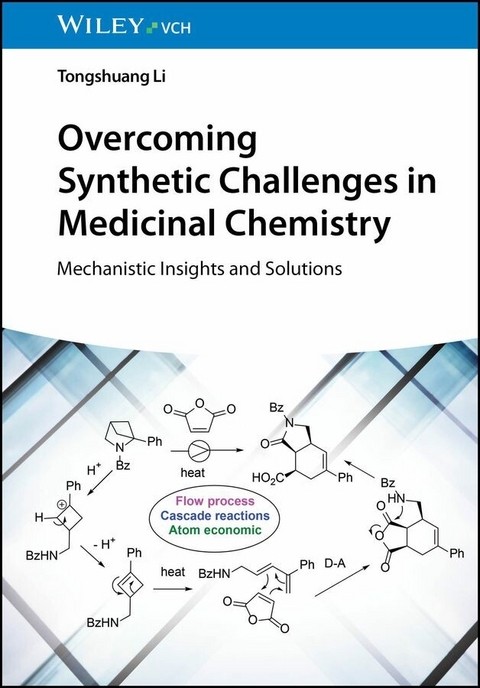
Overcoming Synthetic Challenges in Medicinal Chemistry (eBook)
720 Seiten
Wiley-VCH (Verlag)
978-3-527-85262-8 (ISBN)
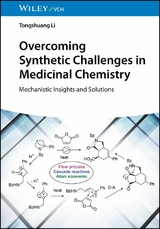
Collection of 150 synthetic problems in medicinal chemistry offering mechanistic insights into complex reactions and potential pitfalls in drug synthesis
Overcoming Synthetic Challenges in Medicinal Chemistry is a comprehensive collection of around 150 challenging organic reactions in medicinal chemistry, drawn from the author's work experience and recent journal and patent publications. Problems are arranged by the structure of the reaction product to make it easier for the reader to find the information needed.
In this book, readers will find information on:
- General terms and concepts in synthetic organic chemistry and medicinal chemistry
- Specific reactions leading to desired products or unexpected side products
- Step-by-step mechanisms, experimental procedures, literature information, and applications for each reaction
- Ways to reduce mistakes in synthetic work and optimize product synthesis
Overcoming Synthetic Challenges in Medicinal Chemistry serves as a valuable guide for organic chemists, professionals, and job candidates in the pharmaceutical industry, as well as graduates and lecturers at university, helping them grasp complex reactions and gain insight into potential pitfalls and side reactions in drug synthesis.
Tongshuang Li has extensive experience in synthetic organic chemistry and medicinal chemistry, with over 22 years in the pharmaceutical industry and 12 years in academia. Currently, he is working as a chemistry consultant for both biotech companies and academics. Dr. Li's work primarily focuses on the synthesis of target compounds for drug discovery, with two new drugs recently approved in China.
Chapter 1
Opinions and Suggestions
1.1 Be a “Doctor,” Not Just a “Drug Fetcher”
Even after more than 40 years, I still vividly recall the advice my professor shared with us during my college organic chemistry experiments. He said, “When conducting a synthetic reaction, it’s essential to grasp the reaction mechanism and the principles behind each step of the process. It’s similar to how a physician prescribes medication based on a patient’s condition. If you merely follow the prescription to prepare the medication, you’ll always remain a ‘drug fetcher,’ never a doctor.” I don’t intend to diminish the role of a “drug fetcher” in any way. The key issue is that our aim in training organic chemists is to cultivate “doctors,” not just “drug fetchers.” Understanding the reaction mechanism allows you to master it, draw connections, design better experimental procedures, and tackle challenges in your research. For this reason, comprehending the mechanisms of organic reactions is a fundamental skill for any synthetic organic chemist.
1.2 Synthetic Organic Chemistry: Still as Much an Art as a Science
During my tenure as a university professor, one of my responsibilities was overseeing students conducting organic chemistry experiments in the laboratory. I frequently came across an intriguing scenario: despite following the same experimental procedure, students would obtain varying yields and qualities of the product. In certain extreme cases, some students failed to produce any of the intended product, resulting in a failed experiment. This highlighted the challenges of reliability and reproducibility in synthetic chemistry.
When it comes to the reliability and reproducibility of published articles, I consider the annual journal Organic Syntheses to be the top-ranked among organic chemistry journals. This is primarily because the procedures featured in this journal are rigorously verified by an independent group of chemists. However, even in such cases, each synthetic reaction typically yields a range of results or varying yields across different batches, rather than a fixed value.
The yield of a reaction is influenced by numerous factors, including temperature, concentration, the order and speed of reagent addition, stirring method and speed, solvent choice, catalyst, the suppliers and purities of starting materials and reagents, reaction scale, workup procedures, and purification methods. Even when all these external factors are carefully controlled, different chemists may still achieve different yields. Furthermore, for a particular chemist, yields can vary from one batch to another. This indicates that the yield of a synthesis depends not only on the reaction conditions but also on the individual performing the experiment—the chemist.
In this sense, while synthetic organic chemistry is undeniably a science, it also retains a significant degree of artistry. The skill, intuition, and experience of the chemist play a crucial role in the success of a reaction, making it as much an art as it is a scientific discipline.
1.3 Synthetic Organic Chemistry Is an Experimental Science under the Guidance of Theory
Whether an organic reaction is described detail in a textbook, in a reference book, or in a journal-published article, replicating or referencing these experimental procedures can sometimes lead to issues of varying degrees. Any seemingly insignificant error could cause a reaction failure or lead to a different result from those reported. Occasionally, some planned synthetic reactions yield unexpected products or side products. On the other hand, many groundbreaking organic reactions have been discovered serendipitously. This unpredictability makes synthetic organic chemistry both challenging and fascinating. As a result, synthetic organic chemistry remains, and will continue to be, an experimental science.
Organic chemistry is grounded in a solid theoretical framework, which has been developed and refined by skilled chemists over centuries. These theories are built upon the vast body of experimental data accumulated through the collective efforts of countless chemists over hundreds of years. Understanding and explaining organic reaction mechanisms relies heavily on these established principles. In the field of medicinal chemistry, particularly in synthetic work, a deep mastery of organic chemistry theory and a thorough familiarity with various reaction mechanisms can significantly enhance the efficiency and productivity of our synthetic designs and practices. Therefore, organic synthesis is not merely an experimental science but one that is profoundly guided by theoretical insights.
1.4 Reduce Mistakes in Your Synthetic Work
Given the above considerations, it is imperative that chemists at all levels have opportunities to enhance their knowledge, experience, and skills throughout their careers. Many of us spend more than 8 hours a day in the lab, 6 days a week. But does this alone make us productive chemists? The answer is not necessarily. While dedicating a certain number of hours to lab work each day is a necessary condition for productivity, it is not sufficient on its own. The true measure lies in the efficiency of our work.
A common question I receive from graduate students and colleagues I supervise is: How can we improve the efficiency and quality of our synthetic work? My response is straightforward: by minimizing or even eliminating mistakes in our work, thereby increasing the success rate of our synthetic reactions. If every reaction we conducted were successful, it would undoubtedly be the most efficient way to work. However, in practice, this is nearly impossible. Therefore, the best approach to enhancing productivity is to reduce errors and improve the success rate of our synthetic reactions.
To achieve this, it is crucial to completely understand the mechanism of every synthetic reaction we perform. We can drastically reduce mistakes by anticipating potential problems and devising strategies to avoid them. This proactive approach not only improves the quality of our work but also enhances overall efficiency, making us more productive chemists in the long run.
1.5 Your Knowledge, Experience, and Skills Can Never Be Too Much
For any entry-level synthetic chemist fresh out of university—whether you hold a bachelor’s degree or a Ph.D. with postdoctoral research experience—working as a medicinal chemist in drug discovery, your knowledge, experience, and skills will always feel insufficient. Mistakes are inevitable in the early stages of your career. However, if you are a quick learner, you will rapidly grow by learning from your own work and the expertise of others. By striving to understand the mechanism behind every reaction you perform, your problem-solving abilities will improve significantly. Over time, as you accumulate more knowledge and experience, the frequency of errors in your synthetic work will steadily decrease.
I’ve heard hiring managers or HR professionals use the term “overqualified” as a reason to reject certain applicants for a position. However, when it comes to performing a synthesis, no chemist, regardless of their experience level, can ever be considered “overqualified.” For even the most experienced chemist, a lack of caution during a synthetic reaction can result in failure. Experience doesn’t eliminate the need for careful attention to detail—it reinforces it.
Synthetic organic chemistry is a rapidly evolving field, continuously advancing with the emergence of new synthetic methods, innovative reagents, and cutting-edge technologies. These developments are documented in a growing number of articles published across various organic chemistry journals. The volume of published research is expanding, and new journals dedicated to organic synthesis are also being established. Given the finite nature of time and energy, it is challenging to keep up with every new paper relevant to your work. Nevertheless, it is feasible to efficiently skim through titles and abstracts to identify key publications. When a paper particularly captures your interest, you can delve into it in greater detail. While the papers you read may not always directly contribute to your current projects, maintaining this habit over the long term can significantly enhance your expertise and benefit your career.
1.6 What Is a Mistake?
What is a mistake? From my perspective, it is a relative term or concept. A synthetic plan or experimental design created by a relatively junior chemist might be considered reasonable or acceptable. However, the same plan could be seen as an obvious mistake if it were designed by a more experienced, senior-level chemist. For instance, consider a medicinal chemistry project where the goal is to synthesize a series of aromatic ethers (1) featuring a difluoro alkyl branch, aiming for final compounds in the range of 5–10 mg. Your proposed synthesis design for compound 1 (R2 = Me) is shown below.
The target compounds could be synthesized from phenol 2 (suppose 2 have been prepared or commercially available) and alcohol 3. You find 3 (R2 = Me) is commercially available, but very expensive (Sigma-Aldrich, US$1746/1 g, US$220/mmol). So, you decide to prepare 3 (R2 = Me) from the relatively less expensive diol 4 (AK Scientific, US$162/5 g, US$3.63/mmol) by iteroselective monomethylation. You also find references (a, US2013/0131050, A1. b, J. Med. Chem.,...
| Erscheint lt. Verlag | 10.9.2025 |
|---|---|
| Sprache | englisch |
| Themenwelt | Naturwissenschaften ► Chemie ► Organische Chemie |
| Schlagworte | drug design • Experimental Procedures • medicinal chemistry • Name reactions • organic synthesis • Pitfalls • Problem Solving • reaction mechanism • selectivity • side product |
| ISBN-10 | 3-527-85262-X / 352785262X |
| ISBN-13 | 978-3-527-85262-8 / 9783527852628 |
| Informationen gemäß Produktsicherheitsverordnung (GPSR) | |
| Haben Sie eine Frage zum Produkt? |
 EPUB (Adobe DRM)
Kopierschutz: Adobe-DRM
Adobe-DRM ist ein Kopierschutz, der das eBook vor Mißbrauch schützen soll. Dabei wird das eBook bereits beim Download auf Ihre persönliche Adobe-ID autorisiert. Lesen können Sie das eBook dann nur auf den Geräten, welche ebenfalls auf Ihre Adobe-ID registriert sind.
Details zum Adobe-DRM
Dateiformat: EPUB (Electronic Publication)
EPUB ist ein offener Standard für eBooks und eignet sich besonders zur Darstellung von Belletristik und Sachbüchern. Der Fließtext wird dynamisch an die Display- und Schriftgröße angepasst. Auch für mobile Lesegeräte ist EPUB daher gut geeignet.
Systemvoraussetzungen:
PC/Mac: Mit einem PC oder Mac können Sie dieses eBook lesen. Sie benötigen eine
eReader: Dieses eBook kann mit (fast) allen eBook-Readern gelesen werden. Mit dem amazon-Kindle ist es aber nicht kompatibel.
Smartphone/Tablet: Egal ob Apple oder Android, dieses eBook können Sie lesen. Sie benötigen eine
Geräteliste und zusätzliche Hinweise
Buying eBooks from abroad
For tax law reasons we can sell eBooks just within Germany and Switzerland. Regrettably we cannot fulfill eBook-orders from other countries.
aus dem Bereich