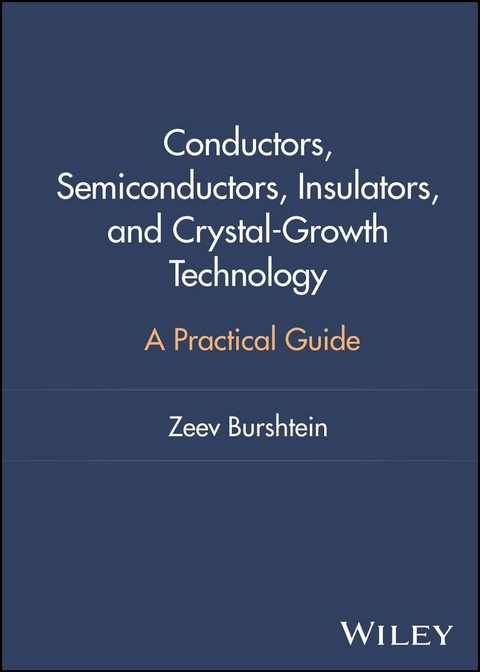
Conductors, Semiconductors, Insulators, and Crystal-Growth Technology (eBook)
618 Seiten
Wiley (Verlag)
978-1-394-33986-0 (ISBN)
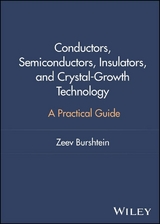
An expert discussion of the physics underlying the electrical industrial use of metals and semiconductors
In Conductors, Semiconductors, Insulators, and Crystal-Growth Technology, distinguished nuclear science researcher, Zeev Burshtein, delivers a comprehensive discussion of the most relevant aspects of solid-state physics, basic devices, and material preparation. The book details the evaluation of content, beginning with solid materials and including the physics occurring in solids, the translation of resulting properties into devices, and explanations of how to prepare solid materials for electronic and optical applications.
Burshtein also includes features appendices with additional material, as well as complete discussions of crystal-growth technology intertwined with explanations of the underlying physical applications of grown crystals.
Readers will also find:
- A thorough introduction to solid-state structure, crystal lattice vibrations, and free electrons in metals
- Comprehensive explorations of semiconductor basics, charge-carriers under thermal equilibrium, and charge-carrier dynamics
- Practical discussions of field-effect devices, radiation and light detectors, and passive optical components
- Complete treatments of the history of grown crystals, solidification processes, furnace design technology, and crystal growing methods
Perfect for advanced undergraduate and graduate students in physics, electronics engineering, and materials engineering, Conductors, Semiconductors, Insulators, and Crystal-Growth Technology will also benefit electronics and materials engineers involved in research and development of related technologies.
Zeev Burshtein, PhD, is a former member of the Nuclear Research Center, Negev. He's a teacher and instructor of PhD students in the Materials Engineering department at Ben Gurion University, Be'er Sheva, Israel. He is a former Chief Advisor of the Israeli Minister of Science and Technology.
1
Solid State Structure
1.1 Crystalline Lattice
Solids are most often constructed of well‐defined crystalline structures, whose essence is a periodic system of atoms or molecules spanned across a considerable range. The periodic structure comprises an imaginary crystalline lattice attached with an atomic basis. The lattice is a set of points in space from which the crystal looks the same. A crystalline lattice may be defined by a set of three fundamental vectors, , , and , such that the crystal appears identical when viewed from points and satisfying
where n1, n2, and n3 are arbitrary integers. The collection of points actually defines the crystalline lattice. The vector is called lattice vector or lattice translation vector. The three‐dimensional parallelepiped based on three fundamental vectors is called unit cell. A lattice and its constructing vectors are granted the adjective primitive if all lattice points are defined by Eq. (1.1). Otherwise, the unit cell is called centered. The aforesaid underlying ideas are displayed in Figure 1.1, describing rather a two‐dimensional lattice. As the figure demonstrates, it is possible to choose different combinations of fundamental vectors to form different unit cells for the same lattice; in fact, an infinite number of such different unit cells can be chosen. A unit cell exhibits the property that it is possible to fill the entire space by its translations using all lattice vectors.
Notably, thus formed unit cells have identical volumes (identical areas in the case of the two‐dimensional lattice of the figure). It is also possible to construct unit cells exhibiting the same property that are not necessarily a spatial parallelepiped of the fundamental lattice vectors. One important example is the Wigner–Seitz unit cell formed by the following procedure: initially, one of the lattice points is selected as an origin. Then, all out‐pointing lattice vectors are sliced in two by adding perpendicular, infinitely large planes. The smallest enclosed polyhedron establishes the desired unit cell. It is quite obvious that its volume would be identical to that of the parallelepiped unit cell, because it spans the entire lattice volume with no voids, where each such cell is assigned to a different lattice point. Furthermore, by its definition, the Wigner–Seitz unit cell is independent of the selection of fundamental lattice vectors!
Figure 1.1 Schematic illustration of a two‐dimensional lattice with three different selections of fundamental lattice vectors and the unit cells they generate (the shaded grey areas). The black small bullets indicate the lattice points, and the different choices are given different subscript numbering.
Figure 1.2 Illustration of the construction method of the Wigner–Seitz unit cell. The dashed lines mark the projections on the page plane of the perpendicular slicing planes of lattice vectors which outpoint from the lattice point selected as the origin. The gray‐shaded area marks the Wigner–Seitz cell.
The formation of a two‐dimensional Wigner–Seitz unit cell is illustrated in Figure 1.2.
The unit cell volume is given by the absolute value of the determinant of the Cartesian coordinates of the , , and lattice fundamental vectors:
As previously noted, the lattice is an abstract mathematical entity. The crystal itself is formed when an identical atom or an identical stiff collection of atoms (say a molecule) is attached to each lattice point. The attached entity is called atomic basis.
An attached atomic basis may sometimes reduce the lattice symmetry. For demonstration, we consider the two‐dimensional square lattice of Figure 1.3, where each lattice point is attached with a couple of identical atoms such that the lattice point is exactly at the mid distance between the atoms. It is easily seen that while each lattice point exhibits a rotational symmetry of 90° about an axis crossing it perpendicularly to the page plane (a fourfold rotational symmetry denoted C4), the rotational symmetry order of the crystal itself is only twofold (namely only a 180° rotation about each said axis yields the same crystal construction; it is denoted as C2). Thus, different crystals may exhibit different symmetry orders even if they belong to the same crystalline lattice.
Figure 1.3 Schematic illustration of rotational symmetry reduction of a crystal lattice caused by addition of an atomic basis. The two‐dimensional lattice of the small bullets has a fourfold rotational symmetry about axes perpendicular to the page plane crossing the lattice points. The symmetry is reduced to only a twofold rotational symmetry after addition of an atomic basis comprising two identical atoms (represented by balls) to each lattice point.
The various possible lattice shapes have been classified by Bravais into 14 different families, and subclassified as 7 crystalline systems. The crystalline systems are defined by the relationships among the lengths of the fundamental , , and linearly independent (not necessarily primitive) vectors and their corresponding α, β, and γ inter angles. If a unit cell generated by these vectors is not primitive, it is then centered, comprising lattice points not coinciding with the cell corners. Bravais systems and the different families belonging to each system are listed and illustrated below.
The mathematical instrument used to present and analyze crystal symmetry is Group Theory. The symmetry of the different lattice structures is described by 32 groups of point‐symmetry operations. The latter include inversion, mirror reflections, rotations (so‐called “proper” rotations), and rotations followed by mirror reflections (so‐called “improper” rotations), that leave at least a single point in space unaltered, and make the operated‐upon object seem identical with the original structure. When other special symmetry operations are added – lattice translations and mirror reflections, each followed by a translation that differs from any lattice translation (called glide‐mirror), and rotations, each followed by a translation that differs from any lattice translation (called screw axis) – 230 groups are obtained, called space groups. The space group properties cast conditions on the possible structure of atomic bases that could be attached to lattice points belonging to a certain space group.
- (i) Cubic system a = b = c; α = β = γ = 90°.
- (ii) Hexagonal system a = b ≠ c; α = β = 90°; γ = 60°.
- (iii) Rhombohedral (trigonal) system a = b = c; α = β = γ < 120° and ≠120° or 60°.
- (iv) Tetragonal system a = b ≠ c; α = β = γ = 90°.
- (v) Orthorhombic system a ≠ b ≠ c; α = β = γ = 90°.
- (vi) Monoclinic system a ≠ b ≠ c; α = γ = 90° ≠ β.
- (vii) Triclinic system a ≠ b ≠ c ≠ a; α ≠ β ≠ γ ≠ α.
Solids may also appear as crystals exhibiting disorder at occasional sites or even in many sites; also as poly‐crystalline forms, where a crystalline order is maintained at only tiny fractions of a millimeter; in glassy forms, where a crystalline order is only slightly larger than the size of a unit cell; and in an amorphous structure, where the order never exceeds the size of a single comprising molecule. In 1984, a special ordered structure of solids exhibiting a fivefold (C5) rotational order was discovered, a symmetry that is inconsistent with a requirement of a perfect crystal. That discovery yielded an extended definition of the crystalline concept, and the person who made this discovery (D. Shechtman) was granted a Nobel Prize in chemistry in 2011. In our following discussions, however, we limit ourselves to consider only regularly ordered crystals, where needed.
1.2 Indication of Crystal Planes and Orientations
A crystalline...
| Erscheint lt. Verlag | 10.9.2025 |
|---|---|
| Sprache | englisch |
| Themenwelt | Naturwissenschaften ► Physik / Astronomie ► Atom- / Kern- / Molekularphysik |
| Schlagworte | charge-carrier dynamics • charge-carriers • Conductor physics • conductor physics basics • conductor physics book • crystal lattice vibrations • grown crystal methods • Semiconductor physics • semiconductor physics book • solid-state structure |
| ISBN-10 | 1-394-33986-0 / 1394339860 |
| ISBN-13 | 978-1-394-33986-0 / 9781394339860 |
| Informationen gemäß Produktsicherheitsverordnung (GPSR) | |
| Haben Sie eine Frage zum Produkt? |
 EPUB (Adobe DRM)
Kopierschutz: Adobe-DRM
Adobe-DRM ist ein Kopierschutz, der das eBook vor Mißbrauch schützen soll. Dabei wird das eBook bereits beim Download auf Ihre persönliche Adobe-ID autorisiert. Lesen können Sie das eBook dann nur auf den Geräten, welche ebenfalls auf Ihre Adobe-ID registriert sind.
Details zum Adobe-DRM
Dateiformat: EPUB (Electronic Publication)
EPUB ist ein offener Standard für eBooks und eignet sich besonders zur Darstellung von Belletristik und Sachbüchern. Der Fließtext wird dynamisch an die Display- und Schriftgröße angepasst. Auch für mobile Lesegeräte ist EPUB daher gut geeignet.
Systemvoraussetzungen:
PC/Mac: Mit einem PC oder Mac können Sie dieses eBook lesen. Sie benötigen eine
eReader: Dieses eBook kann mit (fast) allen eBook-Readern gelesen werden. Mit dem amazon-Kindle ist es aber nicht kompatibel.
Smartphone/Tablet: Egal ob Apple oder Android, dieses eBook können Sie lesen. Sie benötigen eine
Geräteliste und zusätzliche Hinweise
Buying eBooks from abroad
For tax law reasons we can sell eBooks just within Germany and Switzerland. Regrettably we cannot fulfill eBook-orders from other countries.
aus dem Bereich