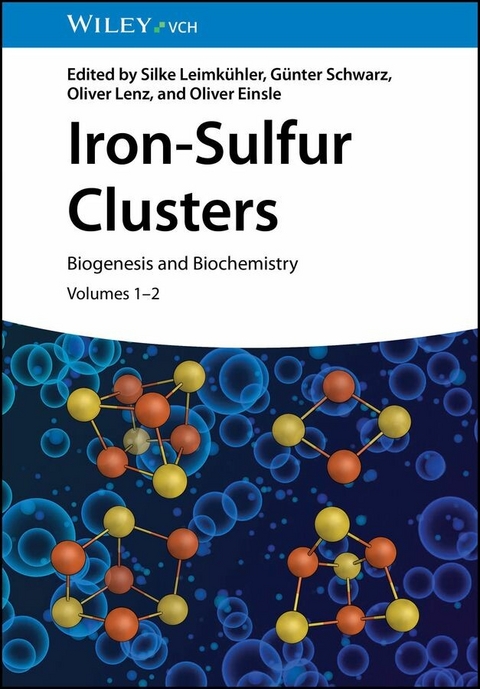
Iron-Sulfur Clusters (eBook)
1465 Seiten
Wiley-VCH (Verlag)
978-3-527-84358-9 (ISBN)
An authoritative and up-to-date collection of resources covering the ubiquitous iron-sulfur cluster-containing proteins
In Iron-Sulfur Clusters: Biogenesis and Biochemistry, a team of distinguished researchers delivers an incisive and practical discussion of the assembly and role of metalloproteins containing an iron atom in a mononuclear or binuclear metal-active site, or where the assembly and final activity of the enzyme depends on an Fe-S cluster containing protein.
The book examines the crosstalk in the assembly of metal-active sites and the roles played by various metal ions in polynuclear metalloclusters. It also describes metal homeostasis and trafficking in a cellular context and explains why the availability of metal ions is tightly regulated.
Of particular interest to chemists working with iron-sulfur (Fe-S) clusters in biology, biochemistry, pharmaceuticals, and drug synthesis, the book also contains:
- A thorough introduction to the biosynthesis of hydrogenase cofactors and hydrogenase reaction mechanisms
- Comprehensive explorations of the reaction mechanisms of molybdoenzymes, including sulfite oxidase, aldehyde oxidase, and formate dehydrogenase
- Practical discussions of the biosynthesis of Fe-S clusters in prokaryotes and eukaryotes
- Complete examinations of the insertion of Fe-S clusters and the biosynthesis of Moco and FeMoco
- An overview of the chemical, crystallographic, spectroscopic and theoretical methods commonly used to characterize Fe-S clusters.
Perfect for biochemists and protein, pharmaceutical, bioinorganic, and organic chemists, Iron-Sulfur Clusters will also be useful for food and environmental chemists, as well as professionals working in the pharmaceutical industry.
Silke Leimkühler, PhD, is a Full Professor in Molecular Enzymology at the University of Potsdam in Germany. Her research is focused on molybdenum cofactor biosynthesis, molybdoenzyme enzymology, cellular sulfur transfer mechanisms for sulfur-containing biomolecule synthesis, and related subjects.
Günter Schwarz is Professor for Biochemistry at the University of Cologne. His research is focused on molecular biology, protein biochemistry, enzymology, structural biology, cell biology, and more.
Oliver Lenz is the Head of the Research Group Biochemistry of Gas-Converting Biocatalysts at the Technische Universität Berlin. His research is focused on the role of molecular hydrogen in the metabolism of microorganisms.
Oliver Einsle is a Full Professor of Biochemistry in Freiburg, Germany and the Director of the Institute of Biochemistry in the Faculty of Chemistry and Pharmacy. His research is focused on the structural and functional characterization of metalloproteins, like nitrogenase and nitrous oxide reductase.
1
ISC‐Based Fe–S Protein Biogenesis in Bacteria
Béatrice Py1 and Frédéric Barras2
1Aix‐Marseille Université, Laboratoire de Chimie Bactérienne (UMR7283), Institut de Microbiologie de la Méditerranée, Institut Microbiologie Bioénergies et Biotechnologie, Centre National de la Recherche Scientifique, 31 chemin Joseph Aiguier, 13009 Marseille, France
2Institut Pasteur, Université Paris Cité, CNRS UMR6047, Department of Microbiology, Unit Stress Adaptation and Metabolism in Enterobacteria, 25‐28 rue du Dr Roux, 75015 Paris, France
Chapter Goals
- Provide a simple overview of the current state of the art on the iron–sulfur cluster (ISC) machinery in bacteria.
Main Chapter Points
- Fe–S (iron–sulfur) proteins are fundamental to life, playing critical roles in processes like electron transport, enzymatic functions, and regulation of gene expression.
- Our article delves into the discovery of one of the most studied multiprotein machineries, iron–sulfur cluster (ISC), which is able to ensure the biogenesis of a group of vital proteins.
- By exploring the latest discoveries, we will also unravel how cells orchestrate the precise construction of Fe–S clusters and integrate them into target proteins.
- Whether you are a student or an experienced researcher new to the field, this article provides a comprehensive overview, highlighting the necessary concepts needed to understand Fe–S protein biogenesis and how this can pave the way for advancements in fundamental research, biotechnology, and medicine.
1.1 Introduction
Fe–S clusters have been “recruited” by living systems very early in evolution [1]. It is likely that, under primitive anaerobic conditions, the abundance and availability of iron, then in ferrous form (Fe2+), and sulfur, then in sulfide form (S2−), contributed to their acquisition by emerging enzymatic systems. However, with the advent of an aerobic atmosphere, maintaining a biology partly based on Fe–S clusters became both more challenging – as iron exists in insoluble oxidized form – and more dangerous – as iron can act as a catalyst for the production of reactive oxygen species (ROS), which are destructive to Fe–S clusters.
There are several types of Fe–S centers. The most common ones are [2Fe–2S] and [4Fe–4S] clusters (Figure 1.1). Fe–S clusters are associated with polypeptides via noncovalent bonds between iron atoms and the side chains of amino acid residues, mostly Cys residues, although other residues, such as Asp, His, and Arg, can also serve as ligands. The different electron valences of iron and sulfur confer properties to Fe–S clusters that allow them to endow host proteins with a wide spectrum of activity. Thus, Fe–S clusters are used frequently as electron relays in electron transfer chains, sensors for modification of the redox potential of the surrounding environment, and also as Lewis acid by directly participating in catalytic reactions [1, 3, 4].
For over 30 years, the formation of Fe–S clusters was considered a spontaneous event. Discovery of the iron–sulfur cluster (ISC) machinery in the 1990s and since then, general concepts for de novo Fe–S protein maturation (here referred to as Fe–S protein biogenesis) have emerged. First, de novo Fe–S clusters are built onto a scaffold protein whose role is to acquire both elements separately, sulfur and iron, and to provide an adequate platform for assembly of the elements into an Fe–S cluster. Sulfur is produced by a cysteine desulfurase, an enzyme admitting L‐cysteine as a substrate. Second, once assembled, the cluster is delivered to one of the many target cellular proteins via one or several Fe–S cluster carriers, which can form a highly plastic network depending on the environmental conditions and/or the target proteins.
Studies in model organisms such as Escherichia coli and Azotobacter vinelandii for prokaryotes, and Saccharomyces cerevisiae, Arabidopsis thaliana, and humans for eukaryotes, have identified three machineries necessary for the formation of Fe–S centers and their insertion into “client” cellular proteins: the ISC machinery, present in bacteria and mitochondria, the SUF (Sulfur mobilization) machinery, present in bacteria and chloroplasts, and the NIF (Nitrogen fixation) machinery that is present in nitrogen‐fixing bacteria. The construction of Fe–S centers by the ISC, NIF, and SUF machineries follows relatively similar logics, i.e. assembling the Fe and S elements in Fe–S clusters and then delivering Fe–S clusters to the cell's “client” proteins (Figure 1.2). The ISC and SUF systems are referred to as general Fe–S biogenesis machineries, meaning that they are able to furnish Fe–S clusters for all Fe–S proteins of the cell. In contrast, the NIF machinery is specialized in the assembly of Fe–S clusters for only one enzyme, the nitrogenase. Eukaryotic systems responsible for Fe–S cluster formation, ISC within mitochondria and SUF within photosynthetic lineages, have evolutionary origins traceable to endosymbiotic events involving Alphaproteobacteria and Cyanobacteria, respectively [5]. Eukaryotes possess an additional machinery, the cytosolic iron–sulfur clusters assembly (CIA), which could be described as an “extension of the distribution line” of the ISC machinery, located in the cytoplasm [6]. The CIA is required for the maturation of cytoplasmic and nuclear Fe–S proteins.
Figure 1.1 Main steps of Fe–S cluster‐containing protein biogenesis. (a) Most common Fe–S clusters found in proteins. Schematic representation of the structure of the rhombic [2Fe–2S] cluster (left) and the cubane [4Fe–4S] cluster (right). Yellow and gray circles represent sulfur and iron atoms, respectively. RS/SR indicates the cysteinyl ligation via cysteine residues of the protein. (b) General principles of de novo Fe–S protein biogenesis by the ISC machinery. In the first step, the Fe–S cluster (yellow/black square) is assembled on a scaffold protein (green), which receives sulfur (yellow circles) from a cysteine desulfurase (orange) carrying a PLP cofactor, and iron (black circles) from an as‐yet nonidentified source. Electrons are provided from ferredoxin (blue). Then, the newly formed Fe–S cluster is released from the scaffold, by a chaperone/co‐chaperone (dark and light purple) assisted process that is ATP dependent, and transferred to one or several carrier proteins (red) that deliver the cluster to the final apo‐target [2].
Recently, an exhaustive bioinformatic and phylogenomic search of 10 000 archaeal and bacterial genomes, representative of the prokaryotic biodiversity, has unearthed two additional “minimal” Fe–S cluster assembly machineries, minimal iron–sulfur (MIS) and SUF‐like minimal system (SMS) [2]. These “minimal” Fe–S cluster assembly machineries have been inferred to be present in the last universal common ancestor (LUCA) [2].
Here, we will focus on the prokaryotic ISC machinery whose functioning is evolutionarily conserved in eukaryotes, notably in humans in which deleterious mutations can lead to severe pathologies [7]. We will detail how this machinery has been discovered, as well as its functioning, regulation, and evolution.
Figure 1.2 The E. coli ISC Fe–S protein biogenesis machinery. (a) Genetic organization of the E. coli isc operon. Genes are color‐coded depending on the function ensured as indicated in Figure 1.1. The cyaY gene that is not part of the isc operon and iscX, the last gene of the isc operon, are color coded as a putative modulator of Fe–S cluster assembly by the ISC machinery, in dark and light gray, respectively. The IscR transcriptional regulator (back). The transcription start of the iscSUA‐hscBA‐fdx‐iscX operon is indicated by a black arrow. (b) Functionally important residues of the ISC components are indicated.
1.2 Discovery of the ISC Fe–S Protein Biogenesis Machinery
The existence of Fe–S protein biogenesis systems was revealed by genetic approaches. This major breakthrough did not emerge from the most widely used model organism, E. coli, but from the nitrogen‐fixing bacteria Klebsiella pneumoniae and A. vinelandii. Nitrogenase activity was, and still is, the focus of a tremendous interest as it enables fixation of atmospheric dinitrogen (N2), under ammonia, a reaction of vital importance for plants and more widely for the terrestrial biogeochemical nitrogen cycle [8, 9]. The nitrogenase is composed of two proteins, which requires a [4Fe–4S] cluster together with the P cluster 8Fe–7S and the Fe–Moco cluster [7FeMo9SC].
Mutants of K. pneumoniae incapable of utilizing N2 as their primary nitrogen source were searched following nitrosoguanidine treatment. Based on variation of the colony aspects (size and pigmentation), when grown on minimal agar medium...
| Erscheint lt. Verlag | 8.9.2025 |
|---|---|
| Sprache | englisch |
| Themenwelt | Naturwissenschaften ► Chemie ► Organische Chemie |
| ISBN-10 | 3-527-84358-2 / 3527843582 |
| ISBN-13 | 978-3-527-84358-9 / 9783527843589 |
| Informationen gemäß Produktsicherheitsverordnung (GPSR) | |
| Haben Sie eine Frage zum Produkt? |
 EPUB (Adobe DRM)
Kopierschutz: Adobe-DRM
Adobe-DRM ist ein Kopierschutz, der das eBook vor Mißbrauch schützen soll. Dabei wird das eBook bereits beim Download auf Ihre persönliche Adobe-ID autorisiert. Lesen können Sie das eBook dann nur auf den Geräten, welche ebenfalls auf Ihre Adobe-ID registriert sind.
Details zum Adobe-DRM
Dateiformat: EPUB (Electronic Publication)
EPUB ist ein offener Standard für eBooks und eignet sich besonders zur Darstellung von Belletristik und Sachbüchern. Der Fließtext wird dynamisch an die Display- und Schriftgröße angepasst. Auch für mobile Lesegeräte ist EPUB daher gut geeignet.
Systemvoraussetzungen:
PC/Mac: Mit einem PC oder Mac können Sie dieses eBook lesen. Sie benötigen eine
eReader: Dieses eBook kann mit (fast) allen eBook-Readern gelesen werden. Mit dem amazon-Kindle ist es aber nicht kompatibel.
Smartphone/Tablet: Egal ob Apple oder Android, dieses eBook können Sie lesen. Sie benötigen eine
Geräteliste und zusätzliche Hinweise
Buying eBooks from abroad
For tax law reasons we can sell eBooks just within Germany and Switzerland. Regrettably we cannot fulfill eBook-orders from other countries.
aus dem Bereich