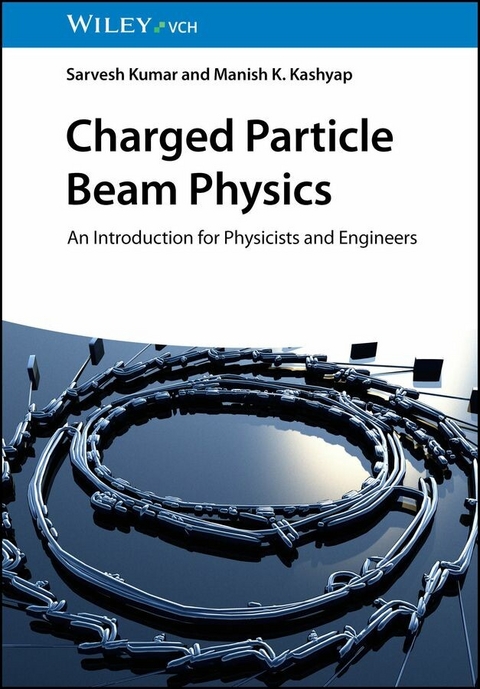
Charged Particle Beam Physics (eBook)
523 Seiten
Wiley-VCH (Verlag)
978-3-527-83297-2 (ISBN)
Offers a clear and practical introduction to the essentials of charged particle beam physics, covers the design of accelerator machines and their basic components
A cornerstone of modern accelerator technology, charged particle beam physics encompasses theoretical principles, advanced simulations, and real-world applications. Charged Particle Beam Physics: An Introduction for Physicists and Engineers provides a comprehensive foundation for understanding, modeling, and implementing beam optics components in accelerator systems.
Combining essential concepts with cutting-edge techniques, such as the transfer-matrix method and numerical simulation tools, this detailed yet accessible textbook simplifies the core concepts and principles of the complex field. Reader-friendly chapters systematically address ion sources, beam optics design, advanced diagnostic and vacuum systems, and more. Authors Sarvesh Kumar and Manish K. Kashyap discuss key topics such as electrostatic, magnetostatic, and radiofrequency fields, as well as practical applications in materials science, plasma physics, and radiation biology.
Bridging theoretical knowledge with practical implementation, Charged Particle Beam Physics:
- Provides in-depth coverage of charged particle beam physics, relevant to both single-pass configurations and standard beam transport lines across accelerator systems
- Combines elements of electrodynamics, particle physics, optics, and engineering for a holistic understanding
- Explores state-of-the-art methods such as open-source beam optics codes
- Includes end-of-chapter problems and worked solutions, along with numerical examples using open-source tools such as TRANSPORT and TRACE3d
Charged Particle Beam Physics: An Introduction for Physicists and Engineers is ideal for graduate-level students in physics and engineering courses focused on accelerator physics and beam optics, as well as researchers and professionals working in accelerator design and operation. It serves as both a teaching resource and a reference for practitioners tackling fundamental calculations and developing accelerator components across various disciplines.
Dr. Sarvesh Kumar is an experimental plasma and accelerator physicist with nearly two decades of experience at the IUAC, New Delhi, India. He contributed to significant national and international projects such as the Large Hadron Collider project. He is presently working as Associate Professor in the Department of Physics & Astrophysics, University of Delhi, India. His main area of interests are plasma wakefield acceleration, plasma instabilities, particle accelerator designs, beam optics and beam-plasma interaction.
Dr. Manish K. Kashyap is a Professor at the School of Physical Sciences, Jawaharlal Nehru University (JNU), India. His areas of interest are condensed matter physics, plasma physics and accelerator physics. His work integrates theoretical modeling with experimental perspectives to enhance beam quality and stability in ion accelerators. He has published around 110 research papers in international journals and conference proceedings.
Chapter 1
Introduction to Charged Particle Beams
“If you want to find the secrets of the universe, think in terms of energy, frequency, and vibration.”
—Nikola Tesla
In accelerator physics, a particle beam is typically defined as a collection of like-charged particles, all moving with momentum predominantly in one direction compared to the other two transverse directions. This characteristic allows the beam to be transported over long distances using electromagnetic fields and further accelerated to energies reaching several teraelectronvolts (TeV) in modern accelerators. Naturally occurring particle beams exist in space, commonly referred to as cosmic rays or solar particles. A specific example is the stream of charged particles, such as solar wind or proton beams, emitted by the Sun. These particles are captured by Earth’s magnetic field, resulting in collisions with particles in Earth’s upper atmosphere. In the Earth ionosphere, charged particles from the solar wind, guided by Earth’s magnetic field, collide with oxygen and nitrogen atoms in the atmosphere, exciting them and releasing energy as colorful light displays known as the aurora, or Northern Lights.
Curiosity: Have you ever wondered how particle accelerators can speed up tiny particles like protons or electrons to nearly the speed of light? Why do they need a vacuum—can’t particles just move through air like anything else? To push particles forward, accelerators use special devices called RF cavities that work like swings, giving the particle a timed “kick” each cycle. But as particles gain speed, why do we need magnets to bend and focus their paths—why don’t they just go straight? And did you know that your microwave oven uses a tiny kind of particle accelerator called a magnetron? What if, instead of electric fields, we could use sound waves or even gravity to accelerate particles—could that work someday? If batteries produce voltage, why can’t we just use a giant one to reach GeV energy levels? Inside circular accelerators, how do particles manage to stay in sync with the accelerating fields without flying off-track? When too many particles gather close together, do they repel each other and cause the beam to spread out? It’s amazing that the first particle accelerator, built in the 1930s, could fit on a tabletop! And why do fast-moving particles give off brilliant light—called synchrotron radiation—when they are forced to turn? Finally, imagine this: could we one day shrink a whole accelerator down to fit on a tiny microchip? We try to explore some of these curious questions here—but many remain open, inviting you to keep wondering, exploring, and discovering.
The energy (E) of a particle [1] can be related to its temperature using the Boltzmann relation:
and 1 eV corresponds to approximately 11 605 K. This implies that particles accelerated to energies in the kiloelectron volt (keV), megaelectron volt (MeV), and gigaelectronvolt (GeV) range are effectively heated to extremely high temperatures. Understanding particle beam dynamics is crucial in space physics and accelerator sciences.
When ions are generated in a laboratory as a stream of charged particles, they must be accelerated and transported to a target with minimal intensity loss. These ions are used in various fields of science, such as nuclear physics, materials science, and atomic physics. In discussing heavy ions, which are larger than protons, a key difference lies in their approach to the speed of light as they gain energy. The total energy of a charged particle is given by the following equation:
The relativistic energy–momentum relation is:
where is the total energy of the particle, is the relativistic momentum, is the rest mass of the particle, and is the speed of light.
The relativistic momentum is related to the velocity of the particle by:
where (the Lorentz factor) is defined as:
Here . Thus, the total energy of particle is given as follows:
Finally, the kinetic energy is given by:
If we plot the velocity of different charged particles as per Equation 1.6, then the electrons begin to exhibit significant relativistic behavior at energies around 0.511 MeV, which corresponds to their rest mass energy. However, according to special relativity, they can never reach the speed of light, no matter how much energy they gain. Protons become relativistic at much higher energies, near 938 MeV, their rest mass energy. Similarly, heavy ions, they require even higher energies (in the GeV per nucleon range) to exhibit relativistic effects due to their much greater mass. Regardless of particle type, no material particle can attain the speed of light; they can only asymptotically approach it as their energy increases. This is illustrated in Figure 1.1.
Figure 1.1 Velocity behavior of different charged particles as they approach the speed of light.
To maintain particles in a stable orbit as a beam, they must be placed in a constant magnetic field, where they spiral around the magnetic lines of force. This leads to the concept of magnetic rigidity, defined alongside the magnetic force, cyclotron frequency, and gyroradius as follows:
Magnetic force on particle:
Cyclotron frequency of the particle:
Larmor radius (gyroradius) of particle:
Magnetic rigidity:
In terms of practical units:
Here, is the total energy of the particle. Using Equation 1.11, if we plot the magnetic rigidity required to bend different ions with a fixed energy of 500 MeV and a unit charge state, we see that it increases with the mass of the ions. This is shown in Figure 1.2, alongside the corresponding normalized particle velocities. Following conclusions can be drawn:
- Maximum magnetic rigidity is calculated for the heaviest mass, highest energy, and unit positive charge state of the beam desired in the accelerator.
- Magnetic rigidity increases with mass and energy of charged particles for a given charge state of the beam particles.
- Magnetic rigidity is maximum for a unit charge state of an ion beam with target energy.
- Magnetic rigidity depends on the mass-to-charge ratio directly, When where is the voltage by which particles are accelerated.
Figure 1.2 Velocity and magnetic rigidity of different ion beams of mass M (amu) at 500 MeV energy.
In 1909, Ernest Rutherford bombarded alpha particles onto a thin gold foil. To overcome the Coulomb barrier between the alpha particles and the gold nucleus, high energies were necessary to surmount the Coulomb repulsion. The higher the energy imparted to particles, the shorter their de Broglie wavelength . Just as a living cell is observed under an optical microscope using scattered visible light photons, energetic particles can be used to probe matter, depending on their wavelength. The wavelength of energetic particles determines the size of the object to be resolved, so high-energy particles (with mass , velocity , and energy ) are required to probe deep into atoms and nuclei. The de Broglie wavelength is given by the Planck–Einstein relation, the relationship between energy and momentum:
In terms of practical units:
Here, is the energy of the particle (or photon), is Planck’s constant, is the frequency of the de Broglie wave associated with the particle.
Accelerators have evolved over the last two centuries as a result of applying electricity and magnetism to charged particles, driven by the pioneering work of many great scientists and engineers. Initially motivated by Rutherford’s famous experiment to explore the nucleus, modern particle accelerators are essential tools for probing the structure of atoms, protons, neutrons, and electrons through high-energy collisions that reveal their internal components. They enable the discovery of new particles, such as quarks, leptons, and the Higgs boson, by recreating the extreme conditions necessary for these short-lived particles to manifest. Studying particle interactions at high energies allows scientists to explore the fundamental forces of nature – gravity, electromagnetism, and the strong and weak nuclear forces – and how they behave and unify. Additionally, accelerators like the Large Hadron Collider (LHC) recreate the energy densities present just after the Big Bang, offering insights into the origins of the universe. They also provide a platform to test and confirm theoretical models of quantum mechanics and relativity, including the Standard Model, by observing particle behavior and interactions with exceptional precision.
Thus, the evolution of accelerators has progressed from natural particle accelerators like cosmic rays and radioactive materials to highly engineered devices capable of producing extreme energetic particles. Cosmic rays, consisting of high-energy particles originating from astrophysical events, represent the earliest and most powerful natural accelerators. Similarly, radioactive sources emit high-energy particles during...
| Erscheint lt. Verlag | 8.9.2025 |
|---|---|
| Sprache | englisch |
| Themenwelt | Naturwissenschaften ► Physik / Astronomie ► Atom- / Kern- / Molekularphysik |
| ISBN-10 | 3-527-83297-1 / 3527832971 |
| ISBN-13 | 978-3-527-83297-2 / 9783527832972 |
| Informationen gemäß Produktsicherheitsverordnung (GPSR) | |
| Haben Sie eine Frage zum Produkt? |
 EPUB (Adobe DRM)
Kopierschutz: Adobe-DRM
Adobe-DRM ist ein Kopierschutz, der das eBook vor Mißbrauch schützen soll. Dabei wird das eBook bereits beim Download auf Ihre persönliche Adobe-ID autorisiert. Lesen können Sie das eBook dann nur auf den Geräten, welche ebenfalls auf Ihre Adobe-ID registriert sind.
Details zum Adobe-DRM
Dateiformat: EPUB (Electronic Publication)
EPUB ist ein offener Standard für eBooks und eignet sich besonders zur Darstellung von Belletristik und Sachbüchern. Der Fließtext wird dynamisch an die Display- und Schriftgröße angepasst. Auch für mobile Lesegeräte ist EPUB daher gut geeignet.
Systemvoraussetzungen:
PC/Mac: Mit einem PC oder Mac können Sie dieses eBook lesen. Sie benötigen eine
eReader: Dieses eBook kann mit (fast) allen eBook-Readern gelesen werden. Mit dem amazon-Kindle ist es aber nicht kompatibel.
Smartphone/Tablet: Egal ob Apple oder Android, dieses eBook können Sie lesen. Sie benötigen eine
Geräteliste und zusätzliche Hinweise
Buying eBooks from abroad
For tax law reasons we can sell eBooks just within Germany and Switzerland. Regrettably we cannot fulfill eBook-orders from other countries.
aus dem Bereich