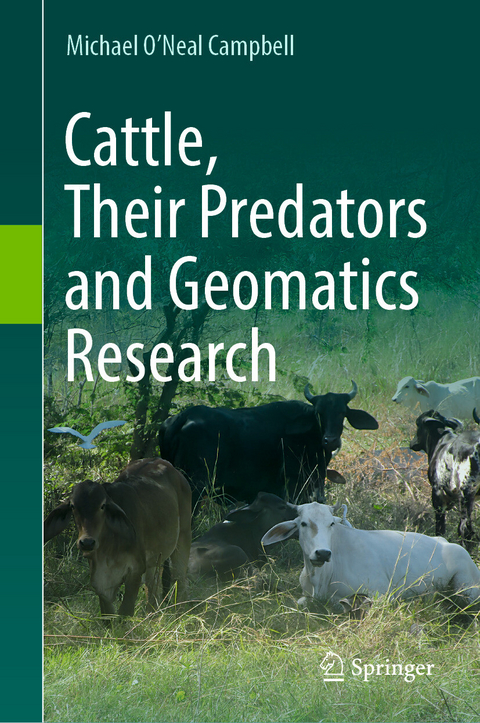
Cattle, Their Predators and Geomatics Research (eBook)
403 Seiten
Springer-Verlag
978-3-031-97363-5 (ISBN)
Cattle are currently the most important domesticated mammals, with populations numbering in the hundreds of millions and occupying large tracts of land, while the conservation of large mammalian carnivores is becoming a dominant discourse in modern geopolitics, also claiming large portions of the Earth's land surface. Computer-based surveying and communication systems, including geomatics, Big Data and Big Tech, are becoming an essential part of human communication and environmental assessments and are critical to large-scale assessments of land conflicts. A current, critical, potent but neglected issue concerns the measurement of the interfaces of large carnivore and cattle ecologies, in a cross continental format.
This book offers a novel approach to the interfaces of the sciences of conservation biology, animal ecology, agricultural development and geomatics, which are increasingly interconnected in modern, global development scenarios. For animal ecology and conservation biology, it is about the management systems that have developed from ecological and human parameters. For agricultural development, topics concern ancestral development, physiological characteristics, ecological requirements, and predation opportunities and conflicts of cattle breeds. For geomatics, the topics concern the image-based and survey-based technologies that enable more critical environmental assessments. The book takes a novel approach by examining the ancestry of cattle, including the aurochs and current wild buffalos, gaur, banteng, yaks, bison, the process of domestication into taurine and indicine cattle, the semi-domestication of yaks and water buffalo, the ecologies of ancestral and modern large carnivores, including bears, big cats and canids, and how the requirements of these large charismatic mammals conflict with the requirements of cattle and agricultural development, in Asia, Europe, Africa, North America, and South America. This integrative approach contributes to the interests of academic researchers, students, practitioners and policy makers, and general readers.
| Erscheint lt. Verlag | 6.8.2025 |
|---|---|
| Sprache | englisch |
| Themenwelt | Geisteswissenschaften ► Philosophie ► Ethik |
| Naturwissenschaften ► Biologie | |
| ISBN-10 | 3-031-97363-1 / 3031973631 |
| ISBN-13 | 978-3-031-97363-5 / 9783031973635 |
| Informationen gemäß Produktsicherheitsverordnung (GPSR) | |
| Haben Sie eine Frage zum Produkt? |
 PDF (Wasserzeichen)
Größe: 31,9 MB
DRM: Digitales Wasserzeichen
Dieses eBook enthält ein digitales Wasserzeichen und ist damit für Sie personalisiert. Bei einer missbräuchlichen Weitergabe des eBooks an Dritte ist eine Rückverfolgung an die Quelle möglich.
Dateiformat: PDF (Portable Document Format)
Mit einem festen Seitenlayout eignet sich die PDF besonders für Fachbücher mit Spalten, Tabellen und Abbildungen. Eine PDF kann auf fast allen Geräten angezeigt werden, ist aber für kleine Displays (Smartphone, eReader) nur eingeschränkt geeignet.
Systemvoraussetzungen:
PC/Mac: Mit einem PC oder Mac können Sie dieses eBook lesen. Sie benötigen dafür einen PDF-Viewer - z.B. den Adobe Reader oder Adobe Digital Editions.
eReader: Dieses eBook kann mit (fast) allen eBook-Readern gelesen werden. Mit dem amazon-Kindle ist es aber nicht kompatibel.
Smartphone/Tablet: Egal ob Apple oder Android, dieses eBook können Sie lesen. Sie benötigen dafür einen PDF-Viewer - z.B. die kostenlose Adobe Digital Editions-App.
Buying eBooks from abroad
For tax law reasons we can sell eBooks just within Germany and Switzerland. Regrettably we cannot fulfill eBook-orders from other countries.
aus dem Bereich