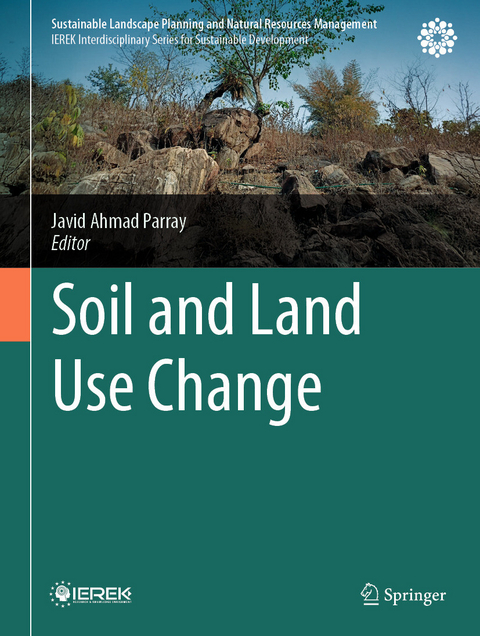
Soil and Land Use Change (eBook)
146 Seiten
Springer (Verlag)
978-3-031-93075-1 (ISBN)
This book focuses on the overview of the causative factors for forcing land use changes and the historical developments worldwide. Healthy soil is the foundation of agriculture and an essential resource for meeting 21st-century human needs such as food, feed, fiber, clean water, and air. It is an integral component of ecosystems and earth system functions that help to deliver primary ecosystem services. Soil change, as opposed to soil variability, refers to the alteration of soil and its properties over time in one location. Although soils change due to pedogenesis, this book focuses on anthropogenic soil changes. Human use and management can cause soil change over long or short periods and on small or large scales. Many soils have had their chemical, physical, or biological properties altered due to agricultural activities such as cultivation, tillage, and weeding. The primary cause of accelerated soil erosion is human activity and related land use change, which seriously affects nutrient and carbon cycling, land productivity, and global socioeconomic conditions. Land degradation and land use have reached alarming proportions, exacerbated by climate change. Land use change has been identified as a worldwide issue because it is one of the primary causes of environmental change.
The book outlines various socioeconomic setups driving soil and land use change. The composition of the community influences the function of the ecosystem. Understanding how these forces affect the soil biological community is critical to preventing land degradation and desertification. Agriculture production is decreasing as a result of existing biotic and abiotic stresses. In this regard, the book emphasizes an integrated approach that includes strategies for replacing essential concepts with desperately needed realistic, sustainable, and economically viable techniques. Land use changes are frequently nonlinear, which can cause system feedback, stress living conditions, and expose people to vulnerability.
| Erscheint lt. Verlag | 3.9.2025 |
|---|---|
| Reihe/Serie | Sustainable Landscape Planning and Natural Resources Management |
| Zusatzinfo | VI, 146 p. 33 illus., 27 illus. in color. |
| Sprache | englisch |
| Themenwelt | Naturwissenschaften ► Biologie |
| Technik ► Bauwesen | |
| Schlagworte | cover change • disease incidence • Forest • Grassland • land degradation • land use • land use patterns • microbes • restoration • Soil health • soil use • sustainable agriculture • urbanization |
| ISBN-10 | 3-031-93075-4 / 3031930754 |
| ISBN-13 | 978-3-031-93075-1 / 9783031930751 |
| Informationen gemäß Produktsicherheitsverordnung (GPSR) | |
| Haben Sie eine Frage zum Produkt? |
 PDF (Wasserzeichen)
DRM: Digitales Wasserzeichen
Dieses eBook enthält ein digitales Wasserzeichen und ist damit für Sie personalisiert. Bei einer missbräuchlichen Weitergabe des eBooks an Dritte ist eine Rückverfolgung an die Quelle möglich.
Dateiformat: PDF (Portable Document Format)
Mit einem festen Seitenlayout eignet sich die PDF besonders für Fachbücher mit Spalten, Tabellen und Abbildungen. Eine PDF kann auf fast allen Geräten angezeigt werden, ist aber für kleine Displays (Smartphone, eReader) nur eingeschränkt geeignet.
Systemvoraussetzungen:
PC/Mac: Mit einem PC oder Mac können Sie dieses eBook lesen. Sie benötigen dafür einen PDF-Viewer - z.B. den Adobe Reader oder Adobe Digital Editions.
eReader: Dieses eBook kann mit (fast) allen eBook-Readern gelesen werden. Mit dem amazon-Kindle ist es aber nicht kompatibel.
Smartphone/Tablet: Egal ob Apple oder Android, dieses eBook können Sie lesen. Sie benötigen dafür einen PDF-Viewer - z.B. die kostenlose Adobe Digital Editions-App.
Buying eBooks from abroad
For tax law reasons we can sell eBooks just within Germany and Switzerland. Regrettably we cannot fulfill eBook-orders from other countries.
aus dem Bereich