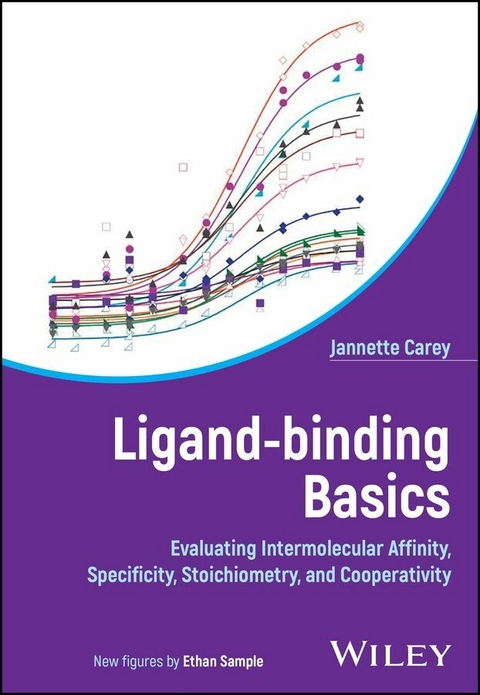
Ligand-Binding Basics (eBook)
472 Seiten
Wiley (Verlag)
978-1-119-87847-6 (ISBN)
A concise and accessible textbook covering ligand-binding theory in chemistry, biology, and drug development
In Ligand-binding Basics: Evaluating Intermolecular Affinity, Specificity, Stoichiometry, and Cooperativity, accomplished chemist Professor Jannette Carey introduces ligand binding in a thorough and practical way for those new to the topic, as well as anyone seeking a connection between theory and experiment. Using a minimum of mathematical formalism, this book offers analytical rigor while remaining accessible to non-specialist practitioners. It provides readers with the skills they need to analyze their own binding data or published results, helping them develop an intuitive grasp of ligand-binding phenomena integrated with structural and thermodynamic understanding.
Topics covered include:
- Application of the principles of equilibrium, mass action, and mass balance to derive the basic equations that describe all binding processes
- Recommended approaches for plotting and graphical analysis of binding data
- Strategies for designing, analyzing, interpreting, and troubleshooting experiments from the perspective of ligand-binding theory
- Review of selected examples that illustrate integration of structural and thermodynamic analysis
Perfect for students and educators in chemistry, biochemistry, molecular biology, and pharmaceutical science, Ligand-binding Basics will also appeal to practitioners who aim to study ligand binding in any molecular system.
Jannette Carey has been a member of the Chemistry faculty at Princeton University for over thirty years, where she developed and teaches a two-term sequence in biophysical chemistry that is accessible to early graduate and advanced undergraduate students in a wide range of disciplines. Her biophysical research is focused on unifying the thermodynamic and structural basis for macromolecular interactions.
A concise and accessible textbook covering ligand-binding theory in chemistry, biology, and drug development In Ligand-binding Basics: Evaluating Intermolecular Affinity, Specificity, Stoichiometry, and Cooperativity, accomplished chemist Professor Jannette Carey introduces ligand binding in a thorough and practical way for those new to the topic, as well as anyone seeking a connection between theory and experiment. Using a minimum of mathematical formalism, this book offers analytical rigor while remaining accessible to non-specialist practitioners. It provides readers with the skills they need to analyze their own binding data or published results, helping them develop an intuitive grasp of ligand-binding phenomena integrated with structural and thermodynamic understanding. Topics covered include: Application of the principles of equilibrium, mass action, and mass balance to derive the basic equations that describe all binding processesRecommended approaches for plotting and graphical analysis of binding dataStrategies for designing, analyzing, interpreting, and troubleshooting experiments from the perspective of ligand-binding theoryReview of selected examples that illustrate integration of structural and thermodynamic analysis Perfect for students and educators in chemistry, biochemistry, molecular biology, and pharmaceutical science, Ligand-binding Basics will also appeal to practitioners who aim to study ligand binding in any molecular system.
Introduction
Aims and Rationale
This book is intended for two audiences: those who are new to thinking about ligand binding, and those who have been engaged with the topic but want a better basic understanding, further explanation of the equations and plots, or practical connections between theory and experiment. The book is deliberately as unsophisticated as possible, using an absolute minimum of mathematical formalism, not to patronize the reader but because that is all that is truly required while maintaining analytical rigor. This treatment aims to promote broad access for nonspecialist practitioners, and to equip you with skills that can be applied equally to your own binding data or to published or unpublished results you may rely upon in your work. The overall goal is to help you gain an instinctive feeling for ligand‐binding phenomena and data. The tradeoff is that topics included in more sophisticated treatments are absent here, but those are covered well by other authors.
The specific aim of this book is to introduce the basics of ligand binding in a thorough and practical way for those who have only general chemistry as preparation. Part of the reason for a “basics” approach reflects the fact that ligand‐binding phenomena are widely distributed in chemistry and biology. Many scientists may find themselves confronted with an example, in their own work or in published work they are relying on, that may not conform to examples treated in courses they have studied. In addition, one‐time users should not have to master the demanding formalism or esoteric details of advanced treatments in order to address a single problem, yet they need practical advice to devise a plan for tackling it correctly; if that's all you want, then you can skip to Chapter 5. But the aim is not only to enable you to master ligand binding using straightforward theoretical, practical, and interpretive tools, but also to convey and encourage an intuitive understanding of ligand‐binding phenomena integrated with structural and thermodynamic understanding that may help you weave your results into a holistic picture of your system.
The other part of the reason for a basics approach is that ligand‐binding theory and practice have long been shrouded in mystery and confusion, as attested, e.g., by the titles of the classic book (Klotz, 1997) and review article (Klotz, 1985) by Professor Irving M. Klotz that reflected his hope of demystifying the topic. Despite his best efforts toward a simple and straightforward exposition, the topic retains its reputation as being complex and elusive, while at the same time having attained even wider scope and importance in chemistry and biology than it had in his lifetime. As Klotz observed, there is confusion even among practitioners, as demonstrated by the many peculiar or contradictory reports on ligand binding in the literature, suggesting widespread misunderstanding; this remains true a quarter‐century after the publication of his book. A prospective practitioner is ill‐advised to choose examples from the literature to emulate without a thorough understanding of the underlying principles, both theoretical and practical. Regrettably for the scientific enterprise, the mere fact that something has appeared in black and white (or color, for that matter) is no endorsement of its inherent quality. Caveat emptor!
Klotz explained the principles of ligand binding in relatively simple and accessible ways in his book and chapter, so one might rightly ask why another book is needed now. There are two reasons. The first is that Klotz's book is long out of print, and difficult to find in numbers sufficient for students in a course. Even many academic libraries lack a copy. The second reason is more philosophical than pragmatic. It is entirely possible to derive the necessary equations and to understand the features of ligand‐binding phenomena using only three elementary principles that every student of general chemistry already knows by heart: the law of mass action (an example of Le Chatelier's principle), the definition of the equilibrium constant, and the conservation of mass. By hewing closely to these three principles it is possible to develop the topic of ligand binding by applying nothing beyond high school algebra, and with no elaborate formalism whatsoever. From these three principles students are able to derive every equation required to treat even complex examples of ligand binding, using only elementary algebra and no mathematical sleight of hand. When students do so they can acquire an understanding of ligand binding beyond what can come from presenting equations as faits accomplis or mere mathematical abstractions. This book aims to present the topic with a minimalist formalism, even compared with Klotz's, and certainly compared with most other treatments.
Besides Klotz, several other works, both classic (Cantor & Schimmel, 1980; Freifelder, 1982; Weber, 1992) and more recent (Barrick, 2017), treat ligand binding with varying approaches and at a range of levels of detail and mathematical sophistication. I particularly favor the books by Weber and by Barrick, which are more complementary than redundant; both necessarily present on‐ramps to their formalisms. The article from Herschlag's group (Jarmoskaite et al., 2020) is an excellent introduction; his nomenclature differs from that used here. Some treatments either assume a background in statistical thermodynamics, and/or they derive or present equations with limited discussion of their origins, meanings, and/or practical consequences. This book offers you a starting point by providing a basic understanding that may motivate you later to pursue a more detailed treatment. Caution is needed before adopting the treatments of some older works that advocated linearization approaches that were never justified and are now superseded by computational advances. You will learn here how to apply the substitutes without requiring any specific computational background. Finally, ligand‐binding texts rarely help you move from theory to practice, instead imagining that you will somehow magically translate the former into the latter. This book fills that gap. However, specific methods are not described in any detail; rather, they are discussed only as they relate to ligand‐binding theory.
The treatment of ligand binding here is based only partly on my research, which applies ligand‐binding theory to several molecular systems from which most of the examples are drawn, and also on my experiences in teaching the topic to audiences of widely mixed backgrounds. For 35 years I have taught a two‐semester sequence of courses in biophysical chemistry at Princeton that I developed with the explicit aim of reaching graduate and undergraduate students from all branches of the physical, mathematical, and engineering sciences whose only common background is general chemistry. Typical audiences include beginning graduate students, advanced undergraduates, and industrial practitioners from companies in the vicinity of the campus. The courses present fundamental principles of macromolecular structure, stability, and interactions in one term, and methods for studying macromolecular structure, stability, and interactions in another term. The two terms are purposely independent of each other.
In addition, I have taught both ligand‐binding theory and the fundamental principles and methods of macromolecular structure and stability to undergraduates from all over the U.S., largely from community colleges, who participate in an NSF Training Site in biophysics that I have directed for over twenty years at Princeton in a summer Research Experience for Undergraduates program. In Europe I have taught the material as part of FEBS and EMBO international summer schools and practical courses that I have organized, and at selected universities as a visiting professor. I developed an entire laboratory course in biophysics for medical students at Karolinska Institutet that also featured ligand‐binding theory and practice. From these experiences I know that when the topic is taught in the way presented in this book students can gain the deep instinctive and practical understanding that I intend.
What This Book Does – and Doesn't – Do
Through the development of quantitative ligand‐binding theory, the book encompasses methods and strategies for designing, analyzing, interpreting, and troubleshooting ligand‐binding experiments. These devices will enable you to handle even complex cases in simple but rigorous ways, whether in your own data or from published results. Readers will learn how to use the principles of equilibrium, mass action, and mass balance to derive the basic equations that describe all binding processes; correctly plot binding data; use graphical analysis to interpret binding data; calculate predicted binding isotherms; understand the simulation and fitting of binding isotherms; determine and quantify affinity, specificity, stoichiometry, and cooperativity of binding processes; and identify, diagnose, and evaluate random and systematic errors in binding data. It is not an aim of this book to present or discuss specific experimental methods for ligand‐binding studies. Rather, general strategies for experimental design that derive from binding theory are presented, and some advantages or disadvantages of selected methods are discussed as they relate to features of theory. These points can aid in designing experiments and interpreting data. Some strategies...
| Erscheint lt. Verlag | 3.9.2025 |
|---|---|
| Illustrationen | Ethan Sample |
| Sprache | englisch |
| Themenwelt | Naturwissenschaften ► Chemie ► Organische Chemie |
| Schlagworte | Adair equation • affinity heterogeneity • basic ligand-binding • cryptic contributions to binding • faciliated or antagonized binding • Graphical analysis • host-guest chemistry • implications for drug design • Langmuir Equation • ligand-binding applications • ligand-binding biology • ligand-binding chemistry • ligand-binding experimentation • ligand-binding experiment design • ligand-binding experiments • ligand-binding principles • Ligand-binding theory • MWC concerted allostery model • proteins as gestalt objects • reconciling structure and energetics • simulation and fitting • Species distribution • thermodynamic linkage |
| ISBN-10 | 1-119-87847-0 / 1119878470 |
| ISBN-13 | 978-1-119-87847-6 / 9781119878476 |
| Informationen gemäß Produktsicherheitsverordnung (GPSR) | |
| Haben Sie eine Frage zum Produkt? |
 EPUB (Adobe DRM)
Kopierschutz: Adobe-DRM
Adobe-DRM ist ein Kopierschutz, der das eBook vor Mißbrauch schützen soll. Dabei wird das eBook bereits beim Download auf Ihre persönliche Adobe-ID autorisiert. Lesen können Sie das eBook dann nur auf den Geräten, welche ebenfalls auf Ihre Adobe-ID registriert sind.
Details zum Adobe-DRM
Dateiformat: EPUB (Electronic Publication)
EPUB ist ein offener Standard für eBooks und eignet sich besonders zur Darstellung von Belletristik und Sachbüchern. Der Fließtext wird dynamisch an die Display- und Schriftgröße angepasst. Auch für mobile Lesegeräte ist EPUB daher gut geeignet.
Systemvoraussetzungen:
PC/Mac: Mit einem PC oder Mac können Sie dieses eBook lesen. Sie benötigen eine
eReader: Dieses eBook kann mit (fast) allen eBook-Readern gelesen werden. Mit dem amazon-Kindle ist es aber nicht kompatibel.
Smartphone/Tablet: Egal ob Apple oder Android, dieses eBook können Sie lesen. Sie benötigen eine
Geräteliste und zusätzliche Hinweise
Buying eBooks from abroad
For tax law reasons we can sell eBooks just within Germany and Switzerland. Regrettably we cannot fulfill eBook-orders from other countries.
aus dem Bereich