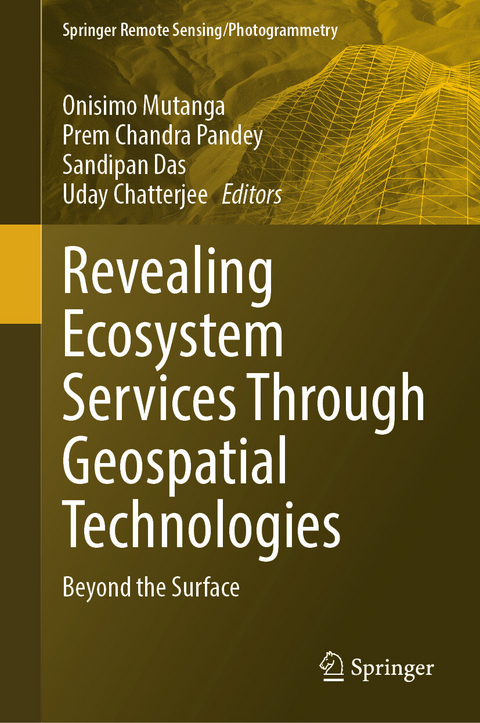
Revealing Ecosystem Services Through Geospatial Technologies (eBook)
394 Seiten
Springer-Verlag
978-3-031-98048-0 (ISBN)
This book covers the quantification of forests, grasslands, and woodlands ecosystem services from the supply side (e.g., regulatory and provisioning services) to the demand side, including human cultural needs. The Millennium Ecosystem Assessment (MA, 2005) defines ecosystem services as simply the benefits that are derived from ecosystems for human well-being (Board 2005). The report has documented that ecosystems have contributed more than 50% of the world's GDP. However, as a result of climate change and anthropogenic impacts, about 60% of the world's ecosystem services have been degraded. This significant reduction of services has serious consequences on food production, climate regulation, and net primary production, among other services which directly affect human well-being. In order to appreciate the benefits of various ecosystems to humanity and monitor their degradation, a systematic quantification of ecosystem services and their change in both time and space is critical. In particular, there is a need to characterize the ecological infrastructures, processes, and ecosystem functions that underpin the ecosystem services in ways that can be evaluated and tracked (Potschin and Haines-Young 2016). In addition, various intervention measures to restore degraded ecosystems require constant and accurate measurement of the ecosystem characteristics in order to assess the benefits of ecological restoration.
Vegetation in particular provides a number of provisioning (forage production, food), regulatory (climate, temperature), supporting (primary production, nutrient cycling), and cultural (educational, recreation) ecosystem services as well as biodiversity maintenance (Masenyama et al. 2022). Remote sensing data contributes significantly to mapping, modeling, and quantitative valuation of the ecosystem services in a spatially explicit manner. It provides an opportunity to use standard protocols at various spatial scales as well as wall-to-wall mapping of phenomena through time, which is critical for monitoring on a continuous basis.
| Erscheint lt. Verlag | 30.8.2025 |
|---|---|
| Reihe/Serie | Springer Remote Sensing/Photogrammetry |
| Zusatzinfo | XXIV, 394 p. 97 illus., 82 illus. in color. |
| Sprache | englisch |
| Themenwelt | Naturwissenschaften ► Geowissenschaften ► Geografie / Kartografie |
| Schlagworte | Big data analysis • change analysis • Ecosystem functions mapping • ecosystem services quantification • future ES prediction • remote sensing ES monitoring |
| ISBN-10 | 3-031-98048-4 / 3031980484 |
| ISBN-13 | 978-3-031-98048-0 / 9783031980480 |
| Informationen gemäß Produktsicherheitsverordnung (GPSR) | |
| Haben Sie eine Frage zum Produkt? |
 PDF (Wasserzeichen)
DRM: Digitales Wasserzeichen
Dieses eBook enthält ein digitales Wasserzeichen und ist damit für Sie personalisiert. Bei einer missbräuchlichen Weitergabe des eBooks an Dritte ist eine Rückverfolgung an die Quelle möglich.
Dateiformat: PDF (Portable Document Format)
Mit einem festen Seitenlayout eignet sich die PDF besonders für Fachbücher mit Spalten, Tabellen und Abbildungen. Eine PDF kann auf fast allen Geräten angezeigt werden, ist aber für kleine Displays (Smartphone, eReader) nur eingeschränkt geeignet.
Systemvoraussetzungen:
PC/Mac: Mit einem PC oder Mac können Sie dieses eBook lesen. Sie benötigen dafür einen PDF-Viewer - z.B. den Adobe Reader oder Adobe Digital Editions.
eReader: Dieses eBook kann mit (fast) allen eBook-Readern gelesen werden. Mit dem amazon-Kindle ist es aber nicht kompatibel.
Smartphone/Tablet: Egal ob Apple oder Android, dieses eBook können Sie lesen. Sie benötigen dafür einen PDF-Viewer - z.B. die kostenlose Adobe Digital Editions-App.
Buying eBooks from abroad
For tax law reasons we can sell eBooks just within Germany and Switzerland. Regrettably we cannot fulfill eBook-orders from other countries.
aus dem Bereich