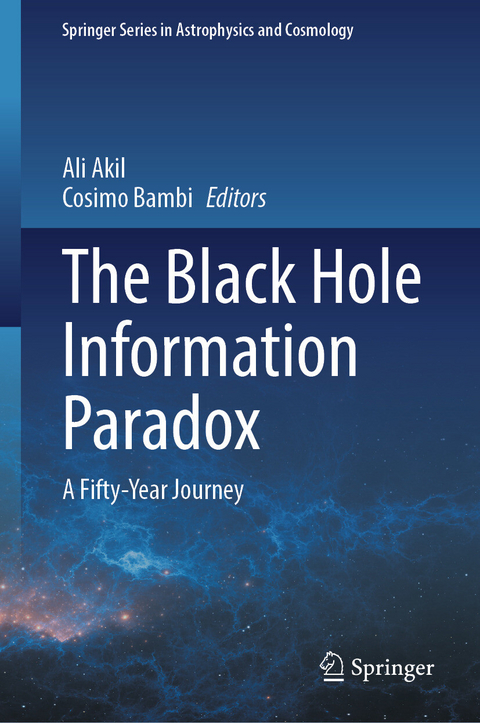
The Black Hole Information Paradox (eBook)
716 Seiten
Springer-Verlag
978-981-96-6170-1 (ISBN)
This book reviews a few different derivations of the Hawking radiation, most main solutions to the paradox proposed in the literature, and some analog laboratory experiments. A black hole is an object whose gravity is so strong that nothing, not even light, can escape its grasp. However, applying quantum field theory on a black hole background, Stephen Hawking showed that black holes are not completely black. In fact, they seem to emit a form of radiation that was named the Hawking radiation. The Hawking radiation appears to be thermal and in a quantum state that is independent of the initial state that formed the black hole; instead, it solely depends on the black hole's total mass, spin, and electric charge. A problem arises when we consider an initial system that collapses, forms a black hole, and eventually the black hole evaporates completely through Hawking radiation. Since Hawking radiation depends solely on the black hole's total mass, spin, and electric charge, it implies that numerous distinct initial states could all lead to the same final state. Consequently, the intricate details of the initial state seem to be lost, which contradicts the unitarity of evolution of closed systems, a fundamental principle of quantum mechanics. The unitarity principle implies that closed systems evolve in a reversible manner, such that, knowing a system’s final state, and the way it evolved, one can always determine its initial state. The many-to-one evolution of the black hole initial state to radiation evolution is in a clear contradiction with this principle. This is the black hole information paradox. The black hole information paradox was found in the 1970s by Stephen Hawking. Over the past 50 years, it has attracted a lot of interest in the theoretical physics community and is still an active research field. Chapters are written by leading experts in the field.
| Erscheint lt. Verlag | 29.8.2025 |
|---|---|
| Reihe/Serie | Springer Series in Astrophysics and Cosmology |
| Zusatzinfo | VIII, 716 p. 144 illus., 88 illus. in color. |
| Sprache | englisch |
| Themenwelt | Naturwissenschaften ► Physik / Astronomie ► Astronomie / Astrophysik |
| Schlagworte | Analog Models of Gravity • Black Hole Evaporation • Black Hole Remnants • Black hole thermodynamics • Hawking Radiation • Quantum Field Theory in Curved Spacetime |
| ISBN-10 | 981-96-6170-6 / 9819661706 |
| ISBN-13 | 978-981-96-6170-1 / 9789819661701 |
| Informationen gemäß Produktsicherheitsverordnung (GPSR) | |
| Haben Sie eine Frage zum Produkt? |
 PDF (Wasserzeichen)
DRM: Digitales Wasserzeichen
Dieses eBook enthält ein digitales Wasserzeichen und ist damit für Sie personalisiert. Bei einer missbräuchlichen Weitergabe des eBooks an Dritte ist eine Rückverfolgung an die Quelle möglich.
Dateiformat: PDF (Portable Document Format)
Mit einem festen Seitenlayout eignet sich die PDF besonders für Fachbücher mit Spalten, Tabellen und Abbildungen. Eine PDF kann auf fast allen Geräten angezeigt werden, ist aber für kleine Displays (Smartphone, eReader) nur eingeschränkt geeignet.
Systemvoraussetzungen:
PC/Mac: Mit einem PC oder Mac können Sie dieses eBook lesen. Sie benötigen dafür einen PDF-Viewer - z.B. den Adobe Reader oder Adobe Digital Editions.
eReader: Dieses eBook kann mit (fast) allen eBook-Readern gelesen werden. Mit dem amazon-Kindle ist es aber nicht kompatibel.
Smartphone/Tablet: Egal ob Apple oder Android, dieses eBook können Sie lesen. Sie benötigen dafür einen PDF-Viewer - z.B. die kostenlose Adobe Digital Editions-App.
Buying eBooks from abroad
For tax law reasons we can sell eBooks just within Germany and Switzerland. Regrettably we cannot fulfill eBook-orders from other countries.
aus dem Bereich