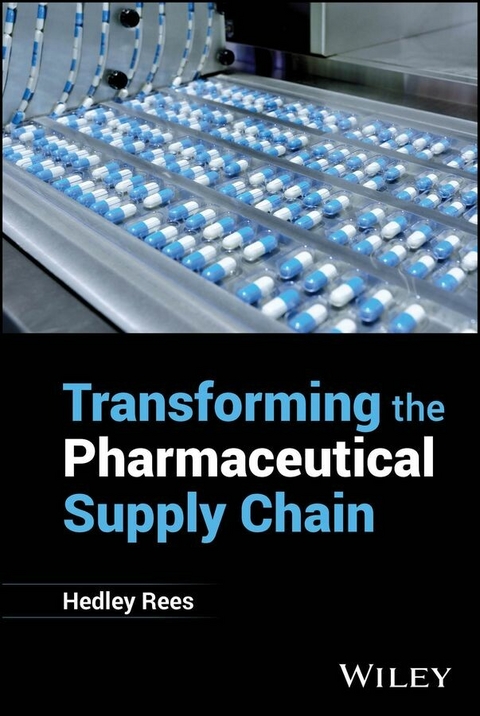
Transforming the Pharmaceutical Supply Chain (eBook)
573 Seiten
Wiley (Verlag)
978-1-394-24413-3 (ISBN)
Effective and insightful solutions to the most pressing supply chain challenges facing pharmaceutical companies today
In Transforming the Pharmaceutical Supply Chain, veteran biotech supply chain strategist, Hedley Rees, delivers a reasoned and systematic solution to the most widespread and relevant challenges in the pharmaceutical supply chain. The book explains the deeply rooted issues within pharma supply chains and the modus operandi of the industry while also discussing effective solutions to the underlying causes that led to widespread system breakdown.
The author applies modern methods of product development and commercial supply successfully used by leaders in the field. He provides real-world examples of ways to make the delivery of medicines to patients efficient and effective.
Readers will also find:
- A clear explanation of the development, manufacture, and delivery of drugs to patients
- Comprehensive explorations of the issues and challenges to the current supply chain system paired with effective solutions
- Expert witness accounts, anecdotes, case studies and examples of pharmaceutical supply chain difficulties and solutions
- Complete treatments of how to adapt supply chain techniques to a pharmaceutical era dominated by biologics and advanced therapies
Perfect for pharmaceutical and biopharmaceutical professionals working in drug development, Transforming the Pharmaceutical Supply Chain will also benefit industry professionals with a responsibility for the logistics, commercial supply, manufacturing, regulation, quality management, finance, and marketing of pharmaceuticals.
Hedley Rees, PhD, is Managing Consultant at PharmaFlow Ltd. He has 25 years' experience in the biotech industry, advising drug developers in the strategic management of their preclinical, clinical, and commercial supply chains. He is the author of Supply Chain Management in the Drug Industry: Delivering Patient Value for Pharmaceuticals and Biologics.
Effective and insightful solutions to the most pressing supply chain challenges facing pharmaceutical companies today In Transforming the Pharmaceutical Supply Chain, veteran biotech supply chain strategist, Hedley Rees, delivers a reasoned and systematic solution to the most widespread and relevant challenges in the pharmaceutical supply chain. The book explains the deeply rooted issues within pharma supply chains and the modus operandi of the industry while also discussing effective solutions to the underlying causes that led to widespread system breakdown. The author applies modern methods of product development and commercial supply successfully used by leaders in the field. He provides real-world examples of ways to make the delivery of medicines to patients efficient and effective. Readers will also find: A clear explanation of the development, manufacture, and delivery of drugs to patientsComprehensive explorations of the issues and challenges to the current supply chain system paired with effective solutionsExpert witness accounts, anecdotes, case studies and examples of pharmaceutical supply chain difficulties and solutionsComplete treatments of how to adapt supply chain techniques to a pharmaceutical era dominated by biologics and advanced therapies Perfect for pharmaceutical and biopharmaceutical professionals working in drug development, Transforming the Pharmaceutical Supply Chain will also benefit industry professionals with a responsibility for the logistics, commercial supply, manufacturing, regulation, quality management, finance, and marketing of pharmaceuticals.
Foreword
It has certainly been my experience, when observing business practitioners making strategic and tactical decisions, that “a little knowledge can be a very dangerous thing.” It is also true that human beings often see things, but they do not really observe what the truly causal factors are behind any phenomena. Consequently, managers often make seriously misguided decisions. This is because they act with a high degree of “bounded rationality”: they believe they are acting objectively and rationally, but their decisions are normally made within the bounds of limited information and an inadequate understanding of the causal factors behind any cause of business success or failure.
There is an additional problem in human decision making, and this is the tendency of human beings to copy and emulate others rather than to think for themselves. Henry Ford was famous for saying that because thinking for oneself is so very difficult, most people don’t do very much of it. This is not surprising given that human beings normally learn from an early age that the way to succeed in life is to copy what others (parents, siblings, peer groups, teachers, etc.) tell them to do. The irony is that most human beings, when they grow up, never seem to progress from this early learning stage.
This is why most business management practice is more about managers copying the latest business fads than thinking for themselves. These fads are often presented on a plate to them as a surefire way to achieve success by self-serving management consultants, repackaging what other successful companies have achieved in other industries and supply chains. Rather than starting from first principles and truly understanding what the appropriate thing is to do given the circumstance they are in, managers have a tendency to copy others. It is, therefore, extremely gratifying to be able to write a foreword for a colleague who has used his own extensive knowledge and understanding to explain from first principles some of the major causal factors behind the current malaise in pharmaceutical and the health care supply chains.
My association with the author has been a long one, and we first made a connection as similarly minded iconoclastic presenters against the current best practice fads at numerous conferences. Most of these conferences focused on general purchasing and supply issues, but also those concerned with the major challenges experienced in pharmaceutical and health care supply chains. As Hedley explains in this volume, his own experience was initially in the operational problems he had experienced in successfully and unsuccessfully managing new product development within the pharmaceutical supply chain. From this starting point, Hedley’s research and consulting experience has led him to be highly critical of the business models practiced by “big pharma” companies, and especially skeptical about the long-term viability of their approaches to outsourcing and supply chain management.
While arriving at a very similar end point, my own experience has been somewhat different. Initially, I worked as an academic in the field of political economy, studying comparative state, finance, and industry relationships. This led me to understand the unique socio-economic and political causes of economic development and business success in different cultures and societies. I then undertook extensive work on the effective regulation of public and defense procurement for the European Union, as it developed its single market rules in the 1980s and 1990s. Subsequently, I became professor of Business Strategy and Procurement at Birmingham University’s Business School, with a remit to establish the first MBA in this area in the United Kingdom.
What surprised me on encountering the purchasing and supply chain management profession in the 1990s was the fact that there was (and still is) a regnant orthodoxy among all of the major purchasing professional associations (ISM in the United States, CIPS in the United Kingdom, etc.), as well as among the majority of the academics working in the field. This orthodoxy about world-class best practice about business success and sourcing can be outlined in summary as follows:
Companies should focus on their core competencies and, working as “channel captains,” they should outsource all noncore activities to suppliers.
Outsourced suppliers at the first tier of the supply chain should be managed based on the principles of “win-win” partnerships, using the lean/agile management techniques as practiced by the extremely successful Japanese car manufacturers.
Partnership sourcing principles should be cascaded by the “channel captain” companies, working with the first-tier suppliers, all the way down the extended tiers of their supply chains.
What has always astounded me about this dominant fad in Western business culture is its complete lack of understanding of the unique socio-economic, political, and cultural pre-conditions that made extensive outsourcing and effective supply chain management feasible and successful in Japan. For one thing, Japanese companies were never highly vertically integrated historically because of the very high cost of land and lack of space. As a result, the car manufacturers had, of necessity, to outsource a high percentage of their productive capacity to suppliers as they grew. Furthermore, Japan is a hierarchical society in which superior-subordinate relationships are embedded in a culture that despises opportunism, in favor of duty and obligations between the focal company/channel captain and servant (suppliers in the supply chain).
There can be no doubt that these factors supported the introduction of partnership-style supplier and supply chain management in Japan, as they successfully adopted total quality and lean/agile management techniques to their post-war production and supply chain management processes. Unfortunately, for Western emulators, seeing and describing this success is not the same as understanding how or why it worked effectively—or more importantly, whether it can be successfully copied in completely different socio-economic, political, and cultural contexts. What is missing from most analyses of Japanese management and outsourcing success is, therefore, any understanding of the reality of power and leverage in Japanese society, industry, and supply chains. Japanese industry operates with dominant buyers who control their suppliers as nonopportunistic servants. This is a very different socio-economic, political, and cultural environment to that operating in the West.
It is not surprising, therefore, that if Western managers, academics, and consultants fail to understand the reality of the causal factors behind the business and supply chain management processes they describe, it is likely that their advice to Western companies searching for “quick-fix” business solutions will be misguided. It is also likely, as I have argued elsewhere (11) that implementing this type of core competence outsourcing and “win-win” partnership supply chain management practice in very different socio-economic, political, and cultural circumstances is likely to lead in the long-term to disaster. In particular, if companies do not understand what are their “critical assets” and always retain them in-house, and if they also fail to understand that managing outsourced suppliers is a strategic business competence requiring significant resourcing and managerial effort to guard against post-contractual moral hazard, then it can lead to significant business underperformance, if not outright failure.
It is to the author’s credit that in this volume he demonstrates quite clearly that this type of failure, if not outright disaster, is now coming to pass in many Western pharmaceutical and healthcare supply chains. The author successfully shows how “big pharma,” by slavishly following the core competence and outsourcing best practice fad outlined above, has consistently failed to understand how to maintain control over its critical assets. Furthermore, it has also lost control of its supply chains and constantly risks falling into the trap of post-contractual moral hazard with opportunistic suppliers.
Given the importance of healthcare and new drug development for an increasingly aging population, this book is certainly timely. Not only does it lay bare many of the problems facing the pharmaceutical industry and its supply chains but it also recommends a number of ways forward out of the mess that the adoption of misguided best practice fads has led the industry. While one may not agree with all the recommendations for radical improvement made, it is important that the debate about the future of this critical industry and its supply chains is further illuminated. By shedding light on the serious errors of the past and providing a vision for a better future, the author is to be highly commended for addressing an issue that will affect everyone in the future.
Professor Andrew Cox, PhD
International Institute of Advanced Purchasing & Supply
January 2024
Note
- 1 Andrew Cox (2004), “Strategic Outsourcing: Avoiding the Loss of Critical Assets and the Problems of Adverse Selection and Moral Hazard,” Business Briefing: Global Purchasing and Supply Chain Strategies, pp. 67–70; Andrew Cox (2014), Source Portfolio Analysis: Power Positioning Tools for Category Management and Strategic Sourcing, Earlsgate Press, Stratford-upon-Avon; Andrew Cox (2015), “Sourcing Portfolio Analysis & Power Positioning: Towards a...
| Erscheint lt. Verlag | 29.8.2025 |
|---|---|
| Sprache | englisch |
| Themenwelt | Naturwissenschaften ► Chemie |
| Schlagworte | biologics supply chains • biologics supply chain solutions • drug development • drug manufacturing • Pharmaceutical supply chain issues • pharmaceutical supply chain solutions • pharma supply chain challenges • pharma supply chain logistics |
| ISBN-10 | 1-394-24413-4 / 1394244134 |
| ISBN-13 | 978-1-394-24413-3 / 9781394244133 |
| Informationen gemäß Produktsicherheitsverordnung (GPSR) | |
| Haben Sie eine Frage zum Produkt? |
 EPUB (Adobe DRM)
Kopierschutz: Adobe-DRM
Adobe-DRM ist ein Kopierschutz, der das eBook vor Mißbrauch schützen soll. Dabei wird das eBook bereits beim Download auf Ihre persönliche Adobe-ID autorisiert. Lesen können Sie das eBook dann nur auf den Geräten, welche ebenfalls auf Ihre Adobe-ID registriert sind.
Details zum Adobe-DRM
Dateiformat: EPUB (Electronic Publication)
EPUB ist ein offener Standard für eBooks und eignet sich besonders zur Darstellung von Belletristik und Sachbüchern. Der Fließtext wird dynamisch an die Display- und Schriftgröße angepasst. Auch für mobile Lesegeräte ist EPUB daher gut geeignet.
Systemvoraussetzungen:
PC/Mac: Mit einem PC oder Mac können Sie dieses eBook lesen. Sie benötigen eine
eReader: Dieses eBook kann mit (fast) allen eBook-Readern gelesen werden. Mit dem amazon-Kindle ist es aber nicht kompatibel.
Smartphone/Tablet: Egal ob Apple oder Android, dieses eBook können Sie lesen. Sie benötigen eine
Geräteliste und zusätzliche Hinweise
Buying eBooks from abroad
For tax law reasons we can sell eBooks just within Germany and Switzerland. Regrettably we cannot fulfill eBook-orders from other countries.
aus dem Bereich